This comprehensive Zanus AI review explores whether an offline, on-premises “AI in a box” hardware system can truly replace cloud-based machine learning infrastructures. Instead of relying on variable cloud APIs, the Zanus platform promises localized inference execution, absolute data sovereignty, and secure compliance workflows—all operated within an air-gapped office environment.
Most technology leaders and enterprise operations managers don’t need another generic cloud software subscription. They need a way to solve grueling, resource-intensive data processing and physical tracking bottlenecks without exposing private corporate assets to public networks.
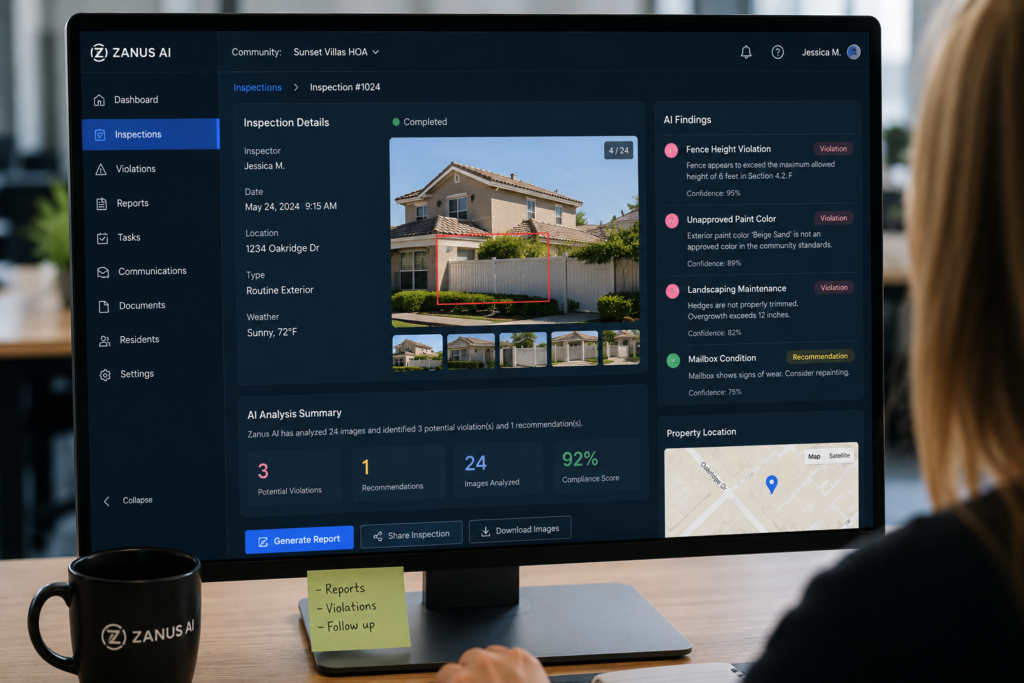
Most Homeowners Association (HOA) management companies don’t need another generic software subscription. They need a way to solve the grueling, labor-intensive property inspection bottlenecks that quietly bleed administrative hours and trigger explosive resident disputes every single week.
Traditionally, property managers had to walk or drive through neighborhoods, manually log exterior violations on clipboards or smartphones, and transfer data into a central database. It is a slow, subjective process prone to human error, delivery delays, and costly legal challenges under strict frameworks like California’s Davis-Stirling Act.
To fix this, some forward-thinking teams started uploading neighborhood photos to public cloud AI platforms like OpenAI or AWS. But this created an immediate legal backdoor: capturing a resident’s face, an unapproved vehicle plate, or a minor child playing in a backyard instantly opens the door to devastating Fair Housing Act (FHA) and privacy lawsuits.
Zanus AI takes a completely different path. Instead of routing private community photos and sensitive data through the cloud, Zanus packs dedicated server hardware, local vision models ($YOLOv8/YOLOv10$), and a secure local vector database into a single physical machine sitting directly in your management office.
This review evaluates the Zanus AI hardware-software ecosystem to determine if its offline, on-premises “AI in a box” delivers on its promise to automate compliance workflows without the cloud liabilities.
Quick Summary: Zanus AI Review Verdict
For mid-to-large-scale HOA management firms and community boards, Zanus AI is one of the strongest investments available to automate property enforcement. By moving computer vision workflows to an air-gapped, offline server, it eliminates recurring cloud token fees and provides an unassailable data privacy boundary that keeps legal counsel happy.
If you manage a small, single-building condo or have zero access to technical support for basic office network routing, the upfront infrastructure requirements will be overkill. But for portfolio managers drowning in manual inspection paperwork and escalating resident pushback, this local system pays for itself by turning a five-day manual cycle into a three-hour automated workflow.
The AIReviewZones Scorecard
Our editorial team evaluates enterprise property technology across eight core business metrics. Rather than a generic software checklist, these scores reflect real-world operational value and implementation feasibility.
| Review Category | Score (1-10) | Editorial Assessment |
| Ease of Use | 7 / 10 | The no-code dashboard is highly intuitive for administrative staff, but initial setup requires baseline local IT support. |
| Features | 9 / 10 | Exceptional automation that handles everything from video ingestion and temporal downsampling to automated PDF citation drafting. |
| AI Capabilities | 10 / 10 | Local $YOLOv8-PSN$ and Multimodal RAG deliver exceptionally accurate physical defect detection with zero cloud latency. |
| Integration | 8 / 10 | Built-in REST APIs and local webhooks smoothly synchronize final compliance drafts with systems like AppFolio, Yardi, and Vantaca. |
| Scalability | 9 / 10 | Exceptional local capacity. Portfolios can scale from the standalone Prime server up to multi-node Enterprise Clusters. |
| Value for Money | 9 / 10 | A significant upfront capital expense ($19,900 for typical Prime packages) that entirely wipes out volatile, long-term cloud token subscription costs. |
| Customer Support | 8 / 10 | Comprehensive vendor onboarding and clear local backup hardware documentation, though you manage your own physical site protection. |
| Innovation | 10 / 10 | A brilliant pivot away from the typical SaaS trend, packaging specialized local vision hardware into a highly practical, private business appliance. |
Best For: Matching the Platform to Your Operations
Recommended For:
- Multi-Community Portfolio Managers: Firms overseeing large residential developments where drone or mobile video inspections generate hundreds of gigabytes of data monthly.
- Strict Regulatory Environments: Managers operating under aggressive data privacy laws who require verifiable, local-only storage of resident property images.
- Cost-Conscious Operations Teams: Organizations that want to freeze their technological operational expenditure by substituting monthly per-user or per-token SaaS fees with a single, depreciable capital asset.
Not Recommended For:
- Self-Managed, Low-Unit HOAs: Small communities (under 100 doors) where a volunteer board member handles seasonal walks; the hardware capability vastly outstrips the operational scale.
- Offices Lacking Basic Network Control: Teams that do not have an IT resource capable of managing local static IPs and configuring standard internal LAN firewalls.
Key Operational Strengths: Delivering Real Outcomes
Technology only matters because business problems exist. Zanus AI outperforms cloud alternatives by delivering three major operational outcomes.
1. Zero Cloud Token Costs at Massive Scale
Cloud-based multimodal AI engines charge you per image or per frame analyzed. A single drone flight or a multi-hour drive-by camera recording across a 1,000-home community generates tens of thousands of video frames. Uploading this volume to a public cloud API yields volatile, unpredictable monthly software bills.
Because Zanus runs on an internal, dedicated GPU array, your variable cost per image analyzed is exactly 0%. You can scan your communities daily or weekly without adding a single dollar to your operational budget.
2. Elimination of AI Hallucinations via “Precision” Local RAG
Standard large language models tend to invent rules or cross-reference incorrect regional codes when pushed to draft legal documents. Zanus solves this by anchoring its deep reasoning model strictly to an internal vector database containing your specific community’s official CC&Rs (Covenants, Conditions, and Restrictions) and bylaws.
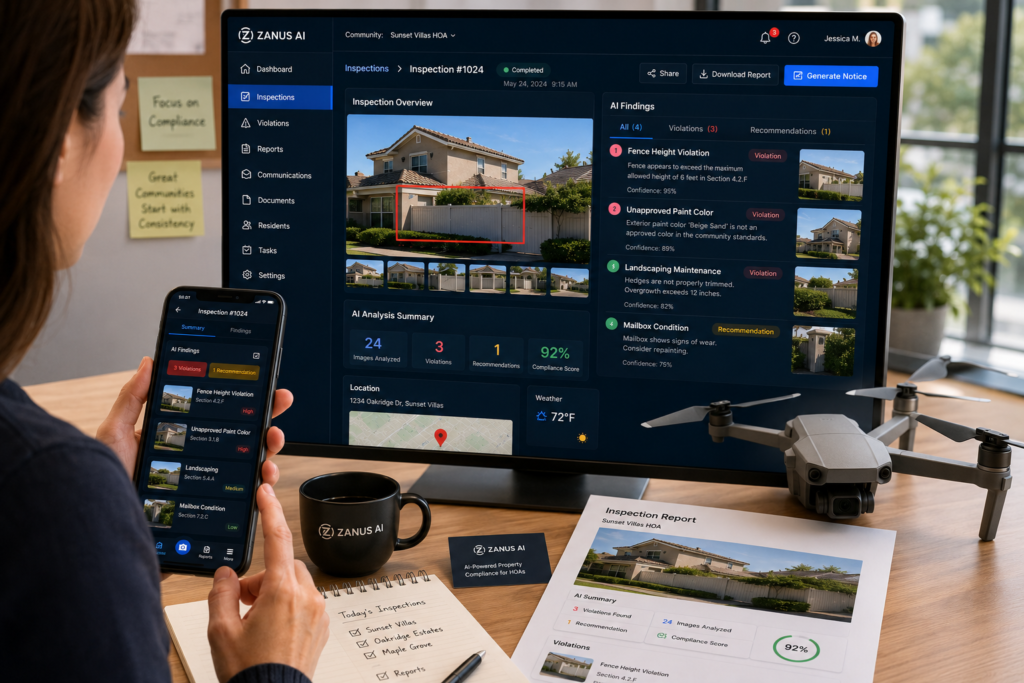
When the computer vision engine flags a structural issue—such as a broken perimeter fence or an unapproved exterior paint tint—the local system calculates the mathematical similarity between the visual defect and your uploaded rules using cosine similarity:
$$\text{Cosine Similarity} = \frac{A \cdot B}{\|A\| \|B\|}$$
Where $A$ represents the multi-modal embedding vectors of the visual defect frame, and $B$ represents the vector space of your legalized rulebook. The system automatically matches the visual evidence with the exact section and paragraph of the rule being broken. It then drafts a precise, auditable warning letter citing true community history—entirely eliminating the risk of automated hallucinations.
[Field Video Frame] ➔ [Internal Vision LLM]
                            │ (Identifies concrete cracks & spalling)
                            ▼
[Your Digital CC&Rs] ➔ [Local Precision Vector Store] ➔ [Zanus Reasoning Model]
                                                             │ (Matches to Section 4.2)
                                                             ▼
                                                [Flawless PDF Violation Draft]
                                                Accurate rule citations. Zero fabrication.
3. Absolute Privacy Isolation (The Air-Gap Defense)
Resident pushback against board monitoring often centers on privacy fears regarding drone footage or property snapshots. Because the Zanus system is capable of running completely air-gapped (100% disconnected from the outer internet), your data never leaves the physical walls of your office building. It cannot be intercepted by third-party web hackers, and it is never used to train public AI models. Having a physically isolated machine gives your board an ironclad legal shield against civil privacy complaints.
The Trade-Offs: Real-World Implementation Roadblocks
Balanced engineering means every system has limitations. Moving your AI operations out of the cloud and into your office introduces physical demands that traditional SaaS products avoid.
- Heavy Power and Thermal Requirements: The Zanus AI Prime machine can draw up to 6 kW of electricity under peak computer vision loads (dropping to roughly 1 kW when idling). While it runs on standard 90–240V AC power without requiring specialized 3-phase industrial wiring, you cannot lock it inside an unventilated utility closet. The internal enterprise GPUs generate substantial heat, requiring an open, well-ventilated space or a climate-controlled room to preserve component life.
- Total Local Disaster Liability: Cloud providers handle data redundancies across multiple global data centers. With an on-premises box, data protection is entirely your responsibility. If your physical office suffers a fire, localized flood, or theft, your data goes with it. You must implement a disciplined local backup routine, utilizing the system’s RAID 10 NVMe storage configurations or offloading to physical LTO tape copies.
Side-by-Side: Zanus AI Server Implementations
| Technical Specifications | Zanus AI Prime | Zanus AI Quantum | Enterprise Cluster |
| Portfolio Target | Mid-sized communities | Large master-planned areas | Multi-regional management firms |
| Document Retention | Up to 2,000,000 pages | Up to 5,000,000 pages | Unlimited (Scalable nodes) |
| Video/Drone Capacity | 50,000 hours of footage | 100,000 hours of footage | Petabyte-scale architecture |
| Reasoning Model Profile | Deep Reasoning | Extended Context Reasoning | Distributed Multi-Node Processing |
| Scalability Options | Modular expansion bays | Integrated High-Performance GPU | Automated node load balancing |
Workflow Transformation: Before vs. After Zanus AI
To see how this tech translates to pure time savings, look at the end-to-end operational cycle for a baseline community of 1,000 homes:
The Traditional Workflow (Time Spent: ~46 Hours)
- Preparation (~4.0 hrs): Sorting through past spreadsheet logs, printing physical neighborhood maps, and planning routes.
- Field Collection (~16.0 hrs): Field staff walking or slowly driving every block, taking phone pictures, and hand-writing notes for each home.
- Data Matching (~12.0 hrs): Returning to the office, renaming image files, matching photos to addresses, and manually searching paper rulebooks.
- Drafting Notices (~8.0 hrs): Manually copying and pasting violation images into Word documents and look up homeowner names.
- Syncing System (~6.0 hrs): Typing entries line-by-line into the property CRM and creating separate maintenance work orders for shared spaces.
The Zanus AI Workflow (Time Spent: ~3 Hours)
- Preparation (~0.5 hrs): The local server pulls community logs and maps out the optimal camera/drone drive route automatically.
- Field Collection (~1.5 hrs): A vehicle-mounted camera or autonomous drone captures 4K video of all property fronts in a single pass.
- Data Matching (~0.5 hrs): Video is fed via network LAN into the server. The system uses temporal downsampling to drop frame rates to 4 FPS, tranches keyframes, and flags anomalies instantly at 99 frames per second via local $YOLOv8-PSN$.
- Drafting Notices (~0.2 hrs): Local language models cross-reference the vector database and generate completed, itemized compliance PDFs with exact CC&R citations.
- Syncing System (~0.3 hrs): Drafts are reviewed via Human-in-the-Loop (HITL) dashboards to eliminate false positives (e.g., contractor trucks or holiday decorations), then synced across portfolio management systems like AppFolio or Yardi via internal API endpoints.
The Verdict: Implementing this automation cuts your total operational cycle time by 93.5%, shifting your team from data-entry clerks into high-value operations managers.
Editor’s Take
If your management firm handles large residential portfolios where field tracking hours are eating your margins and exposing you to data liabilities, then purchasing an on-premises solution like Zanus AI is a highly logical move, because it fundamentally decoupling your operational scale from variable cloud costs while locking your resident data behind an impenetrable physical firewall.
Final Recommendation: Your Next Action Step
Buying AI before stabilizing your data and workflow is like dropped a performance racing engine into a car with flat tires.
If you are struggling to maintain compliance consistency across multiple neighborhoods, your immediate next step should not be a hasty software rollout. Instead, conduct a 30-day internal audit of your current inspection process. Track the exact hours your staff spends driving routes and manually matching images to files, and consult your legal team regarding your current cloud data exposure.
If your audit shows significant administrative bleed and vulnerable data paths, bypass the typical SaaS subscription loop and request a direct hardware deployment consultation for a Zanus AI Prime system. Securing your data boundaries today saves your portfolio from the costly operational and legal friction of tomorrow.
Technical Infrastructure Frameworks
If you are configuring hardware parameters or drafting a total cost of ownership model for localized deployment, explore our enterprise infrastructure deep-dives:
- Enterprise AI Hardware Buying Guide: Best AI Appliances 2026 – Learn how to audit factory validation processes, analyze production software licensing tiers, and evaluate hyperconverged infrastructure (HCI) options.
- Hybrid AI Infrastructure vs. On-Premises: 2026 Strategy Guide – Calculate your long-term infrastructure inflection point using the Deloitte TCO threshold formula and the 6-hour operational rule.
- Enterprise AI Deployment Report: On-Premises Blueprint & Checklist – Review a complete 24-week deployment roadmap, thermodynamic calculations for Blackwell DGX B200 nodes, and a production-ready go-live checklist.
Related Reviews
If you’re exploring AI solutions for business operations and workflow automation, you may also like: