

Best Enterprise AI Supply Chain Planning Platforms in 2026 reviewing.
Buying an enterprise supply chain planning platform isn’t just a software procurement exercise. For a company generating over $3 billion in revenue, choosing between o9 Solutions, Kinaxis, Blue Yonder, and SAP IBP is a multi-year, $4 million to $15 million decision that directly affects your bottom line, working capital, and operational resilience.
If your inventory levels are out of sync, your forecast accuracy is falling, or your planners are drowning in spreadsheets, buying more software won’t automatically fix the problem. The real question enterprise CTOs, CSCOs, and supply chain directors must ask is: Which architectural design solves our specific operational bottleneck without introducing unmanageable overhead?
Here is an independent, decision-focused evaluation of the four market leaders to help you determine which platform belongs on your shortlist.
Quick Summary: Which Platform Fits Your Enterprise?
- Choose o9 Solutions if your priority is creating a cross-functional digital twin that links physical supply chain trade-offs directly to P&L financial outcomes using graph technology.
- Choose Kinaxis if you operate across a complex, multi-ERP enterprise and require instantaneous, concurrent what-if scenario modeling to manage daily supply volatility.
- Choose Blue Yonder if you are a high-volume retailer, CPG manufacturer, or 3PL needing autonomous, domain-specific AI agents and high-granularity probabilistic demand sensing.
- Choose SAP IBP if your IT environment is heavily standardized on SAP S/4HANA and your leadership prioritizes single-vendor architecture and direct financial ledger alignment.
Enterprise Platform Comparison
| Feature / Metric | o9 Solutions (Digital Brain) | Kinaxis (Maestro Platform) | Blue Yonder (Luminate Platform) | SAP IBP |
| Best For | Cross-functional commercial, operational, & P&L alignment | Concurrent planning speed across multi-ERP environments | Autonomous retail/CPG demand sensing & execution | Native SAP S/4HANA environments seeking single-vendor stack |
| Core Architecture | Graph Database (Enterprise Knowledge Graph) | In-Memory Concurrent Calculation Engine | Microservices on Microsoft Azure & Snowflake Data Cloud | SAP HANA In-Memory Database Engine |
| AI Focus | Agentic composite AI & graph-based ML demand sensing | Maestro AI exception detection & decision orchestration | Probabilistic daily ML forecast rebuilds & domain agents | HANA-embedded ML & SAP Joule natural language copilot |
| Multi-ERP Agility | High: Maps non-standard data schemas into graph nodes | Very High: Native, vendor-agnostic connectors across all major ERPs | High: Snowflake data sharing & pre-built 4–6 week connectors | Low to Moderate: Native for SAP; requires custom CPI-DS mapping for non-SAP |
| Scenario Modeling | High (Simultaneous P&L and operational network impact) | Very High (Instantaneous in-memory concurrent sandboxing) | High (Millisecond visibility across massive SKU networks) | Moderate to High (Fast local runs; global networks require batching) |
| Deployment Timeframe | 6–9 mos (Module) / 12–18 mos (Full Enterprise) | 6–9 mos (Module) / 12–24 mos (Full Enterprise) | 4–6 mos (Module) / 6–12 mos (Full Enterprise) | 6–9 mos (Module) / 12–24 mos (Full Enterprise) |
| 3-Year Estimated TCO | $4M – $15M+ | $4M – $15M+ | Six-figure annual license + 30–50% implementation fees | $4M – $15M+ |
Best Enterprise AI Supply Chain Planning Platforms: Detailed Reviews
1. o9 Solutions (Digital Brain)
The Verdict: The strongest choice for global enterprises seeking to unify supply chain mechanics with corporate financial planning.
       [ Commercial / Demand Data ]      [ Supply / Network Data ]
                                 \        /
                                  v      v
                      +----------------------------+
                      | o9 Enterprise Knowledge    |
                      | Graph (Digital Twin)       |
                      +----------------------------+
                                   |
                                   v
             [ Agentic AI Evaluation of P&L Trade-Offs ]
                                   |
             +---------------------+---------------------+
             |                                           |
             v                                           v
[ Financial P&L Impact ]                    [ Operational Execution Plan ]
Overview
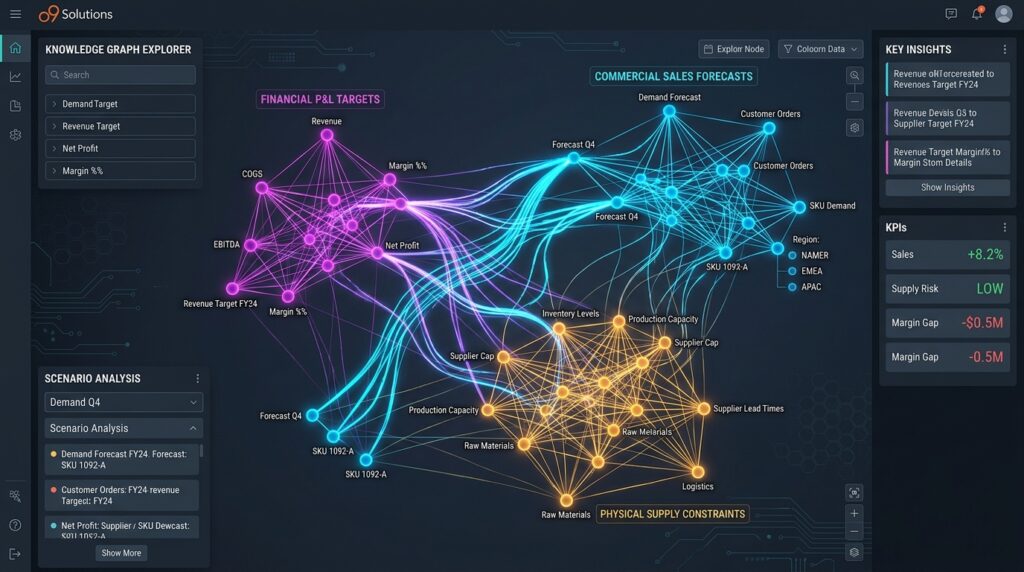
o9 Solutions models an enterprise’s value chain as a flexible graph network rather than rigid relational database tables. By modeling relationships between suppliers, manufacturing lines, distribution routes, and financial nodes, o9 allows companies to run end-to-end Integrated Business Planning (IBP) and S&OP within a single environment.
Key Strengths
- Graph-Based Digital Twin: The Enterprise Knowledge Graph natively accommodates unstructured data and non-standard organizational hierarchies without requiring complex database schema redesigns.
- Financial & Operational Integration: Evaluates physical trade-offs (such as expedited freight or factory overtime) alongside direct financial P&L metrics, enabling executives to make profit-optimized decisions.
- Agentic AI Deployment: Features composite AI agents capable of evaluating cross-functional scenarios and presenting prescriptive recommendations complete with financial justification.
Limitations
- Implementation Overhead: Building a graph model that accurately reflects an enterprise value chain requires rigorous data governance and intensive setup during early project phases.
- Configuration Complexity: Its customizability requires dedicated internal super-users to maintain workflow logic over time.
Pricing & TCO
Typically targets tier-one enterprises ($3B+ revenue). Three-year total cost of ownership spans $4 million to over $15 million, depending on module breadth and enterprise scale.
Editor’s Take: Choose o9 Solutions if your organization struggles to connect operational planning decisions with financial reporting. If your commercial teams, supply chain planners, and finance directors operate in silos, o9 bridges those gaps better than relational alternatives.
2. Kinaxis (Maestro Platform)
The Verdict: The undisputed leader for complex discrete manufacturers operating across heterogeneous, multi-ERP environments.
                  +-----------------------------------+
                  |   Kinaxis Concurrent In-Memory    |
                  |        Calculation Engine         |
                  +-----------------------------------+
                    /               |               \
                   /                |                \
                  v                 v                 v
          [ Supply Plan ]    [ Demand Plan ]   [ Capacity Plan ]
                  \                 |                 /
                   \                |                /
                    +---------------+---------------+
                                    |
            ( Instantaneous Multi-Tier Impact Calculation )
                                    |
            +-----------------------+-----------------------+
            |                                               |
            v                                               v
[ Instant Exception Alert ]                   [ Concurrent Sandbox What-If ]
Overview
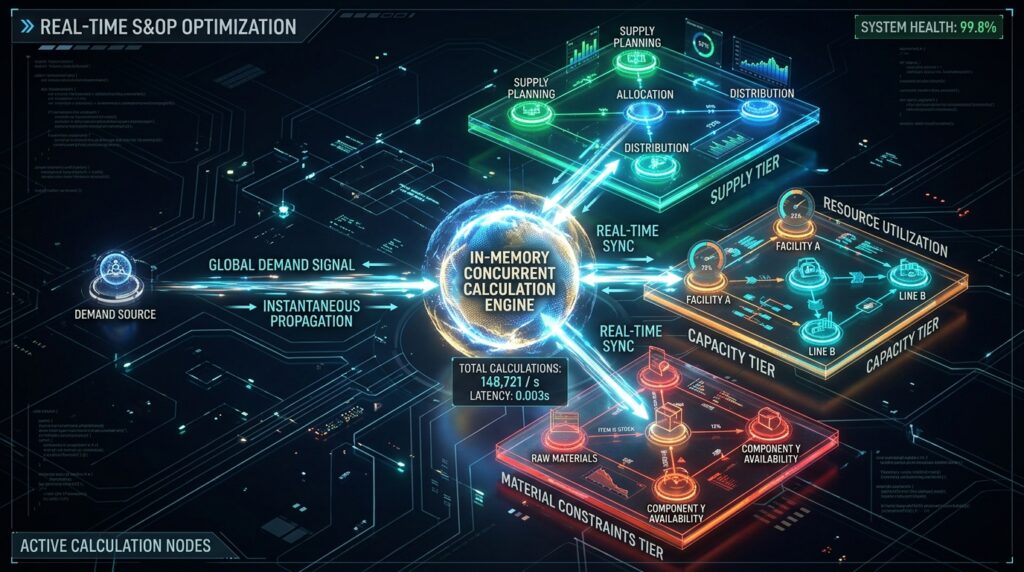
Kinaxis built its reputation on concurrent planning. Instead of calculating demand, supply, and capacity plans in sequential batch runs, Kinaxis updates the entire supply chain network continuously. When a capacity constraint or material outage occurs, planners see the upstream and downstream impacts immediately.
Key Strengths
- Concurrent Planning Architecture: Removes multi-step batch processing. A change in customer demand instantly recalculates production schedules, component requirements, and inventory projections.
- ERP Agility: Offers mature, bidirectional connectors for SAP, Oracle, Microsoft Dynamics, and legacy systems, standardizing disparate data streams without forcing an ERP consolidation project.
- Planner Experience: Features an interactive, worksheet-style interface that delivers transparent calculation logic, making scenario evaluation fast and accessible for daily planners.
Limitations
- Master Data Dependency: Concurrent engines require clean master data (such as accurate lead times and bills of materials). Poor data quality propagates instantly across the network.
- Worksheet Performance: Highly complex, multi-layered workbooks can experience load latencies during enterprise-wide calculation passes.
Pricing & TCO
Enterprise deployments generally range from $4 million to $15 million+ over three years, with individual module implementations taking 6 to 9 months.
Editor’s Take: Choose Kinaxis if your business operates in volatile sectors like Automotive, High-Tech, or Industrial Machinery, and relies on multiple ERP systems. If daily supply disruptions force your team into constant firefighting, Kinaxis delivers the fastest scenario evaluation on the market.
3. Blue Yonder (Luminate Platform)
The Verdict: The top platform for high-volume retail, grocery, CPG, and complex logistics networks requiring high-frequency AI automation.
       [ POS Data / Market Signals / Weather / Trends ]
                              |
                              v
             +----------------------------------+
             |  Blue Yonder Probabilistic ML    |
             |  (25B+ Predictions / Day)        |
             +----------------------------------+
                              |
                              v
             [ Specialized Operational AI Agents ]
              /               |                \
             /                |                 \
            v                 v                  v
[ Inventory Re-allocation ] [ Warehouse Tasking ] [ Tariff Management ]
Overview
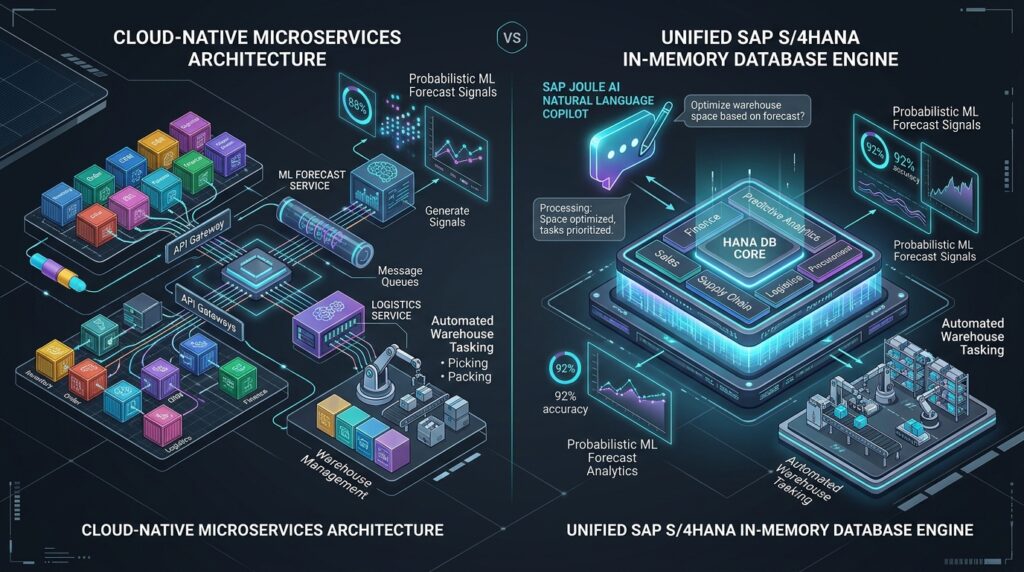
Built on a cloud-native microservices architecture leveraging Microsoft Azure and Snowflake, Blue Yonder excels at hyper-scale demand sensing and retail execution. Its machine learning models recalculate baseline predictions using external demand drivers like point-of-sale updates, weather forecasts, and macroeconomic trends.
Key Strengths
- Probabilistic AI Scale: Processes vast data volumes, generating over 25 billion daily predictions across complex retail and multi-echelon distribution networks.
- Autonomous Domain Agents: Deploys specialized AI agents for operational tasks like inventory re-allocation, warehouse management, and transportation routing, reducing manual planner overrides.
- Snowflake Integration: Simplifies cross-enterprise data ingestion and third-party data sharing using modern cloud architecture.
Limitations
- Administrative Learning Curve: Navigating administrative configurations across disparate modules (reflecting legacy JDA and Revionics acquisitions) can be complex.
- Over-Automation Risk: High automation requires careful operational guardrails to prevent AI models from executing undesirable re-allocations during unprecedented supply disruptions.
Pricing & TCO
Software contracts involve six-figure annual licensing fees, with system implementation services adding 30% to 50% on top of platform licenses.
Editor’s Take: Choose Blue Yonder if you manage high-velocity SKU networks across retail, CPG, or 3PL operations. If your primary goal is automating baseline replenishment decisions using real-time market signals, Blue Yonder provides unmatched domain depth.
4. SAP Integrated Business Planning (IBP)
The Verdict: The most logical choice for enterprises standardizing on SAP S/4HANA that prioritize low architecture complexity and direct ERP integration.
            +----------------------------------+
            |      SAP S/4HANA / SAP ECC       |
            +----------------------------------+
                             |
                   ( Native SAP CPI-DS )
                             |
                             v
            +----------------------------------+
            |      SAP IBP (HANA Engine)       |
            +----------------------------------+
              /              |               \
             /               |                \
            v                v                 v
[ Web Fiori Dashboards ] [ Excel Add-in ]  [ SAP Joule AI Copilot ]
Overview
SAP IBP runs on the SAP HANA in-memory database, serving as SAP’s flagship supply chain planning product. It integrates demand, supply, inventory, and S&OP workflows directly into the broader SAP application ecosystem.
Key Strengths
- Native S/4HANA Integration: Synchronizes master data, routings, and transaction tables seamlessly between planning and operational execution layers without complex middleware.
- Familiar Excel Interface: Daily planning activities take place within an Excel Add-in interface, reducing initial training resistance for traditional planners.
- SAP Ecosystem Synergy: Embedded support for SAP Joule (generative AI copilot) and direct integration with SAP Financial Accounting (FI) ensures financial alignment.
Limitations
- Friction in Non-SAP Environments: Integrating non-SAP ERPs requires custom Cloud Integration for Data Services (CPI-DS) mapping, increasing project timeline and middleware costs.
- Global Scenario Batching: While local scenario runs are fast, multi-echelon global network recalculations can require batch processing rather than instantaneous concurrent execution.
Pricing & TCO
Full global deployments take 12 to 24 months, with 3-year total costs spanning $4 million to $15 million+, heavily influenced by systems integrator fees and licensing tiers.
Editor’s Take: Choose SAP IBP if your company is committed to an all-SAP enterprise strategy. While third-party options may edge out SAP IBP in isolated scenario speed or specialized agentic AI, avoiding multi-vendor middleware usually results in a lower long-term technical debt for SAP-centric organizations.
Buying Advice: How to Approach Your Decision
Avoid the “Enterprise Capability” Trap
Organizations generating under $1 billion to $3 billion in revenue should evaluate these tier-one suites carefully. Mid-market businesses often use less than 40% of the functional scope of these platforms while paying full licensing and implementation costs. If your operational scale doesn’t require global multi-echelon inventory optimization, consider mid-market planning software to achieve faster ROI.
Fix Your Data Governance Before Implementation
No amount of machine learning can overcome inaccurate lead times, outdated bills of materials, or unreliable inventory records. Introducing agentic AI on top of poor master data simply automates bad decisions faster. Clean your master data before starting an implementation.
Focus on Exception Governance
As AI agents assume control over routine replenishment and demand sensing, set explicit policy guardrails. System implementation projects should define who retains decision-making authority over AI recommendations when threshold overrides occur.
What to Do Next
- Audit Your Enterprise Software Landscape: Determine whether your environment is SAP-dominated, multi-ERP, or cloud-native. This structural reality will narrow your choices immediately.
- Define Your Primary Operational Bottleneck: Identify whether your biggest cost driver is inaccurate demand forecasting, slow S&OP financial rollups, or an inability to re-plan rapidly during supply outages.
- Shortlist Two Architectural Approaches: Schedule technical discovery calls with vendors using real operational scenarios from your business, rather than scripted product demonstrations.
To evaluate how enterprise supply chain planning platforms integrate with broader AI software ecosystems, high-throughput compute infrastructure, and cloud network economics, explore our technical benchmarks across the enterprise tech landscape:
- Enterprise Supply Chain Software & Market Analysis: Review our comprehensive market evaluation of the Top 10 AI Supply Chain Software and Platforms for 2026.
- Enterprise AI Infrastructure & Decision Matrices: Compare hosting paradigms in our Bare-Metal vs Workstation vs Serverless GPU Decision Matrix and evaluate cloud unit economics in the AWS EC2 vs RunPod vs Hyperbolic Review.
- Custom LLM Deployment & MLOps Pipelines: Learn how serverless workers deploy specialized reasoning models in Deploying Serverless DeepSeek-R1 on RunPod with vLLM, calculate private GPU requirements in the Sovereign LLM Hardware Sizing Guide on Lambda, and eliminate cloud egress fees in How to Slash Cloud Egress Fees. Bookmark AI Review Zones for continuous enterprise technology coverage.
References
- Gartner Peer Insights: Best Supply Chain Planning Solutions Reviews
- o9 Solutions: The Enterprise Knowledge Graph Architecture
- Kinaxis: Concurrent Planning Engine & Maestro Platform Overview
- Blue Yonder: Luminate Platform & Machine Learning Supply Chain Capabilities
- SAP Help Portal: SAP Integrated Business Planning (IBP) Official Documentation
- Lokad: Supply Chain Software Vendor Landscape