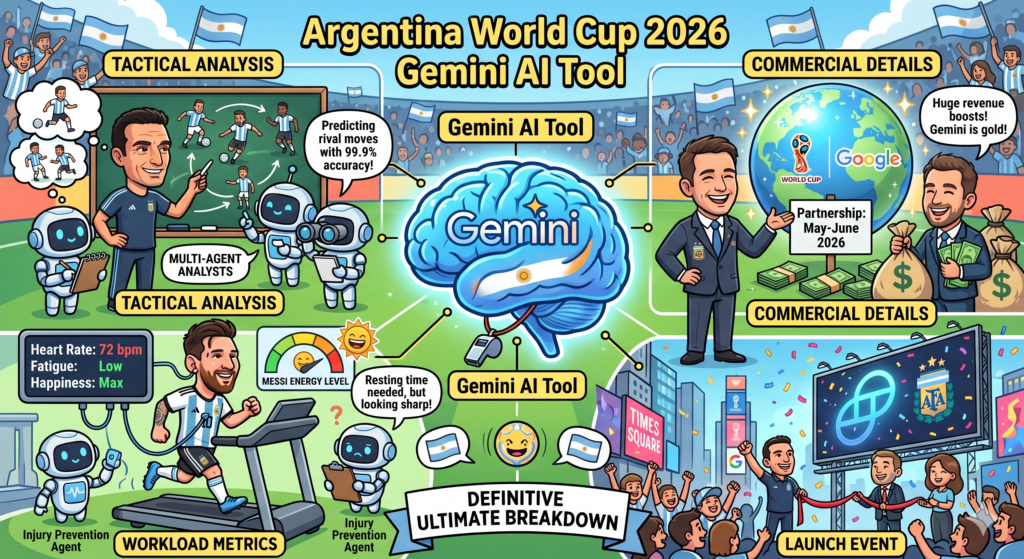
June 2026 marks a historic turning point where elite sports performance permanently merges with frontier computer science. As the FIFA World Cup 2026 kicks off, the pitch is no longer just a battleground of physical grit and human intuition—it has evolved into a theater of algorithmic execution. At the absolute epicenter of this technological shift is the Argentine Football Association (AFA) and their groundbreaking, global tech integration with Google Gemini.
By deploying the specialized Argentina World Cup 2026 Gemini AI tool ecosystem, the reigning world champions are not merely defending their title; they are benchmarking the future of multi-agent sports analytics, predictive sports medicine, and fan-facing generative AI. This comprehensive breakdown analyzes the commercial architecture, the complex multi-agent coaching frameworks, and the precise medical load-management protocols keeping Lionel Messi at peak performance.
1. Commercial Architecture: Google Gemini’s Strategic Foothold in Football
On March 5, 2026, the Argentine Football Association altered the sports marketing landscape by signing a global strategic partnership with Google. This historic agreement positions Google’s flagship AI platform, Gemini, as the “Global Main Sponsor” of all Argentine national teams through the end of 2027.
[AFA Commercial Tier 1 Partners]
 ├── Adidas (Long-term Kit Manufacturer)
 ├── American Express (Financial Services)
 ├── Lexar (Data & Storage Solutions)
 └── GOOGLE GEMINI (Official AI & Tech Partner)
This alignment embeds Gemini into the highest commercial tier of the Albiceleste, standing shoulder-to-shoulder with historical partners like Adidas, American Express, and Lexar. The Gemini branding is integrated across all sectors: training kits, pre-match warm-up gear, and digital media backdrops spanning the Men’s and Women’s senior squads, youth divisions (U-13 to U-17), Futsal, and Beach Soccer rosters.
Under the leadership of Commercial and Marketing Director Leandro Petersen, AFA executed a calculated global expansion plan designed to transform a traditional sporting body into a multi-faceted global entertainment brand. Google’s decision to choose Argentina as its exclusive football partner relies on three core data-driven variables:
- Sustained Media Real Estate: As the 2022 World Cup victors, Argentina guarantees the highest television viewership and media impressions throughout the tournament cycle.
- The Messi Multiplier: Leveraging the global cultural icon Lionel Messi optimizes user acquisition and maximizes interface interactions for the Gemini platform.
- Social Analytics Dominance: Global social listening tools indicate that approximately one-third of all international football discussions link directly to the Argentine national team, providing an organic viral distribution channel.
2. Fan-Facing Ecosystem: Times Square Launch and Democratic AI
To signal this digital migration, AFA and Google hosted a launch event on May 20, 2026, in Times Square, New York. Exactly three weeks before the World Cup opening ceremony, massive, high-definition P1.5 Fine-Pitch LED displays across Manhattan’s busiest intersection showcased the intersection of Argentina’s iconic blue-and-white stripes with the glowing Gemini tech aesthetic. This public activation was followed by an executive summit at the Google Store in Chelsea, featuring AFA’s Leandro Petersen and Florencia Sabatini, Google’s Director of Communications for Hispanoamérica.
During the summit, Sabatini and Petersen unveiled three distinct consumer-facing generative AI pillars designed to democratize advanced sports analytics during the tournament:
Real-Time Fan Tactical Mode
Accessible via Google Search’s “AI Mode,” fans can query complex, natural-language tactical prompts. The tool allows users to correlate historical penalty-kick conversion metrics against an opposing goalkeeper’s saving patterns under specific environmental variables—such as the high-altitude conditions of Estadio Azteca ($7,200\text{ feet}$ above sea level). Initially designed as a premium tier, Google opened this feature completely free of charge for the summer of 2026 to engage millions of fans globally.
Automated Multimedia Creation Hub
Fans can harness Gemini’s multimodal generative capabilities to seamlessly overlay their likeness onto the official Argentina kit, generate personalized digital memes, or draft high-resolution cheering posters optimized for direct social media export.
Stadium Chant Synthesis via Lyria
Integrating Google DeepMind’s specialized music generation model, Lyria, users can compose authentic South American stadium chants (canción de cancha) in seconds. The engine ingests simple text prompts, mapping traditional rhythms, acoustic cadences, and localized sub-dialects to output broadcast-ready audio tracks.
Furthermore, Google updated its navigation layers, integrating real-time score overlays into Waze during vehicular stops, and launching “Ask Maps” within Google Maps to locate and reserve seating at local football viewing hubs in real time.
3. Algorithmic Coaching: The Multi-Agent Architecture of Lionel Scaloni’s Staff
Behind the commercial activations lies the true operational core of the Argentina World Cup 2026 Gemini AI tool: serving as an automated tactical assistant to manager Lionel Scaloni. This operation is directed by Matías Manna, Argentina’s chief tactical analyst and author of the football theory text Paradigma Guardiola. Manna worked alongside Google’s engineers to embed Gemini’s multi-agent analysis frameworks into the team’s match preparation pipelines.
In this computational environment, a football match is simulated as a complex multi-agent system comprising 22 active agents (the players) and one non-linear moving entity (the ball). Argentina’s technical staff leverages advanced spatio-temporal modeling derived from Google DeepMind’s latest research:
[Raw Input: Broadcast Video / Optical GPS Data]
                       │
                       ▼
    [Spatio-Temporal Calibration via TacSIm]
                       │
                       ▼
 [Multi-Agent Diffusion Backbone (TacticGen Transformer)]
                       │
         ┌─────────────┴─────────────┐
         ▼                           ▼
 [Predictive Agent]          [Generative Agent]
   • Space Control Gains       • Set-Piece Design
   • Pressing Efficiency       • GNN Trajectory Optimization
         └─────────────┬─────────────┘
                       │
                       ▼
       [Gemini Multimodal User Interface]
                       │
                       ▼
   [Matías Manna & Tactical Coaching Staff]
Geometric Deep Learning with TacticAI
Scaloni’s analysts utilize TacticAI, a geometric deep learning system developed by Google DeepMind to predict and optimize set-piece trajectories, specifically corner kicks. TacticAI represents the pitch as a graph network where each player functions as a node embedded with spatio-temporal data and physical attributes (height, weight, acceleration profiles). The architecture processes three key components:
- Outcome Prediction: Calculating which player has the highest probability of receiving the ball and the resulting shot-generation likelihood.
- Historical Retrieval: Mining massive database clusters to pull near-identical defensive and offensive structures from historical elite matches.
- Position Optimization: Generating automated recommendations to adjust defensive positioning by mere centimeters to systematically minimize an opponent’s shot probability.
Blind clinical evaluations conducted with professional football analysts from Liverpool FC demonstrated that human experts favored TacticAI’s positional setups over traditional human-designed routines in 90% of cases.
TacSIm and TacticGen Frameworks
To reconstruct raw spatial data from single-angle television broadcasts, the staff utilizes the TacSIm (Tactical Style Imitation) framework. TacSIm maps raw pixel coordinates into standardized pitch telemetry, outputting critical performance indicators such as Effective Playing Space and Pressure Passing Efficiency.
Once calibrated, the TacticGen backbone deploys a multi-agent diffusion transformer to run predictive “what-if” simulations. By establishing the opposing team’s players as autonomous reactive agents conditioned on their historical playstyles, Matías Manna can stress-test tactical adjustments before executing them on the training ground.
SoccerRef-Agents: Referee Profiling
The analytical pipeline features an integration mimicking SoccerRef-Agents, a multi-agent system that decomposes referee behavior into specialized sub-agents: a Video Agent for behavioral scanning, a Rule Agent tracking IFAB legal text, a Precedent Agent analyzing past card distributions, and a Context Agent assessing match volatility (e.g., a high-stakes derby versus a group stage match). This allows the coaching staff to forecast strictness vectors and penalty probabilities, issuing defensive directives to mitigate yellow and red card risks.
These technical insights are optimized for Argentina’s Group J encounters against Algeria (June 16 in Kansas City), Austria (June 22 in Arlington), and Jordan (June 27 in Arlington). The Gemini infrastructure aids Scaloni in maintaining a secure possession-based framework, optimizing passing triangles centered around Rodrigo De Paul to sustain tactical equilibrium.
Table 1: June 2026 Argentina Technical AI Integration Matrix
| Algorithmic Core | Machine Learning Architecture | Practical Coaching Application | Validation Benchmarks | Source |
| TacticAI (DeepMind) | Geometric Graph Neural Networks (GNNs) | Simulating and adjusting player positioning during defensive and offensive corner kicks. | Evaluated superior to traditional tactical setups in 90% of clinical trials. | |
| TacSIm | Spatio-temporal trajectory extraction | Reconstructing 22-player coordinate telemetry from standard broadcast feeds. | High accuracy in homography calibration and direction tracking. | |
| TacticGen | Multi-Agent Diffusion Transformer | Generating synthetic non-ball-player movement scenarios based on natural language commands. | Preserves the stylistic fidelity and kinetic realism of team movements. | |
| SoccerRef-Agents | Decomposed Multi-Agent System | Profiling match officials to predict caution tendencies, foul thresholds, and VAR patterns. | Outperforms standard multimodal LLMs in legal and contextual accuracy. | |
| Google Research Football | Multi-Agent Reinforcement Learning (MARL) | Simulating 11v11 collective behaviors in a physics-based gaming environment. | Achieves a 100% win rate against default 1.0 difficulty bots within 2M training steps. |
4. Precision Medicine: Predictive Load Management for Lionel Messi
At 38 years old, managing the physical load and preventing soft-tissue injuries for captain Lionel Messi is a critical challenge for Argentina’s medical and conditioning staff. The stakes were highlighted in late May 2026, when Messi sustained a minor hamstring injury, forcing a 73rd-minute substitution during Inter Miami’s MLS match against the Philadelphia Union. Manager Lionel Scaloni and fitness coach Luis Martín immediately established an isolated medical tracking protocol fueled by Gemini’s predictive modeling to ensure complete recovery in under two weeks.
The system continuously cross-references External Load (mechanical work measured via high-frequency GPS vests, including total distance, high-intensity sprinting distance, and acceleration/deceleration forces) with Internal Load (physiological responses including heart rate, Heart Rate Variability [HRV], and Session Rating of Perceived Exertion [sRPE]).
To eliminate the recurrence of hamstring strains, Gemini calculates the Acute:Chronic Workload Ratio (ACWR) in real time. The acute workload represents the accumulation of strain over the past 7 days (fatigue), while the chronic workload represents the rolling average of the prior 28 days (fitness). The calculation is structured as follows:
$$\text{ACWR}_t = \frac{\text{Acute Workload}}{\text{Chronic Workload}} = \frac{\sum_{i=0}^{6} \text{Load}_{t-i}}{\frac{1}{4} \sum_{j=1}^{4} \left( \sum_{k=0}^{6} \text{Load}_{t – (7j) – k} \right)} \quad \text{}$$
The medical staff enforces strict bounding parameters for Messi’s performance metrics:
- Green Zone ($0.8 \le \text{ACWR} \le 1.3$): Ideal training load where fitness is safely accumulated, and injury risk is statistically minimized.
- Danger Zone ($\text{ACWR} > 1.5$): Excessive fatigue accumulation. If the ratio crosses this threshold, automated alerts populate Luis Martín’s dashboard, triggering immediate training adjustments or minute restrictions.
Messi’s rehabilitation and progressive re-integration ahead of the opening match followed a calculated timeline:
- Isolated Conditioning Phase: Messi was completely rested during the June 6 friendly against Honduras, undergoing isolated physical therapy monitored by Gemini’s biometric sensors. Once mechanical symmetry was restored, he was cleared for partial team training.
- Controlled Testing (June 10 Friendly vs. Iceland): To evaluate the hamstring under competitive match stress without overloading the muscle fibers, Messi began on the bench. He was introduced in the 71st-minute as the match tempo decelerated. Over 20 minutes, Messi maintained controlled acceleration metrics, converting a 71st-minute penalty to seal a 3-0 victory. Post-match telemetry confirmed his mechanical outputs remained within safe parameters, clearing him for the tournament opener against Algeria.
Table 2: Lionel Messi Summer 2026 Load Tracking Profile
| Date | Match / Session Context | Minutes Played | Hamstring Telemetry & Workload Metrics | Match Performance Outputs | Source |
| 09/05/2026 | Toronto FC (MLS) | $90\text{ min}$ | Normal status; ACWR balanced at $1.05$. | 1 Goal, 2 Assists | |
| 13/05/2026 | FC Cincinnati (MLS) | $90\text{ min}$ | High mechanical load; sRPE peaked at $9.6$. | 2 Goals, 1 Assist | |
| 17/05/2026 | Portland Timbers (MLS) | $90\text{ min}$ | Chronic fatigue signs detected; micro-strain alerts. | 1 Goal, 1 Assist | |
| 24/05/2026 | Philadelphia Union (MLS) | $73\text{ min}$ | Minor hamstring strain detected; immediate substitution. | 2 Assists | |
| 06/06/2026 | Honduras (International Friendly) | $0\text{ min}$ | Rest; shockwave therapy and isolated biometric monitoring. | Did Not Play (DNP) | |
| 10/06/2026 | Iceland (International Friendly) | $20\text{ min}$ | Controlled return; ACWR capped at $0.82$. | 1 Goal (Penalty) |
5. Long-Term Vision: The Algorithmic Future of Global Sports
The integration between the Argentine Football Association and Google Gemini represents a shift where artificial intelligence transitions from a backend tool to the operational core of elite sports. At the World Cup 2026, AI is directly involved in tactical choices, set-piece design, and predictive sports medicine.
For Google, deploying Gemini under the pressure of a global tournament with over 5 billion viewers is a strategic maneuver to demonstrate system stability and real-time reliability. Any technical error, hallucinated data set, or failed injury forecast would face global media scrutiny, making the World Cup a rigorous real-world laboratory. Google’s concurrent acquisitions of official sponsorships with the French Football Federation (positioning Pixel as the official handset) and the United States soccer ecosystem reveal an intent to build an AI infrastructure baseline across global football.
The success of this algorithmic football model establishes a clear precedent for the broader sports industry. As machine learning frameworks become more accessible, the technological disparity between elite federations and emerging football associations will narrow. Local clubs and sports enterprises can deploy similar multi-agent analytics and load-monitoring systems using standardized hardware. The convergence of geometric graph neural networks, multi-agent simulation, and precision medical analytics will remain the dominant force driving the evolution of sports science and performance optimization for decades to come.
AI Review Zones Editorial Verdict: ⭐ 4.9 / 5 — The deployment of the Argentina World Cup 2026 Gemini AI tool represents a highly sophisticated synthesis of data science and athletic performance. It sets a new benchmark for tactical modeling and predictive medicine in professional sports.
How do you think algorithmic coaching will change the future of football? Will Apple’s edge-compute infrastructure or Google’s multi-agent systems dominate sports analytics this season? Let’s discuss in the comments below! Don’t forget to bookmark aireviewzones.com for more authoritative, tech-insider AI analysis and tutorials.