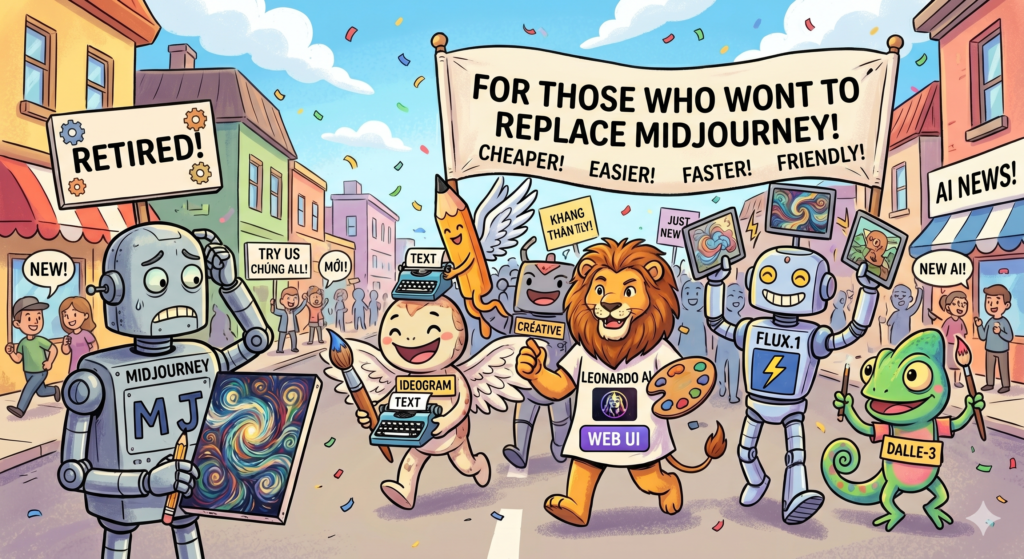
The generative artificial intelligence market has officially graduated from a sandbox of early-stage experimentation into a fiercely competitive, highly specialized enterprise ecosystem. In the early days of generative media, single-platform dominance was the industry norm. Today, corporate design bureaus, agile marketing agencies, and software engineering teams deploy task-specific models to achieve peak computational and creative efficiency.
While Midjourney (v8.1) remains the undisputed gold standard for rich, atmospheric art direction and cinematic textures, its walled-garden ecosystem—notably its lack of a public API, closed architecture, and historically temperamental typographic rendering—has driven professional creators to look elsewhere. The quest for specialized Midjourney AI alternatives 2026 is no longer about finding a clone; it is about deploying precision tools that excel where Midjourney falls short.
This definitive guide reviews the premier frontier image models of 2026, breaking down their accessibility mechanics, rendering velocities, prompt adherence, vector workflows, and commercial pricing structures to help you build the ultimate creative pipeline.
Therefore, finding the absolute best Midjourney AI alternatives 2026 has become a priority for studios looking to bypass platform blockades and optimize their financial budgets this year.
1. Platform Accessibility & Entry Barriers: Free Tiers vs. Walled Gardens
Access models vary drastically across the 2026 generative landscape. While Midjourney operates strictly on a paid-only subscription framework, its primary market challengers leverage generous free tiers and open-source models to aggressively capture market share.
Table 1: 2026 Free Tier Allotments & Licensing Constraints
| Platform / Suite | Free Tier Availability | Daily/Weekly Free Allotment | Core Feature Restrictions on Free Tier | Commercial Rights on Free Tier |
| Midjourney (v7 / v8.1) | No | None | Total platform lockout without an active paid subscription. | Not Applicable |
| Leonardo AI | Yes | 150 daily Fast Tokens | Public-only gallery; lacks Consistent Character Engine and custom LoRA fine-tuning. | Non-exclusive, royalty-free license; platform retains secondary IP. |
| Ideogram (v3 / v4.0) | Yes | 10 slow credits per week | Public generation stream; standard rendering queue speeds; limited vector exports. | Yes, full commercial use rights granted natively. |
| Black Forest Labs Flux 2 | Yes | Unlimited (Self-hosted) | Requires local high-end GPU infrastructure and developer setup. | Yes, open-source Apache-style commercial licensing. |
| Recraft v4.1 | Yes | Credit-based allotment | Standard queue priority; all models (including Vector Pro) remain accessible. | Yes, full commercial rights included on output. |
| Google Nano Banana 2 | Yes | Resolution-capped tier | Access scales back to the standard base model once Pro limits are reached. | Yes, governed by standard Google Cloud Vertex AI terms. |
For casual creators and engineering teams prototyping workflows without upfront capital, Leonardo AI offers an excellent gateway with 150 daily tokens—yielding roughly 8 to 10 images on its modern Phoenix 2.0 engine.
However, professional designers looking at open-weight Midjourney AI alternatives 2026 frequently pivot to Black Forest Labs’ Flux 2 family (Dev/Schnell). By self-hosting these open-weight variations on local GPU rigs, enterprises completely bypass per-image subscription tollbooths, unlocking unlimited raw generation with complete parameter control.
This algorithmic freedom makes open-source frameworks the top-performing Midjourney AI alternatives 2026 for highly customized commercial pipelines.
2. Workspace UX: Discord Native vs. Integrated Web Dashboards
The workflow split between chat-driven native interfaces and rich web workspaces remains a defining operational choice for creative directors.
[Generative Design Pipelines]
 ├── CLOSED INTERFACE: Midjourney (Web App/Discord) ──► No Public API (Creative Silhouette Only)
 └── WEBWORKSPACES & APIS: Leonardo AI & Flux ───────► Full Canva Integration / Serverless GPU Pipelines
Midjourney’s Web Evolution
Midjourney’s web application (midjourney.com) has successfully reduced the friction of its legacy Discord environment. The web workspace provides clean asset galleries, visual prompt shorteners, and intuitive canvas infilling tools. However, the platform remains programmatically locked. Without a public API, developers cannot integrate Midjourney’s aesthetic engine directly into external software stacks or automated ad-tech pipelines.
Leonardo AI’s Design Studio
Following its high-profile acquisition by Canva, Leonardo AI has evolved into an interconnected web-based design ecosystem. Rather than forcing creators to rely entirely on trial-and-error text strings, Leonardo integrates graphic controls like ControlNet for exact pose matching, edge detection, and real-time generation previews. Furthermore, its Essential tier comes bundled with Canva Business, enabling corporate teams to move from canvas layout to AI asset generation in a single click.
Serverless APIs: The Flux Advantage
For automated production lines, the Black Forest Labs Flux model family represents the programmatic benchmark. Built for developer deployment, Flux 1.1 Pro and Flux 2 Pro are widely hosted across serverless GPU aggregators like fal.ai and Replicate. This pay-as-you-go developer pipeline allows software architectures to generate photorealistic imagery inside custom apps, charging only for active compute fractions and eliminating the high idle overhead of private server farms.
3. Speed, Latency, and Rendering Infrastructure Benchmarks
To scale an asset pipeline, you must balance raw resolution ceilings against real-world wait times. The underlying math of how these architectures generate pixels dictates their workplace velocity.
Table 2: Computational Speed & Core Architectural Performance
| Model Variant | Native Resolution Limit | Median Latency / Render Speed | Core Generation Technology | Architectural Focus |
| Midjourney v8.1 | 2K (2048 x 2048 px) | 4.0 – 5.0 seconds | Closed Flow/Diffusion | Cinematic Art Direction |
| Midjourney v7 | 1K (1024 x 1024 px) | 15.0 – 20.0 seconds | Closed Diffusion | Heavy Painterly Textures |
| Flux 2 Pro | 2K (Up to 2048 px) | 8.0 – 15.0 seconds | Flow Transformer + Mistral VLM | Hyper-Real Textures & Physics |
| Flux 1.1 Pro | 1.4K (1440 x 1440 px) | 4.5 seconds | Rectified Flow Matching | Production Rendering Velocity |
| Flux 2 Schnell | 1K (1024 x 1024 px) | 1.0 – 2.0 seconds | Distilled Flow (Open-weight) | Real-Time Prototyping |
| Ideogram 4.0 | 1K (1024 x 1024 px) | 10.0 – 15.0 seconds | Text-Specialized Diffusion | Graphic Design Typography |
| Recraft v4.1 Pro | 2K (2048 x 2048 px) | 12.0 seconds | Proprietary Design Engine | Commercial Mockups & Print |
| Recraft v4.1 Vector | Scalable SVG | 12.0 seconds | Native Vector Geometry | Infinite Resolution Math |
Midjourney’s Native 2K Pipeline
Midjourney v8.1 addresses the rendering latency of its predecessors, processing 4 to 5 times faster than version 7. It completely bypasses the multi-step upscale sequence, rendering native 2K assets directly within 5 seconds. While version 8.0 introduced a flatter, cooler aesthetic that met with mixed reviews from concept artists, version 8.1 returns to the atmospheric, dramatic look of v7 while preserving v8’s anatomy rendering and shorter text execution.
Flux’s Rectified Flow and VLM Framework
The extreme speed of Flux 1.1 Pro stems from Rectified Flow Training. Traditional diffusion models gradually subtract noise over numerous iterative cycles, adding significant rendering time. Flux 1.1 Pro instead calculates straight-line velocity vectors to map random noise directly to clear target pixels, hitting production-ready outputs in a blistering 4.5 seconds.
Conversely, Flux 2 Pro shifts the paradigm by pairing a Mistral-3 Vision-Language Model (VLM) directly with its flow transformer. While this structural addition increases generation times to 8–15 seconds, it grants the model remarkable mastery over spatial layouts and physical material surfaces. In blind A/B testing, Flux 2 Pro wins 67% of matchups against its speed-optimized sibling, displaying superior handling of mixed lighting fields and rich physical textures like aged wood, distressed leather, and reflective water bodies.
When speed dictates production turnarounds, utilizing rectified flow architectures becomes essential, positioning these fast engines among the most viable Midjourney AI alternatives 2026.
4. Typographic Fidelity & Prompt Adherence: Overcoming the Literal Gap
For marketing graphics, app UI mocks, and editorial layouts, the ability to embed legible textual strings and respect exact spatial directions is vital.
Table 3: Typographic Precision & Complex Layout Adherence
| Model / Framework | Typographic Accuracy Rate | Prompt Adherence Score | Primary Spatial Capability |
| Ideogram v4.0 | ~90% – 95% | High | Complex Font Hierarchies & Layout Control |
| GPT Image 2 | ~98.5% (High API) | Exceptional | Reasoning-Driven Multi-Panel Comic Layouts |
| Nano Banana 2 Pro | ~91% | High | Live Web Grounding for Factual Infographics |
| Flux 2 Pro | 70% – 78% | High | Physical Realism & Multi-Source Lighting |
| Midjourney v8.1 | 30% – 40% | Moderate | Highly Interpretive; Favors Aesthetics Over Text |
Ideogram’s Typography Dominance
Built by a veteran team of former Google Brain researchers, Ideogram 4.0 stands as the industry reference point for embedded graphic text, regularly clocking 90% to 95% typographic accuracy. While alternative platforms output garbled characters or misspelled strings, Ideogram accurately processes layout styling, variable font weights, and lengthy sentences. This makes it an essential tool for social media banners and product box designs.
GPT Image 2’s Layout Reasoning
OpenAI’s GPT Image 2 relies on an advanced reasoning-driven architecture. When tasked with complex, multi-column magazine arrangements, it keeps character bleeding to zero and maintains perfect spelling accuracy. The model reads text inputs like code parameters; for instance, when generating a multi-panel comic layout, it smoothly preserves character likeness, clothing configurations, and scene progressions across distinct panes.
Nano Banana 2 Pro’s Live-Search Grounding
Google’s Gemini-backed Nano Banana 2 Pro addresses data-heavy, factual graphic production by applying live web search grounding. While alternative engines depend on static, frozen training logs and risk hallucinating metric details, Nano Banana 2 Pro polls live web search indices to generate accurate data visualizations and workflow charts. This unique capability makes it a prime asset for technical, educational, and newsroom graphic design production.
5. Production Utility: Native Vectors and Custom LoRA Fine-Tuning
For corporate design frameworks, the transition from pixel-bound raster files (JPEGs/PNGs) to editable, infinite-resolution assets represents a major leap forward in utility.
                  ┌──► Recraft v4.1 Vector ──► Native SVG Geometry (Scalable Branding & Logos)
                  │
AI Alternatives ──┼──► Recraft v4.1 Utility ─► Front-Facing Flat Lighting (Product Mockups)
                  │
                  └──► Leonardo AI LoRA ─────► Brand Dataset Fine-Tuning (Custom Visual Style)
Recraft v4.1 and Infinite-Scale SVGs
Recraft v4.1 stands out as the only major AI generator capable of rendering native, fully editable Scalable Vector Graphics (SVGs). Rather than applying a vectorization tracing filter over a raw raster output, Recraft’s specialized engine writes true mathematical paths, preserving pristine edges and clean anchor points at any scaling size.
Its design utility is split into three functional configurations:
- Recraft v4.1 Vector: Built specifically for clean iconography, brand logos, and high-contrast editorial assets.
- Recraft v4.1 Utility: Engineered for product mockups and packaging flats. It outputs clean, predictable front-facing studio lighting to eliminate unwanted creative shadowing.
- Precision Model Sheets: The architecture can generate clean, multi-angle character reference sheets—displaying front, profile, and back positions in uniform alignment—greatly accelerating asset creation pipelines for indie game devs and animators.
Leonardo AI’s Desktop LoRA Workrooms
When a brand requires an unbroken, signature style across thousands of visual assets, generalized models often fall short. Leonardo AI addresses this by providing native Low-Rank Adaptation (LoRA) model training directly inside its web interface. Organizations can upload a modest training set of 10 to 20 existing brand images to train a custom model layer, ensuring subsequent asset runs match their established corporate visual style perfectly.
By offering fine-tuning environments alongside continuous aesthetic control, the platform easily secures its place as one of the most practical Midjourney AI alternatives 2026 for localized marketing campaigns.
6. Financial Infrastructure and Corporate Seat Economics
Operating expenses scale based on your production volume and deployment methodology. The market in 2026 is divided into fixed subscription models, token banks, and serverless compute metrics.
Table 4: Commercial Pricing Tiers & Production Economics
| Platform / Tier | Annualized Monthly Cost | Priority Generations / Monthly Computing Cap | Overage / Top-Up Economics | Critical Commercial & Enterprise Restrictions |
| Midjourney Basic | $8 / month | ~3.3 Fast GPU hours (~200 images) | Hard stop on execution until the next billing loop. | Standard corporate commercial usage rights. |
| Midjourney Standard | $24 / month | 15 Fast GPU hours; unlimited Relaxed rendering. | No fast top-ups; drops into a slow Relaxed wait pool. | Standard corporate commercial usage rights. |
| Midjourney Pro | $48 / month | 30 Fast GPU hours; unlimited Relaxed rendering. | Stealth Mode enabled (hides generations from public feed). | Mandatory tier for firms with gross annual revenues over $1,000,000. |
| Leonardo Essential | $10 / month | 8,500 Fast Tokens per month | 25,500 token Rollover Bank accumulation allowed. | Full commercial rights; included natively in Canva Business accounts. |
| Leonardo Premium | $24 / month | 25,000 Fast Tokens per month | 75,000 token Rollover Bank; unlimited relaxed legacy renders. | Full commercial production rights. |
| Ideogram Plus | $15 / month | 1,000 priority generation credits | 150-credit top-up packs for $4 ($0.027 / credit); unlimited slow credits. | Private generation stream enabled. |
| Ideogram Pro | $42 / month | 3,500 priority generation credits | 250-credit top-up packs for $4 ($0.016 / credit); unlimited slow credits. | Enables automated batch processing via CSV data sheet inputs. |
Analyzing Usage Economics: Hours vs. Tokens vs. API Calls
- Midjourney’s GPU Time Metaphor: On the $30 Standard plan, your 15 Fast GPU hours yield roughly 900 images. The option to switch to “Relaxed Mode” offers a predictable cost model for teams running high-volume, non-urgent creative exploration. However, enterprise organizations crossing the $1M revenue threshold are legally required to buy into the Pro or Mega brackets to secure valid commercial protection.
- Leonardo’s Variable Token Burn: Leonardo calculates costs based on tool intensity. While a standard image generation costs roughly 8 tokens, activating the Consistent Character Engine, custom brand LoRAs, or high-definition upscaling can raise the cost to 36 tokens per image. Video creation ranges from 40 to 60 tokens. Unused allocations migrate into a Rollover Bank rather than disappearing at the end of the month.
- The Scaled API Strategy: For development teams deploying automated pipelines, subscription seats can become cost-prohibitive. Using serverless APIs like
fal.aito handle Flux 2 Pro can lower your per-asset expenses. At approximately $0.04 per image, a team producing 1,000 high-resolution assets via Flux Pro pays a modest $40 per month, gaining direct programmatic access without subscription seat limits.
7. Strategic Synthesis: Building Your Multi-Tool AI Pipeline
Relying on a single image generator to handle every creative assignment often leads to compromised quality. Instead, leading agencies combine these Midjourney AI alternatives 2026 into a specialized, multi-stage visual production line:
[The Multi-Platform Production Pipeline]
   Phase 1: Concept & Art Direction ─────► Midjourney v8.1 (Cinematic Style & Palettes)
   Phase 2: Photorealistic Context ──────► Flux 2 Pro API (Clean Lifestyle & Product Backgrounds)
   Phase 3: Typographic & Text Overlays ─► Ideogram 4.0 (Pristine Marketing Copy & Layouts)
   Phase 4: Scaling & Integration ───────► Recraft v4.1 (Native SVG Geometry & Scalable Icons)
- Phase 1 (Concept & Mood Boards): Run creative development and color palette testing inside Midjourney v8.1 to leverage its world-class cinematic style.
- Phase 2 (Photorealistic Context): Use Flux 2 Pro via serverless APIs to generate hyper-realistic, cleanly lit lifestyle backgrounds and product mockups.
- Phase 3 (Typography & Layout Overlays): Run final drafts through Ideogram 4.0 to place clean, accurately spelled marketing copy and product logo typography.
- Phase 4 (Scale and UI Support Assets): Deploy Recraft v4.1‘s native vector mathematical engine to generate matching icons, scalable brand elements, and vector graphics.
AI Review Zones Editorial Verdict: ⭐ 4.8 / 5 — Building a diversified image generation stack is the ultimate competitive advantage for creative agencies and tech enterprises in 2026. Evaluating these specialized Midjourney AI alternatives 2026 ensures that your studio maximizes both production speed and visual quality without relying on a single ecosystem.
Which of these frontier image generators is driving your design engine this year? Are you hosting open-weight Flux models locally, or are you utilizing web dashboards like Leonardo inside Canva Business? Let us know your thoughts in the comments below! Be sure to bookmark aireviewzones.com for more elite tech reviews and deep-dive software guides.