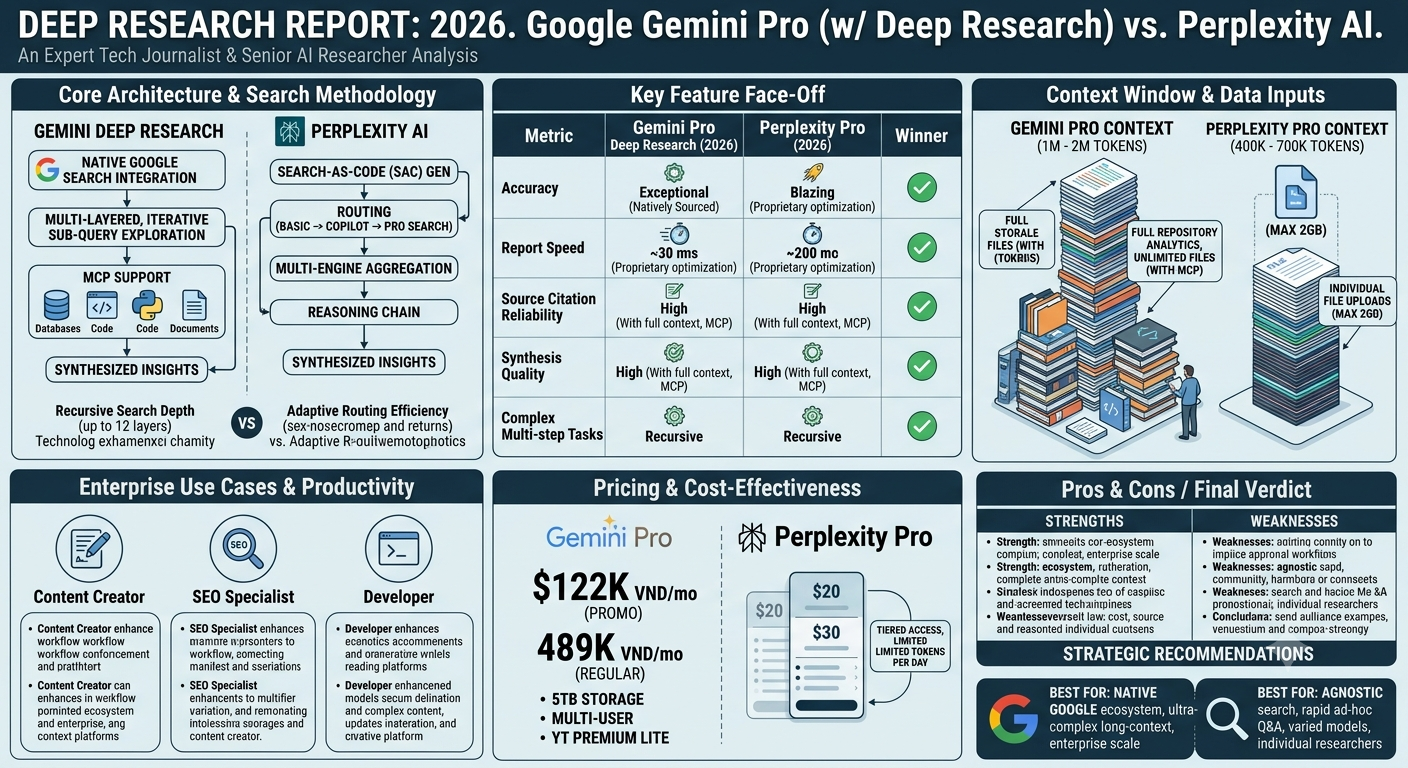
The artificial intelligence landscape has reached an unprecedented turning point in 2026. Following OpenAI’s unexpected shutdown of Sora 2 on April 26, 2026, the focus of global generative AI has radically shifted toward autonomous, search-grounded research agents. Today, the industry is dominated by an elite heavyweight battle: Google Gemini Pro (with Deep Research) versus Perplexity AI.
For SEO specialists, content creators, researchers, and developers, choosing the right tool is no longer about which chatbot writes better sentences—it’s about which engine synthesizes the internet with the highest accuracy and depth. In this comprehensive, data-driven Gemini Pro Deep Research vs Perplexity AI review, we analyze their core architectures, factual benchmarks, context limitations, and cost structures to help you optimize your professional workflow.
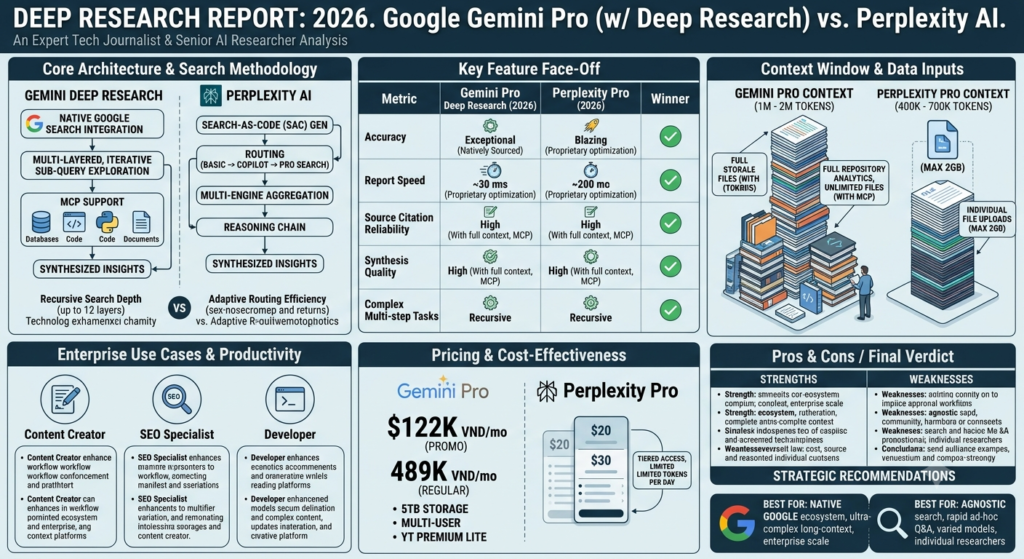
1. Core Architecture and Search Systematics
When evaluating Gemini Pro Deep Research vs Perplexity AI, we must first look at their underlying search models.
Google Gemini Pro and Perplexity AI represent fundamentally divergent paradigms in the engineering of search-grounded artificial intelligence.
Google Gemini Deep Research: The Long-Horizon Planner
The Google Gemini Deep Research agent is built as an autonomous, long-horizon planner that prioritizes cognitive depth and iterative synthesis. Utilizing the frontier Gemini 3.1 Pro as its analytical engine, the system operates on an asynchronous Plan-Search-Iterate-Output workflow.
Developers can invoke this background loop via the Interactions API using specific backend configurations:
JSON
{
  "model": "deep-research-max-preview-04-2026",
  "background": true
}
A core feature of the Gemini architecture is its Collaborative Planning Phase. When triggered, the agent generates a comprehensive research strategy detailing planned subtopics, targeted domains, and search queries before executing. Users can review, reorder, add, or prune these sections. Furthermore, via the Model Context Protocol (MCP), Gemini directly hooks into proprietary corporate databases like FactSet, S&P Global, and PitchBook to scan paywalled data alongside the open web.
Perplexity AI: The “Search as Code” Maverick
The next core pillar in this Gemini Pro Deep Research vs Perplexity AI showdown is how the competitor handles real-time web processing.
Perplexity AI has abandoned traditional, static search routing in favor of an agile Search as Code (SaC) architecture. Instead of feeding standard search engine results pages (SERPs) straight into an LLM, Perplexity’s SaC framework treats the AI as a control plane that dynamically generates Python code to orchestrate custom data retrieval pipelines on-the-fly.
This code runs inside secure compute sandboxes that execute deterministic operations such as filtering, joining, and aggregating web data. This avoids traditional noise and high token costs. Perplexity manages this via an automated Pro Search Classifier that balances tasks across its core systems:
- Fast Search: Single-pass optimized retrieval for basic factual questions.
- Pro Search: Multi-step logical synthesis utilizing specialized web-crawlers (
web_searchandfetch_url_content).
This infrastructure is routed through the Perplexity Computer meta-router, which coordinates a roster of up to 19 partner models (including GPT-5 and Claude Sonnet) backed by an exabyte-scale crawling index (PerplexityBot) tracking over 200 billion unique URLs.
2. Technical and Systemic Feature Comparison
To see how these underlying infrastructures stack up, let’s look at the foundational systems running beneath both platforms in 2026.
Table 1: Architectural System Matrix
| System Dimension | Google Gemini Deep Research | Perplexity AI (Pro Search & SaC) |
| Cognitive Core Engine | Gemini 3.1 Pro | Meta-router (combining 19 specialized frontier models) |
| Search Paradigm | Plan-Search-Iterate-Output loop | Search as Code (SaC) programmatic pipelines |
| Execution Mechanics | Asynchronous, long-running background agent | Real-time code generation and execution sandboxes |
| Primary API Endpoints | Interactions API (interactions.create) | Sonar Chat & Agentic Search API |
| Data Grounding Rails | Google Search index, MCP partner servers, Google Drive | PerplexityBot index, hybrid lexical-semantic scraping |
| User Planning Layer | Multi-turn collaborative plan modification | Automated Pro Search Classifier (Fast vs. Pro routing) |
| Dynamic Media Assets | Native inline HTML and dynamic visual charts | Markdown tables, structured text, and media arrays |
3. Key Feature Face-Off and Empirical Benchmarks
The architectural differences between these platforms create distinct performance profiles. Perplexity AI is engineered for rapid information retrieval, clocking a median factual response time of just 6.8 seconds (with deep research tasks wrapping up in 2 to 3 minutes). Google Gemini Pro, on the other hand, prioritizes massive data synthesis over raw speed, requiring 22 to 90 seconds for basic prompts and 5 to 15 minutes for deep research loops.
The Factual Accuracy Asymmetry
When it comes to factual grounding, the Suprmind Multi-Model Divergence Index evaluates these systems using a strict mathematical metric known as the Catch Ratio:
$$\text{Catch Ratio} = \frac{\text{Model Corrections Generated}}{\text{Factual Errors Committed}}$$
In production testing across 1,324 turns, Perplexity achieved a superior Catch Ratio of 2.54 (generating 335 corrections while committing only 132 errors). Conversely, Gemini scored a low 0.26 (making 109 corrections while being caught in 416 errors). This 9.77x catch-ratio asymmetry highlights Perplexity’s RAG-native strength at continuous verification, whereas Gemini remains prone to confident hallucinations pulled from its parametric memory.
Furthermore, the Citation Journal Report (CJR) error rate—measuring how often a cited source fails to support the AI’s claim—revealed that Perplexity maintained a 37% error rate compared to Gemini 3 Pro’s severe 76% citation error rate.
Benchmark Performance
However, on expert-level logical, scientific, and mathematical evaluations, Gemini’s large-scale models dominate Perplexity’s meta-router system.
Table 2: Hard Core Benchmarks and Performance Metrics
| Metric / Production Benchmark | Google Gemini Pro Deep Research | Perplexity AI (Sonar / Pro / Max) |
| GPQA Diamond Score (Expert Science) | 91.9% (Gemini 3.1 Pro) | 62.3% (Sonar Logical Models) |
| AIME 2025 Score (Advanced Math) | 95.0% (Gemini 3 Pro) | 77.0% (Sonar Logical Models) |
| SimpleQA Accuracy | ~85.0% (Estimated) | 93.9% (Deep Research Variant) |
| HLE Benchmark Score | 44.7% (Gemini 3.1 Pro) | 21.1% (Deep Research Variant) |
| Empirical Catch Ratio (Higher is better) | 0.26 | 2.54 (9.77x more reliable verification) |
| CJR Citation Error Rate (Lower is better) | 76.0% (Gemini 3 Pro) | 37.0% (Sonar Pro) |
| Standard Inference Latency | 22.0 – 90.0 seconds | 6.8 seconds (Median) |
| Deep Research Execution Latency | 5.0 – 15.0 minutes | 2.0 – 3.0 minutes |
| Analytical Depth Score (Out of 5.0) | 4.6 (Deep multi-section reports) | 4.1 (Structured encyclopedic briefings) |
4. Context Capacity and Document Ingestion Limits
For enterprise workflows handling large volumes of internal data, context window capacity is a primary differentiator in this Gemini Pro Deep Research vs Perplexity AI match-up.
Gemini’s Massive Token Real Estate
Google Gemini Pro offers a massive native context window of 1 million to 2 million tokens. To calculate document capacity, text is sized using the industry-standard ratio:
$$\text{Token Sizing Ratio} \implies 1,000\text{ tokens} \approx 750\text{ words}$$
Using this exact ratio, Gemini’s 1-2M token limit seamlessly ingests between 750,000 to 1,500,000 words—the equivalent of 1,500 to 3,000 single-spaced pages or 50,000 lines of complex codebase files. It is also natively multimodal, accepting up to 19 hours of audio or 10 hours of video in a single request.
Note: In the web browser interface, Gemini limits active conversational chat memory to 32,000 tokens for latency control, reserving the full multi-million window for uploaded files.
Perplexity’s Fragmented RAG Approach
Perplexity AI uses a more constrained framework. Its native Sonar models feature a hard cap of 128,000 to 200,000 tokens. App-level claims of 1 million tokens are achieved via segmented vector retrieval, not a unified model window. Direct text pastes are capped at 8,000 tokens before being forced into an automatic file conversion.
File uploads are capped at 40MB for free accounts and 50MB for Pro tiers. While Perplexity provides organized file storage repositories called “Spaces” (holding up to 50 files for Pro and 5,000 for Enterprise Max), parsing accuracy drops significantly on larger datasets. Large spreadsheets or CSV files over 1MB frequently suffer from data clipping, requiring users to manually partition files.
Table 3: Context and Ingestion Parameters
| Ingestion Parameter | Google Gemini Pro | Perplexity AI (Sonar / Pro) |
| Native Model Context Window | 1,000,000 to 2,000,000 tokens | 128,000 to 200,000 tokens |
| Direct Text Input Boundary | Up to 32,000 tokens (Browser UI) | ~8,000 tokens (Forces file upload if exceeded) |
| Max Individual File Upload Size | Scaled via linked Google Drive limits | 40 MB (Free), 50 MB (Pro/API), 1 GB (Enterprise Pro) |
| Project Repository Cap | Integrated Google Drive structures | 50 files (Pro Space), 5,000 files (Enterprise Max) |
| Multi-Modal Native Media Processing | 19 hours of audio / 10 hours of video | Audio/video transcription capped at 40 MB files |
5. Enterprise Use Cases and Workflow Productivity
Enterprise professionals use both platforms to automate complex tasks, relying on each tool’s distinct operational strengths.
Content Strategy & SEO
In digital marketing, a strategic division of labor yields the best results:
- Gemini Pro as the Architect: Because it can ingest 20 competing long-form articles alongside internal brand guidelines, Gemini is ideal for drafting comprehensive campaign pillars, scripts, and content structures.
- Perplexity AI as the Auditor: Once the content draft is ready, marketers route it through Perplexity to check facts, pull real-time market data, and verify source links against the live web.
Software Engineering
Gemini’s deep ecosystem integration gives it a major edge for developers. Gemini Code Assist integrates natively with primary IDEs (VS Code, JetBrains, Android Studio), allowing engineers to upload thousands of lines of code to map out project dependencies or re-architect legacy systems.
Perplexity lacks native IDE integration, but developers use it for rapid debugging by utilizing its Model-Switching panel. By routing niche errors to models like Claude Sonnet or GPT-5, engineers can quickly crowdsource solutions.
6. Pricing Structures and Cost-Effectiveness
Google Gemini has heavily localized its pricing model in Vietnam, offering incredibly competitive tiers. Perplexity AI maintains a standard dollar-denominated global model.
Table 4: Subscription Tiers and Developer API Rates
| Plan Tier | Google Gemini (Global Pricing) | Perplexity AI (Global Pricing) |
| Free / Basic Tier | $0 Access to 3.5 Flash & 3.1 Pro models. | $0.00 / Unlimited basic search, ~5 Pro Searches/day. |
| Entry Paid Tier | $5 USD – AI Plus Includes 200GB storage & Deep Research. | $10.00/month (Education Pro) Verified student access. |
| Premium Individual | $20 USD – AI Pro Unlocks 5TB Cloud storage, YouTube Premium Lite, $10 Cloud credits. | $20.00/month ($200 Annual – Pro) Unlimited Pro Search, 500 Deep Research/day, Statista/PitchBook data. |
| Enterprise / High-Tier | $260.00 to $780.00 per month (Ultra) 20-30TB storage, 2.5 Deep Think multi-agent core. | $40 to $325/month (Enterprise) SSO, data isolation, 5,000 persistent repository files. |
| Power User Tier | N/A | $200.00/month (Perplexity Max) Comet Browser integration, 10,000 Computer credits. |
| API Developer Rates | Charged via Google Vertex AI metrics. | Sonar Standard: $1.00/1M tokens. Sonar Deep Research: $2.00 input, $8.00 output + $5.00/1k searches. |
7. Strategic Evaluation and Verdict
Our final analysis of Gemini Pro Deep Research vs Perplexity AI highlights a clear trade-off between conceptual engineering and factual retrieval.
The direct comparison between Google Gemini Pro and Perplexity AI reveals a clear trade-off between conceptual logic depth and live search accuracy. Neither system is a one-size-fits-all solution; instead, they function as specialized tools optimized for different cognitive demands.
                  ┌────────────────────────────────────────┐
                  │      WHICH AI AGENT SHOULD YOU USE?     │
                  └────────────────────────────────────────┘
                                      │
             ┌────────────────────────┴────────────────────────┐
             ▼                                                 ▼
┌───────────────────────────────┐               ┌───────────────────────────────┐
│       USE GEMINI PRO IF:      │               │      USE PERPLEXITY AI IF:    │
├───────────────────────────────┤               ├───────────────────────────────┤
│ • You process massive files   │               │ • You need elite fact-checking│
│   (Up to 2 Million tokens)    │               │   and real-time data sourcing │
│ • You need advanced logic,    │               │ • You need highly reliable,   │
│   math, or backend coding     │               │   clickable web citations     │
│ • You are fully embedded in   │               │ • You want to cross-reference │
│   the Google Workspace system │               │   premium databases instantly │
└───────────────────────────────┘               └───────────────────────────────┘
The Ultimate Power-User Strategy
For modern enterprise professionals, the most effective approach is a Dual-Tool Pipeline.
By using Gemini Pro as your primary builder—leveraging its multi-million token window to ingest source documents, structure campaigns, and write long-form content—and then routing that output through Perplexity AI as your factual validator to verify claims and add clean citations, you can combine the strengths of both platforms. This hybrid workflow offers the best of both worlds: deep logical reasoning backed by accurate, verified web data.
AI Review Zones Rating:
- Google Gemini Pro Deep Research: ⭐⭐⭐─★ (4.5/5) – The King of Context & Logic.
- Perplexity AI (Pro/Max): ⭐⭐⭐─★ (4.7/5) – The King of Real-Time Factual Verification.
Which platform are you deploying in your business pipeline this year? Do you prefer Gemini’s 2 million token window or Perplexity’s Search-as-Code accuracy? Let us know in the comments section below! Don’t forget to bookmark aireviewzones.com for more authoritative, tech-insider AI reviews and production tutorials.