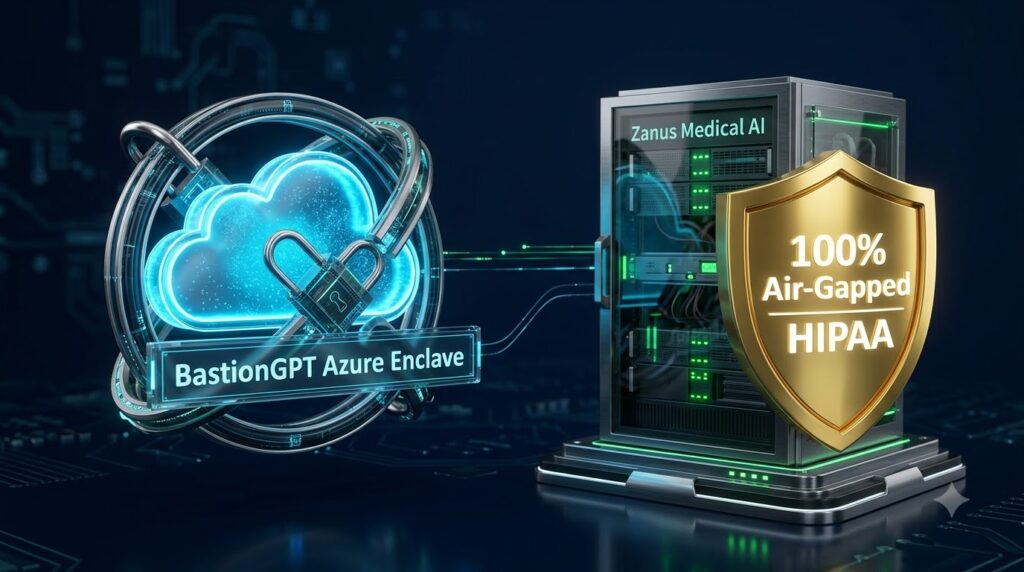
Quick Summary: The Tension Between Clinical Efficiency and Risk
When conducting a thorough BastionGPT HIPAA review and evaluating clinical AI infrastructure, the adoption of artificial intelligence within clinical workflows has shifted from experimental pilots to core operational infrastructure across the United States healthcare ecosystem. Driven by severe clinician burnout and documentation burdens—often referred to as “pajama time,” where physicians spend hours after clinic shifts manually completing electronic health record (EHR) charts—ambient AI scribes and generative language models offer quantifiable relief.
However, integrating AI presents structural challenges under the Health Insurance Portability and Accountability Act (HIPAA) Security Rule (45 CFR Part 164) regarding the protection of electronic Protected Health Information (ePHI). Healthcare leaders face a fundamental choice between two architectural models:
- Hosted Cloud Enclaves (e.g., BastionGPT): Public frontier models wrapped inside a vendor-managed cloud tenant secured by Business Associate Agreements (BAAs) and Zero-Data Retention (ZDR) contracts.
- On-Premise Medical AI Server Appliances (e.g., Zanus Medical AI): Dedicated hardware deployed directly within the healthcare facility’s local data center, enabling physical air-gapping, local HL7/FHIR EHR integration, and absolute egress prevention.
While cloud-hosted models offer rapid, low-friction deployment, they introduce perpetual wide area network (WAN) data transmission risks, third-party subprocessor supply chain exposure, and escalating per-seat subscription costs. On-premise hardware requires upfront capital expenditure (CapEx) but eliminates WAN transmission, eliminates per-user recurring fees, and ensures zero ePHI exposure to external networks.
Comparison at a Glance
| Feature / Metric | BastionGPT (Cloud Enclave) | On-Premise Server (e.g., Zanus) |
| Primary Deployment | Hosted Azure Cloud Enclave | Local Physical Data Center / Server Room |
| Data Boundary | Encrypted WAN Transmission | Local Area Network (LAN) / Air-Gapped |
| HIPAA BAA Requirement | Required across all subprocessor tiers | Not required (Data never leaves infrastructure) |
| Third-Party Subprocessors | Multiple (Microsoft Azure, OpenAI, Anthropic) | Zero external subprocessors |
| Pricing Structure | Perpetual SaaS Subscription ($20–$75/user/month) | One-time Hardware/License CapEx + Maintenance |
| Network Dependency | Active High-Speed WAN Internet Required | Functions Offline / Fully Internal LAN |
| EHR Interoperability | Web Interface / Browser Extension / API | Direct Local HL7 v2 / SMART on FHIR Pipelines |
BastionGPT Architecture & Compliance Evaluation
Hosted Privacy Model and Technical Architecture
BastionGPT functions as a specialized healthcare privacy wrapper hosted on Microsoft Azure’s HIPAA-compliant infrastructure. Rather than operating a proprietary foundational model, BastionGPT routes user prompts, audio dictations, and uploaded clinical documents to underlying frontier large language models (LLMs)—including OpenAI’s GPT-5.5, Anthropic’s Claude Sonnet, and Google’s Gemini 3 Pro—via secure enterprise Application Programming Interface (API) channels.
[ Clinical Endpoint ] ---> (TLS 1.3 / WAN) ---> [ Azure HIPAA Enclave ] ---> (ZDR API) ---> [ Frontier LLM Engine ]
Data flows sequentially from the clinician’s browser or mobile application over an encrypted Transport Layer Security (TLS 1.2/1.3) wide area network link into BastionGPT’s isolated Azure enclave. Within this enclave, the request is validated, sanitized, and forwarded through enterprise zero-retention API endpoints to underlying model vendors. Once processed, generated text returns to the user interface, while request data at the foundational model layer is purged.
- Infrastructure Isolation: The application interface resides within ISO 27001-certified Azure data centers configured to meet HIPAA Security Rule specifications.
- Encryption Standards: Data in transit uses TLS 1.2/1.3; data stored temporarily within the platform is encrypted at rest using AES-256.
- Contractual Business Associate Agreements (BAAs): BastionGPT includes a standard BAA across all tiers, guaranteeing ePHI management according to 45 CFR § 164.502 requirements.
- Zero-Data Retention (ZDR): Enforces enterprise ZDR configurations with underlying AI vendors, prohibiting prompt logging or model training.
Hidden Risks of Cloud BAAs and Hosted Enclaves
Despite contractual safeguards, hosted healthcare AI wrappers introduce technical and legal risks that compliance teams must evaluate:
- Subprocessor Supply Chain Exposure: A standard cloud BAA does not eradicate risk across multi-tiered vendor chains. BastionGPT relies on a chain of subprocessors: Microsoft Azure (hosting), authentication providers, and LLM vendors. Under HIPAA § 164.308(a)(1)(ii)(A), health systems must conduct ongoing risk assessments of the entire vendor chain. A security failure at any subprocessor link introduces regulatory liability to the covered entity.
- WAN Connectivity & Operational Dependency: BastionGPT relies entirely on active, low-latency WAN internet links. Service disruptions or WAN routing degradation instantly suspend clinical documentation capabilities, halting ambient scribing during active patient encounters.
- Legal Risk-Shifting vs. Technical Prevention: A BAA is a legal framework for indemnification and liability allocation—it is not a technical firewall that physically prevents data exfiltration. In contrast to technical prevention, where data is physically blocked from leaving the local network, cloud BAAs merely offer legal recourse after a security incident occurs.
Subscription Tiers and Operational Specifications
| Feature / Metric | Professional Tier | Professional Plus Tier | Ultra Tier |
| Monthly Cost | $20.00 / user / month | $45.00 / user / month | $75.00 / user / month |
| Target Workload | Individual practitioners | Standard clinical teams | Large enterprise systems |
| Ambient AI Scribe | Included (Unlimited) | Included (Unlimited) | Included (Unlimited) |
| Document Capacity | Up to 30 pages / upload | Up to 500 pages / upload | Custom / Enterprise capacity |
| Multimodal Inputs | Text only | Images, charts, and graphs | Full multimodal analysis |
| Identity Control | Email / Password / MFA | Email / Password / MFA | Single Sign-On (SSO / SAML 2.0) |
| Deployment Model | Shared Azure HIPAA Enclave | Shared Azure HIPAA Enclave | Isolated local cloud tenant |
Editor’s Perspective: Operational Impact
Choosing BastionGPT is fundamentally a trade-off: you gain instant deployment and access to state-of-the-art frontier models at the cost of perpetual subprocessor risk and recurring OpEx costs that compound as clinical headcount grows.
On-Premise Medical AI Server Architecture
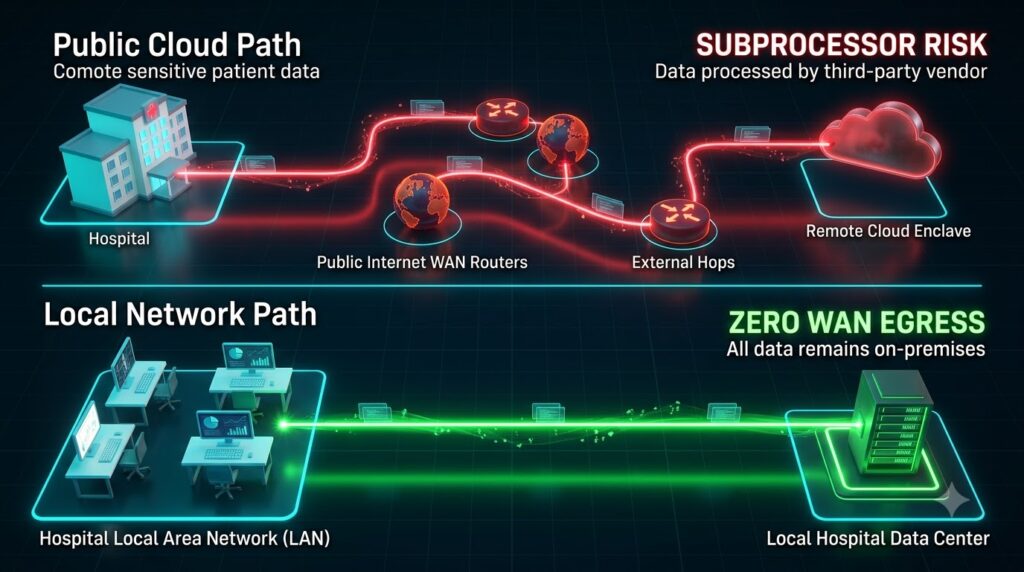
Physical Air-Gap Capabilities and Local Network Topology
The primary architectural alternative to cloud wrappers is a dedicated, on-premise medical AI server appliance, exemplified by systems like the Zanus Medical AI Server. Installed directly within a hospital’s physical server room, an on-premise system processes all inference, vector embedding, and clinical natural language parsing locally.
[ Clinical Endpoint ] ---> (TLS 1.3 / Local LAN) ---> [ Local AI Appliance (GPUs) ] <---> [ Local EHR / Vector Store ]
                                                                ||
                                                     [ Physical Firewall / Air-Gap ]
                                                                ||
                                                     [ External Internet / WAN ] (Blocked)
Clinical workstations, ambient microphones, and local EHR servers connect to the AI appliance via internal local area network (LAN) connections using TLS 1.3 or local micro-service protocols. The physical air-gap boundary ensures network interface cards are strictly restricted from making outbound WAN connections. No telemetry, clinical prompts, audio streams, or raw ePHI ever leave the institution’s secure firewall.

Local EHR Integration (HL7 v2 & FHIR R4)
On-premise medical AI servers interface directly with primary EHR systems—including Epic Systems, Oracle Health (Cerner), athenahealth, and MEDITECH—using standard healthcare interoperability protocols:
- HL7 v2 Message Processing: The server ingests real-time HL7 v2 feeds (such as ADT for patient demographics and ORU for lab/radiology results) via an internal integration engine. This allows the local AI engine to automatically populate contextual patient background data prior to clinical encounters without making external REST calls.
- SMART on FHIR and RESTful APIs: For interactive documentation, the server utilizes secure, local FHIR R4 API connectors. Using OAuth 2.0 Client Credentials or User Access Scopes (e.g.,
system/DocumentReference.write), the AI system directly drafts structured progress notes into the EHR.
Hardware Server Tiers and Operational Specifications
| Hardware Parameter | Prime Server Tier | Quantum Server Tier | Enterprise Server Tier |
| Target Scale | Small practices (1–15 Clinicians) | Mid-size clinics (15–50 Clinicians) | Hospitals (50–250+ Clinicians) |
| GPU Compute | 1× NVIDIA RTX 6000 Ada / L40S | 2× NVIDIA L40S (Dual PCIe Gen4) | 4× to 8× NVIDIA L40S / H100 Node |
| VRAM Capacity | 48 GB GDDR6 with ECC | 96 GB GDDR6 with ECC | 192 GB to 384 GB GDDR6/HBM3 |
| Local LLM Execution | Fits 7B to 32B models natively | Fits 70B models at FP8/INT8 | Fits 70B–120B+ models unquantized |
| System Memory | 128 GB ECC DDR5; 2TB NVMe | 256 GB ECC DDR5; 4TB Enterprise NVMe | 512 GB+ ECC DDR5; 8TB+ RAID NVMe |
| Form Factor | 2U Rackmount Server | 2U / 4U Rackmount Server | 4U Heavy-Duty Rackmount Server |
Editor’s Perspective: Real-World Consideration
On-premise appliances solve the privacy puzzle by shifting the security perimeter from contractual trust (BAAs) to physical isolation. However, this model requires dedicated local IT resources to maintain hardware and manage firmware updates.
Security & Regulatory Compliance Mapping Matrix
To assess regulatory compliance under the HIPAA Security Rule (45 CFR Part 164), both deployment models must be evaluated against the NIST SP 800-66 Rev. 2 guidance:
| HIPAA Security Rule Standard | NIST SP 800-66 Rev. 2 Mapping | BastionGPT Cloud Architecture | On-Premise AI Server Appliance |
| Risk Analysis (§ 164.308(a)(1)(ii)(A)) | Threat vectors & subprocessor chains | Continuous auditing of Azure & model vendor chains required | Surface area limited to physical room & local network policies |
| Business Associate Contracts (§ 164.308(b)(1)) | Legal BAAs with external entities | Covered automatically via cloud BAA and subprocessor BAAs | N/A (No data leaves internal infrastructure) |
| Facility Access Controls (§ 164.310(a)(1)) | Physical access to ePHI systems | Delegated to Microsoft Azure ISO 27001 physical security | Controlled directly by hospital physical security (badges, locks) |
| Device Controls (§ 164.310(d)(1)) | Movement & disposal of hardware | Cloud vendor manages drive sanitization | Hospital maintains physical control over local NVMe/GPU hardware |
| Audit Controls (§ 164.312(b)) | Activity recording & log retention | Cloud logging dashboard; default 30-day transcript retention | Local immutable syslog; retains logs locally for required 6 years |
| Encryption in Transit (§ 164.312(e)(1)) | Network transport protection | Encrypted over public WAN links using TLS 1.2/1.3 | Encrypted internally over local LAN (TLS 1.3 / mTLS) |
| WAN Egress Exposure (§ 164.312(e)(2)(ii)) | Data transit beyond local firewalls | High: Prompts and audio traverse public internet | Zero: Network interface cards can be physically air-gapped |
Financial TCO Comparison: SaaS Seat Fees vs. Hardware CapEx
Baseline Financial Parameters (50-Physician Clinical Team)
- Clinic Size: 50 active attending physicians requiring ambient AI scribing, SOAP note synthesis, and EHR integration.
- BastionGPT Cloud (Professional Plus Tier): $45.00/user/month = $27,000 annually.
- BastionGPT Cloud (Ultra Enterprise Tier): $75.00/user/month = $45,000 annually.
- On-Premise Server Appliance: $32,000 upfront hardware/license CapEx + $12,000 local EHR integration setup + $4,800 annual maintenance (starting Year 1).
Cumulative 3-Year Total Cost of Ownership (TCO)
| Expense Category | BastionGPT Pro Plus ($45/mo) | BastionGPT Ultra ($75/mo) | On-Premise AI Server |
| Year 1 Hardware CapEx | $0.00 | $0.00 | $32,000.00 |
| Year 1 Integration Setup | $0.00 | $0.00 | $12,000.00 |
| Year 1 Subscription / Seat Fees | $27,000.00 | $45,000.00 | $0.00 (Unlimited users) |
| Year 1 Maintenance & Support | $0.00 | $0.00 | $4,800.00 |
| Total Year 1 Outlay | $27,000.00 | $45,000.00 | $48,800.00 |
| Year 2 Recurring Costs | $27,000.00 | $45,000.00 | $4,800.00 |
| Year 3 Recurring Costs | $27,000.00 | $45,000.00 | $4,800.00 |
| Cumulative 3-Year Gross TCO | $81,000.00 | $135,000.00 | $58,400.00 |
| Est. Section 179 Tax Savings | $0.00 (OpEx expense) | $0.00 (OpEx expense) | -$9,240.00 (21% Tax Rate) |
| Effective Net 3-Year Cost | $81,000.00 | $135,000.00 | $49,160.00 |
Cumulative 3-Year Expenditure Comparison (50 Physicians)
------------------------------------------------------------------
BastionGPT Ultra:     [$$$$$$$$$$$$$$$$$$$$$$$$$$$$$$$$$$$$$$$$] $135,000
BastionGPT Pro Plus:  [$$$$$$$$$$$$$$$$$$$$$$$$] $81,000
On-Premise Server:    [$$$$$$$$$$$$$$] $49,160 (Net after Sec. 179)
------------------------------------------------------------------
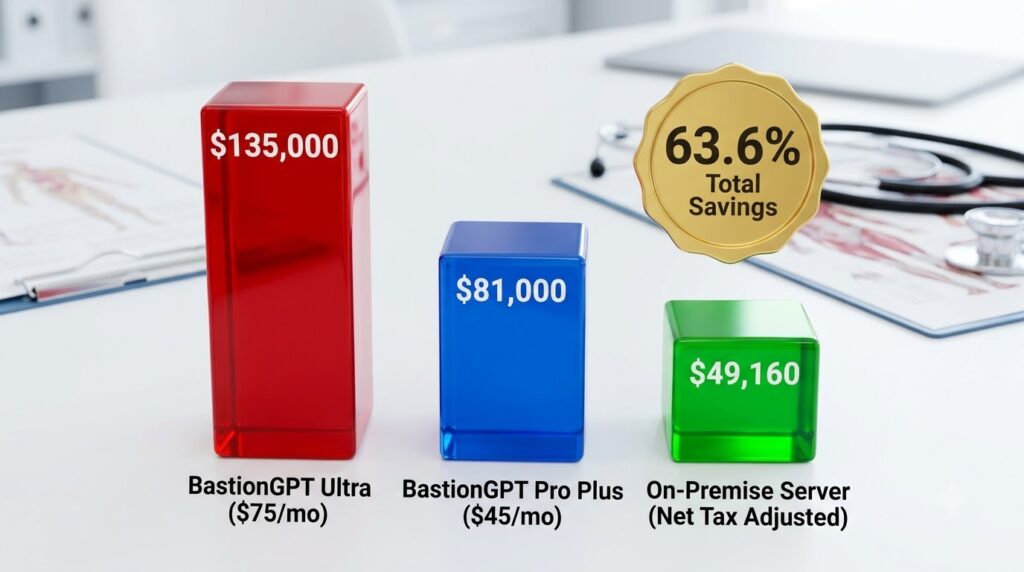
Under IRS Section 179, healthcare organizations purchasing capital hardware can deduct 100% of the equipment purchase price in Year 1. Assuming a 21% corporate tax rate, the $44,000 upfront hardware/software investment yields ~$9,240 in immediate tax savings, dropping the effective net 3-year cost of on-premise hardware to $49,160.
Furthermore, SaaS pricing scales linearly with headcount. Expanding access to 30 additional resident nurses or administrative staff adds $16,200/year to BastionGPT costs, whereas the on-premise server handles additional users with zero incremental licensing cost.
Editor’s Perspective: Deployment Insight
If your organization has fewer than 15 providers and lacks dedicated IT infrastructure, SaaS cloud enclaves offer the lowest friction path to value. Once clinical staff exceeds 20–25 active users, the financial break-even curve aggressively favors purchasing on-premise hardware.
Executive Decision Framework & Strategic Guidance
Which Solution Should You Choose?
- Choose BastionGPT (Cloud Enclave) if:
- You represent a small practice or outpatient clinic (1–10 providers) without internal IT infrastructure.
- Rapid deployment is mandatory, and you want zero upfront capital expenditure.
- Your compliance committee accepts third-party cloud subprocessor chains backed by contractual BAAs.
- Choose On-Premise Medical AI Hardware if:
- You manage a medium-to-large medical center or hospital network (15–250+ providers).
- You handle high-sensitivity clinical specialties where external WAN data egress represents an unacceptable compliance risk.
- Your organization wants to cap recurring costs and maximize long-term ROI via capital asset depreciation (Section 179).
🔍 Related Healthcare AI & Compliance Infrastructure Guides
For healthcare CIOs, medical directors, and compliance officers evaluating clinical AI architecture, explore our related technical analyses and security benchmarks:
- Zanus HIPAA Compliant AI: Read our comprehensive guide on Zanus HIPAA Compliant AI for Healthcare & Hospitals.
- Sovereign & Air-Gapped AI: Discover how local hardware eliminates WAN egress risks in Unlocking Sovereign AI: Why Air-Gapped Zanus AI Servers Win.
- Hardware Pricing & TCO: Compare enterprise hardware tiers and payback models in Zanus AI Server Pricing Guide 2026.
- Zero-Cloud Voice AI: Evaluate sub-300ms local voice agent infrastructure in The Zero-Cloud Zanus AI Call Center Architecture.
- SambaNova RDU vs. GPU: Analyze alternative accelerator hardware for enterprise AI in SambaNova SN40L Pricing & TCO Guide 2026.
References
- BastionGPT Official Documentation & OverviewBastionGPT Software Overview & Pricing
- HIPAA Compliance Guidelines for Large Language ModelsIs ChatGPT / OpenAI HIPAA Compliant? — BastionGPT Analysis
- Zanus Medical AI On-Premise ArchitectureZanus Private On-Premises AI Software & Server Specifications
- NIST Special Publication 800-66 Rev. 2Implementing the Health Insurance Portability and Accountability Act (HIPAA) Security Rule
- HL7 International FHIR Release 4 OverviewHL7 FHIR Infrastructure Standards & Integration Framework