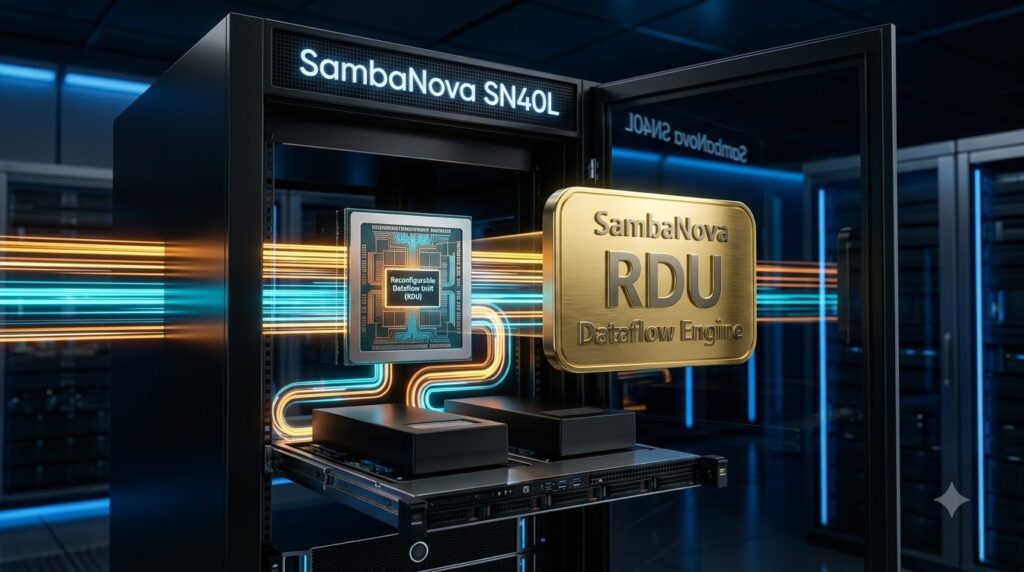
Quick Summary: The AI Infrastructure Shift
When evaluating SambaNova SN40L Pricing and long-term infrastructure investment, enterprise software architecture is undergoing a structural economic shift. For nearly a decade, deploying high-performance artificial intelligence meant buying standard instruction-stream GPUs. However, as enterprise AI evolves from basic conversational bots into multi-agent workflows and multi-trillion-parameter Mixture-of-Experts (MoE) architectures, the limits of standard GPU hardware have become a major operational bottleneck. Memory bandwidth walls, execution stalls, and massive power consumption are forcing enterprises to reassess their underlying infrastructure.
This guide provides a practical, financial, and technical analysis comparing the SambaNova SN40L Reconfigurable Dataflow Unit (RDU) against mainstream enterprise GPU deployments like the NVIDIA H200 and NVIDIA RTX PRO 6000 Blackwell.
                                  +-------------------------------------------------------+
                                  |                 THE ENTERPRISE DECISION               |
                                  +-------------------------------------------------------+
                                                              |
                                  +---------------------------+---------------------------+
                                  |                                                       |
                                  v                                                       v
            +-------------------------------------------+               +-------------------------------------------+
            |      Public Cloud APIs / Traditional GPUs |               |          On-Premise SambaNova SN40L       |
            +-------------------------------------------+               +-------------------------------------------+
            | * Linear, volatile token cost growth      |               | * Fixed, amortized CapEx asset            |
            | * Memory capacity & bandwidth bottlenecks |               | * Terabyte-scale 3-tier memory topology   |
            | * High power & liquid cooling mandates    |               | * Fits standard 10 kW air-cooled racks    |
            | * Third-party data privacy exposure       |               | * Complete air-gapped data sovereignty    |
            +-------------------------------------------+               +-------------------------------------------+
1. Executive Summary: The Rise of Reconfigurable Dataflow Units
The traditional Single Instruction, Multiple Threads (SIMT) execution model used by GPUs introduces severe inefficiencies when handling dynamic AI workloads. In standard GPUs, thousands of core pipelines continuously fetch instructions, schedule thread blocks, and shuttle intermediate tensors across High-Bandwidth Memory (HBM) buses. When running sparse MoE models—where only a fraction of expert networks are routed per generated token—standard GPU clusters must keep the entire model parameter space loaded across dozens of high-cost HBM dies. This forces enterprise teams to deploy massive multi-GPU nodes merely to satisfy memory capacity, leaving valuable compute cores underutilized while driving up energy costs.
  Traditional GPU SIMD Pipeline:
  [Instruction Fetch] -> [Schedule Threads] -> [Fetch HBM Weights] -> [Compute] -> [Bus Contention Stall]

  SambaNova RDU Spatial Dataflow:
  [Data Stream Input] -> [Configured Logic Stages (PCU/PMU Array)] -> [Continuous Execution Pipeline]
SambaNova Systems bypasses this hardware wall with its fourth-generation SN40L Reconfigurable Dataflow Unit (RDU). Built on TSMC’s 5nm process node, the SN40L replaces fixed instruction-fetch pipelines with a spatial dataflow architecture.
Using the SambaNova Composer software compiler, neural network execution graphs are compiled directly into static physical pipelines across an array of Pattern Compute Units (PCUs) and Pattern Memory Units (PMUs). Data streams continuously through configured logic stages, staging weights dynamically across an integrated 3-tier memory system without instruction-fetch stalls or bus contention.
For CTOs, Chief Architects, and Procurement Directors, migrating to spatial dataflow yields three clear business advantages:
- Unbounded Context Processing: By combining on-chip SRAM, HBM3, and terabyte-scale direct-attached DDR5 DRAM, RDUs process 128k+ to multi-million token context windows without requiring complex multi-node tensor partitioning.
- Microsecond Model Switching: Autonomous multi-agent enterprise workflows require instant handoffs between specialized model checkpoints (e.g., orchestrators, domain reasoners, and security guardrails). The SN40L keeps dozens of full model checkpoints in host memory, hot-swapping active execution graphs in microseconds without host CPU intervention.
- Decoupling Costs from Token Metering: As enterprise deployments scale to multi-agent loops processing millions of background tokens daily, public cloud API billing scales exponentially. On-premise RDU infrastructure converts variable utility costs into a predictable capital asset with zero per-token operational metering.
2. Hardware Architecture: SambaNova SN40L vs. NVIDIA Champions
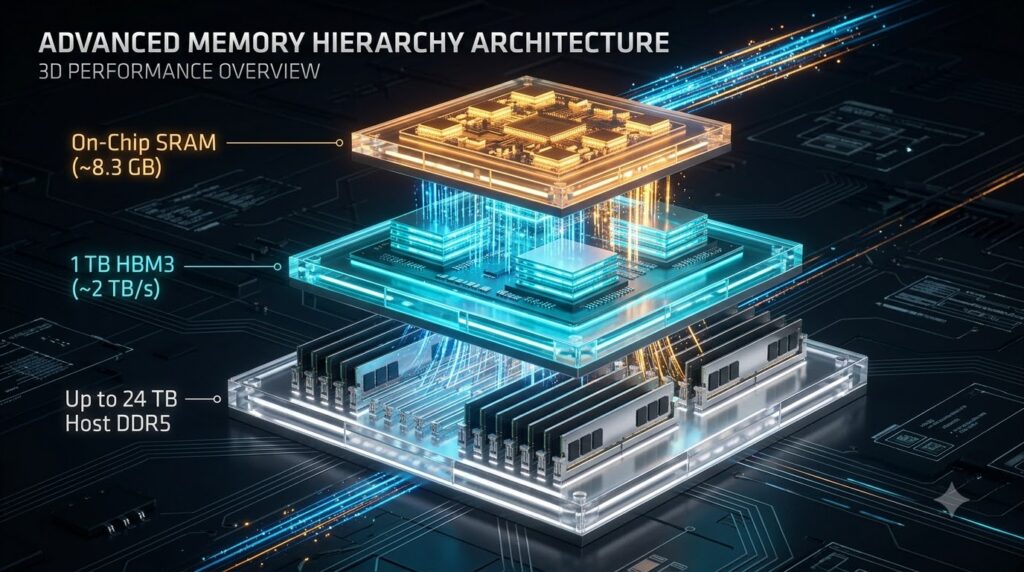
The 3-Tier Memory Hierarchy
Rather than relying strictly on expensive on-package HBM, the SN40L combines three distinct memory tiers managed by the software compiler rather than hardware cache controllers:
+-----------------------------------------------------------------------------------+
|                        SN40L 3-Tier Memory System Architecture                    |
+-----------------------------------------------------------------------------------+
| TIER 1: On-Chip Distributed SRAM (~520 MB / RDU; ~8.3 GB / 16-RDU Rack)            |
| -> Latency: Sub-nanosecond | Purpose: Active Activations & Fused Kernel Execution  |
+-----------------------------------------------------------------------------------+
                                         |
                                         v
+-----------------------------------------------------------------------------------+
| TIER 2: On-Package High-Bandwidth Memory (64 GB HBM3 / Socket; 1 TB / Rack)        |
| -> Bandwidth: ~2 TB/s per Socket | Purpose: Active MoE Experts & Heavy KV Cache   |
+-----------------------------------------------------------------------------------+
                                         |
                                         v
+-----------------------------------------------------------------------------------+
| TIER 3: Direct-Attached Host DRAM (1.5 TB DDR5 / Socket; 12–24 TB / Rack)         |
| -> Bandwidth: >200 GB/s per Socket | Purpose: Cold Experts & Model Bundles        |
+-----------------------------------------------------------------------------------+
- Tier 1: On-Chip Distributed SRAM (~520 MB per RDU / ~8.3 GB per 16-RDU Rack): Provides sub-nanosecond access for active layer activations, intermediate matrix math, and fused spatial kernel pipelines. Processing intermediate data directly on-die eliminates unnecessary read-write cycles to off-chip memory.
- Tier 2: On-Package HBM3 (64 GB per Socket / 1 TB per 16-RDU Rack): Delivers ~2 TB/s bandwidth per socket via TSMC CoWoS packaging. Holds active dense transformer layers, core attention mechanisms, and real-time Key-Value (KV) cache state.
- Tier 3: Direct-Attached Host DDR5 DRAM (Up to 1.5 TB per Socket / 12–24 TB per Rack): Interfaced via dedicated Address Generation and Control Units (AGCUs) on the accelerator die at over 200 GB/s bandwidth. In Mixture-of-Experts architectures, inactive (“cold”) expert parameters reside in this high-capacity DDR5 tier and are dynamically fetched into HBM3 and SRAM only when selected by routing tokens.
Architectural Direct Comparison
| Feature / Metric | SambaNova SN40L (16-RDU Rack) | NVIDIA H200 SXM (8-GPU Node) | NVIDIA RTX PRO 6000 Blackwell (8-GPU Server) |
| Silicon Architecture | Reconfigurable Dataflow (TSMC 5nm) | Hopper GPU Architecture (TSMC 4N) | Blackwell GPU Architecture (TSMC 4N) |
| On-Chip SRAM / L2 Cache | ~8.3 GB Distributed SRAM | ~400 MB L2 Cache | ~400 MB L2 Cache |
| High-Speed On-Package VRAM | 1 TB HBM3 (64 GB/socket) | 1,128 GB HBM3e (141 GB/card) | 768 GB GDDR7 (96 GB/card) |
| Direct System Memory Access | Up to 24 TB Direct DDR5 | System RAM via PCIe Bus | System RAM via PCIe Bus |
| Peak FP8 / BF16 Compute | 10.2 PFLOPS BF16 Native | ~26.7 PFLOPS FP8 | ~12.0 PFLOPS FP8 |
| Max Local Parameter Size | Up to 5 Trillion (MoE / Bundles) | ~700B Dense / ~1.2T MoE | ~400B MoE |
| Power Profile | ~10 kW per Rack | ~10.2 kW per 8-GPU Chassis | ~4.8 kW per 8-GPU Chassis |
Editor’s Perspective: Power & Cooling Realities
Facilities limits are taking over enterprise AI strategy. NVIDIA’s latest multi-GPU cabinets (such as the GB200 NVL72) demand upwards of 120 kW per rack, forcing organizations into expensive facility retrofits for liquid-to-liquid Coolant Distribution Units (CDUs) and direct-to-chip cold plates.
In contrast, the 10 kW operational footprint of a full 16-RDU SambaRack fits directly into standard, air-cooled data center rows using traditional hot/cold aisle containment—saving hundreds of thousands of dollars in facility upgrades before the hardware is even powered on.
3. Configuration & Pricing Structure
SambaNova commercializes its technology through turnkey, integrated hardware-software systems under the SambaRack brand, pre-installed with the SambaStack platform and pre-tuned open-weight foundation models (including DeepSeek R1 and Llama 4).
Hardware Capital Outlay (2026 Baseline Estimates)
| System Configuration | Physical Form Factor | Total Accelerators | Memory Footprint (HBM3 + DDR5) | Estimated Upfront CapEx (USD) | Primary Workload Focus |
| SambaRack SN40L Half-Rack | 19″ Standard Cabinet | 8 RDUs | 512 GB HBM3 + 6 TB DDR5 | $185,000 | Mid-market inference, 70B models, enterprise RAG |
| SambaRack SN40L Full-Rack | 19″ Standard Cabinet | 16 RDUs | 1 TB HBM3 + 12–24 TB DDR5 | $340,000 | Trillion-parameter MoE, long context, agent bundling |
| SambaStack Multi-Rack Cluster | 6-Rack Row Layout | 96 RDUs | 6 TB HBM3 + 72–144 TB DDR5 | $1,950,000 | Enterprise AI Factory & central enterprise substrate |
Note: CapEx estimates include physical chassis, integrated networking switches, SambaStack OS platform licensing, and Year 1 enterprise support.
The Multi-Agent Math: Upfront CapEx vs. Token Metering
When building agentic workflows, a single business query generates multiple internal processing loops:
[User Query]
     │
     ▼
[1. Intent Routing] ──► (2,000 Input Tokens)
     │
     ▼
[2. RAG Retrieval]  ──► (32,000 Input Tokens)
     │
     ▼
[3. Domain Logic]   ──► (8,000 Output Tokens)
     │
     ▼
[4. Code Execution] ──► (4,000 Output Tokens)
     │
     ▼
[5. Guardrail Check]──► (2,000 Output Tokens)
     │
     ▼
[Final Response]    ──► Total: ~48,000 Tokens per Transaction!
Under cloud API utility pricing, scaling these multi-agent workflows across thousands of daily enterprise users creates an unpredictable, rapidly growing operational expense (OpEx). Owning dedicated RDU hardware turns variable per-token fees into a fixed capital asset where the marginal cost per token drops to basic electricity and standard system maintenance.
4. 3-Year TCO Analysis: On-Premise RDU vs. Public Cloud Tokens
To demonstrate the financial breakdown, let’s look at an enterprise running a sustained workload of 5 Billion tokens per month (70% input / 30% output) over a 36-month operational lifecycle.
Baseline Parameters
- Workload: 5B Tokens/Month = 60B Tokens/Year (180B Tokens over 36 months).
- Cloud API Equivalent: Blended average rate of $4.00 per 1M tokens ($2.00/1M input, $8.66/1M output across enterprise frontier tiers).
- On-Premise Hardware: 1x SambaRack SN40L-16 ($340,000 CapEx).
- Facility Power: 10 kW draw at 1.25 PUE = 12.5 kW total power draw @ $0.12/kWh = $13,140/year.
- Maintenance: Year 1 included; Years 2 and 3 billed at 12% of hardware CapEx annually ($40,800/year).
- Colocation Space: Standard rack footprint at $500/month.
36-Month Financial Comparison Table
| Expenditure Category | Public Cloud API Utility | SambaNova SN40L-16 (Gross CapEx) | SambaNova SN40L-16 (Net Tax Adjusted)* |
| Upfront Hardware Acquisition | $0 | $340,000 | $340,000 |
| IRS Sec. 179 Immediate Deduction | $0 | $0 | ($85,000) |
| Net Initial Capital Outlay | $0 | $340,000 | $255,000 |
| Year 1 Operating & Token Costs | $240,000 | $13,140 | $13,140 |
| Year 2 Operating & Token Costs | $240,000 | $13,140 | $13,140 |
| Year 3 Operating & Token Costs | $240,000 | $13,140 | $13,140 |
| Maintenance (Years 2 & 3) | $0 | $81,600 | $81,600 |
| Rack Space (36 Months) | $0 | $18,000 | $18,000 |
| TOTAL 36-MONTH EXPENDITURE | $720,000 | $478,880 | $393,880 |
| NET 3-YEAR SAVINGS | Baseline | $241,120 | $326,120 |
| TOTAL COST REDUCTION | Baseline | 33.5% Savings | 45.3% Savings |

*Note: Net Tax Adjusted calculations assume a combined 25% federal and state corporate tax rate applied to immediate Section 179 equipment write-offs.
IRS Section 179 Tax Offset Benefits
Under US tax guidelines for 2026 equipment acquisitions, IRS Section 179 allows businesses to immediately deduct the full purchase price of qualifying hardware:
- 2026 Section 179 Expense Limit: Up to $2,560,000 with a dollar-for-dollar phase-out starting at $4,090,000.
- Financial Impact: The full $340,000 cost of a SambaRack SN40L-16 fits within the immediate deduction threshold. At a 25% corporate tax rate:
- Tax Shield Formula:Tax Shield = Hardware CapEx × Corporate Tax Rate
- Tax Shield Calculation:$340,000 × 0.25 = $85,000
Payback Horizon & Net Present Value (NPV)
  Monthly Cloud API Cost:    $20,000 / month
- Monthly On-Prem Operating:  $3,862 / month (Power + Maint + Space)
---------------------------------------------------------------------
  Net Monthly Cash Savings:  $16,138 / month

  Payback Horizon = Net CapEx ($255,000) / Monthly Savings ($16,138)
                  = 15.8 Months
Applying an enterprise discount rate of 8.0% per annum over 36 months yields a Net Present Value (NPV) of +$263,485. The investment fully recovers its capital outlay during month 16, delivering pure operational savings for the remainder of its lifecycle.
5. Enterprise Use Cases & Compliance Governance
Context Processing & Model Bundling
On traditional GPU nodes, running sequence lengths over 128,000 tokens causes Key-Value cache sizes to surge, taking up VRAM and lowering overall throughput. The SN40L’s 3-tier memory routes active attention operations to on-chip SRAM while caching larger KV blocks across HBM3 and DDR5, preserving fast token generation speeds even under heavy workloads.
+-----------------------------------------------------------------------------------+
|                        SN40L Software "Model Bundling"                            |
+-----------------------------------------------------------------------------------+
| HOST DDR5 DRAM TIER                                                               |
|  [8B Intent Router]      [70B Reasoning Engine]      [Coder / Domain Agent]   |
+-----------------------------------------------------------------------------------+
                                         │
                         Microsecond Dynamic Hot-Swap
                                         │
                                         ▼
+-----------------------------------------------------------------------------------+
| ACTIVE SN40L EXECUTION PIPELINE (SRAM + HBM3)                                     |
|  --> Executes active task graph instantly without host CPU intervention           |
+-----------------------------------------------------------------------------------+
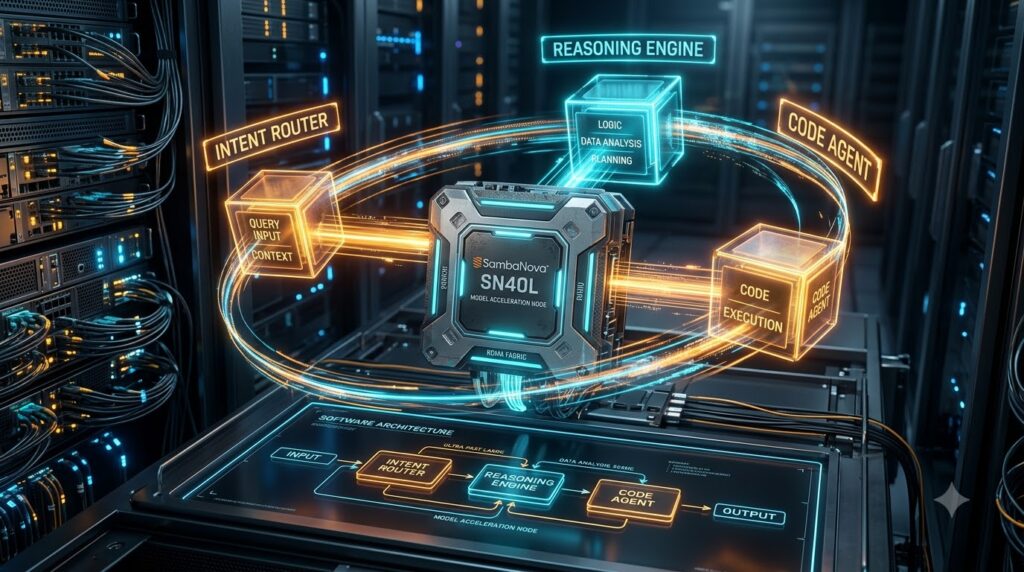
Through Model Bundling, the system keeps multiple specialized models inside host memory simultaneously. When an agent delegates tasks between these tools, the SN40L hot-swaps active execution graphs in microseconds without copying parameters across PCIe buses or restarting runtime engines.
Data Governance & Air-Gapped Deployments
For organizations operating under strict regulatory oversight, running prompts through external public APIs introduces real compliance and security risks:
- SOC 2 Type II Compliance: Keeping hardware on-premise ensures enterprise prompts, context data, and generated tokens stay safely behind the corporate firewall.
- HIPAA Compliance: Healthcare providers processing Protected Health Information (PHI) keep sensitive patient data isolated within their own data center, avoiding complex third-party agreements.
- CMMC 2.0 & FedRAMP High Alignment: Defense contractors and public sector agencies can deploy SambaRack systems in physically isolated, air-gapped data centers. The system operates completely offline without needing remote telemetry or external cloud checks.
6. Strategic Decision Framework & Deployment Roadmap
Decision Matrix
                                  +-------------------------------------------------------+
                                  |            WHAT IS YOUR PRIMARY REQUIREMENT?          |
                                  +-------------------------------------------------------+
                                                              |
                  +-------------------------------------------+-------------------------------------------+
                  |                                                                                       |
                  v                                                                                       v
   [Data Governance & Predictable Cost]                                                    [Low Volume & Utility OpEx]
                  |                                                                                       |
                  v                                                                                       v
+---------------------------------------------------+                   +---------------------------------------------------+
| Choose SambaNova SN40L On-Premise                 |                   | Choose Public Cloud APIs / Cloud GPUs             |
+---------------------------------------------------+                   +---------------------------------------------------+
| * High & predictable volume (>2-3B tokens/mo)     |                   | * Low or variable volume (<1B tokens/mo)          |
| * Mandatory data sovereignty (HIPAA, CMMC, IP)    |                   | * Flexible data privacy policies                  |
| * Multi-agent orchestration & long context        |                   | * Simple single-prompt conversational tasks       |
| * Available air-cooled 10 kW rack capacity        |                   | * Cloud-first model with zero data center footprint|
+---------------------------------------------------+                   +---------------------------------------------------+
90-Day Implementation Plan
  DAYS 1–30                         DAYS 31–60                        DAYS 61–90
  Phase 1: Audit & Tax Strategy     Phase 2: Staging & Integration    Phase 3: Migration & Scaling
  +-----------------------------+   +-----------------------------+   +-----------------------------+
  | * Audit token volumes       |   | * Deliver SambaRack hardware|   | * Configure Model Bundling  |
  | * Check 10 kW rack power    |   | * Hook up 400GbE uplinks    |   | * Redirect API gateways     |
  | * Structure Sec. 179 write-off| | * Initialize SambaStack OS  |   | * Monitor latency & ROI     |
  +-----------------------------+   +-----------------------------+   +-----------------------------+
- Phase 1: Workload Audit & Tax Strategy (Days 1–30):
- Verify that internal token volumes comfortably exceed 2 Billion tokens monthly.
- Confirm data center space for a standard 19-inch rack slot with dual 208V/30A or 400V power feeds (10 kW continuous capacity).
- Consult with internal tax counsel to apply Section 179 deductions for the upcoming purchase.
- Phase 2: Staging & System Integration (Days 31–60):
- Receive and position the pre-integrated SambaRack cabinet within your server room.
- Connect redundant 400GbE or 200GbE network interfaces directly to your internal network backbone.
- Boot up SambaStack OS and compile baseline execution graphs for your target open-weight models (e.g., DeepSeek R1, Llama 4).
- Phase 3: Migration & Production Scaling (Days 61–90):
- Set up microsecond Model Bundling across host memory to power multi-agent workflows.
- Update corporate API gateways and orchestration frameworks (LangChain, LlamaIndex, internal microservices) to point from external endpoints to your internal SambaStack server.
- Monitor token latencies and power consumption as you begin tracking toward a 16-month capital payback.
Decision Checklist: What to Do Next
To choose the right infrastructure path, work through this quick 4-step evaluation:
- [ ] Step 1: Calculate Your Monthly Token VolumeIf your applications consume more than 2–3 billion tokens per month, moving off cloud APIs will generate substantial cost savings.
- [ ] Step 2: Check Your Security & Regulatory MandatesIf you handle sensitive IP, HIPAA PHI, or strict defense data, an air-gapped on-premise RDU provides total data isolation.
- [ ] Step 3: Audit Data Center Power CapacityVerify that your facility has a standard 10 kW, air-cooled 19-inch rack slot available.
- [ ] Step 4: Consult Tax Counsel on IRS Section 179Confirm your eligibility for immediate equipment expense deductions to maximize first-year tax shields.
🔍 Related Enterprise AI Hardware & TCO Guides
If you are evaluating enterprise AI servers, local GPU clusters, or private deployment architectures, explore our related technical reviews and financial benchmarks:
- Zanus AI Server Pricing: Compare hardware tiers and 40-day payback models in our Zanus AI Server Pricing Guide 2026.
- Sovereign & Air-Gapped AI: Discover how local hardware protects sensitive corporate data in Unlocking Sovereign AI: Why Air-Gapped Zanus AI Servers Win.
- Cloud API Tokens vs. Hardware: Analyze the math behind token inflation in Stop Wasting Millions on Cloud Tokens: Zanus AI Server ROI Guide.
- Zero-Cloud Voice AI: Evaluate sub-300ms local voice agent infrastructure in The Zero-Cloud Zanus AI Call Center Architecture.
- Healthcare HIPAA Compliance: Learn how medical systems deploy private LLMs in Zanus HIPAA Compliant AI Guide for Healthcare.
References
- SambaNova Systems Documentation & SN40L SpecificationsSambaRack SN40L-16 System Architecture & RDU Product Overviewhttps://sambanova.ai/products/sambarack-sn40l
- ServeTheHome Enterprise AnalysisSambaNova SN40L RDU for Trillion Parameter AI Modelshttps://www.servethehome.com/sambanova-sn40l-rdu-for-trillion-parameter-ai-models/
- Argonne National Laboratory Leadership Computing FacilityALCF System Overview: SambaNova DataScale & RDU Infrastructurehttps://docs.alcf.anl.gov/
- NVIDIA Enterprise Hardware DatasheetsNVIDIA H200 SXM & RTX PRO 6000 Blackwell Architecture Specificationshttps://www.nvidia.com/en-us/data-center/
- Internal Revenue Service (IRS) Tax GuidanceSection 179 Expense Deduction Limits and Phase-Out Ruleshttps://www.section179.org/