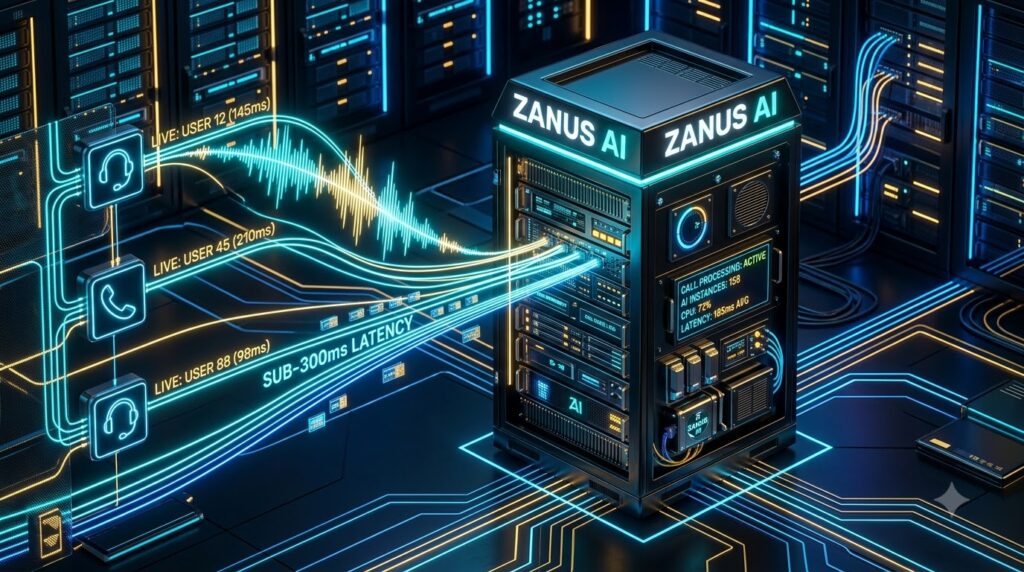
Most enterprise technology leaders evaluating Conversational AI for their contact centers eventually hit the same invisible wall.
They launch an ambitious AI voice agent program built on top of popular cloud APIs. On paper, it looks brilliant: rapid deployment, flexible pricing, and access to state-of-the-art models. But as soon as real customers start calling, the reality sets in.
Calls feel stiff and unnatural. Callers routinely interrupt the agent, collide during turn-taking, or hang up in frustration. Meanwhile, as call volumes scale from thousands to millions of minutes, the finance department raises red flags over skyrocketing, unpredictable monthly API bills.
The problem isn’t your prompts, and it isn’t your choice of model. The problem is the fundamental physics of the multi-tenant cloud API pipeline.
To fix voice AI, enterprises must rethink where and how their conversational stacks run. Here is an independent, technical evaluation of why cloud voice pipelines fail at scale—and how a zero-cloud, hardware-accelerated local architecture (such as the Zanus AI Call Center Architecture) solves the dual crisis of voice latency and operational expenditure.
The Latency and Cost Crisis in Cloud-Based Voice AI
When you build a voice AI stack in the cloud, you aren’t deploying a single cohesive system. You are stitching together a multi-vendor relay race:
- Speech-to-Text (STT) to transcribe incoming customer audio.
- Large Language Model (LLM) to reason and generate a response.
- Text-to-Speech (TTS) to synthesize natural-sounding speech.
- Cloud Orchestration Middleware to pass state and payloads between all three.
While this modular SaaS approach enables rapid prototyping, it introduces severe structural delays and compounding per-minute cost overheads that limit enterprise scalability.
The Anatomy of Latency Amplification
In natural human conversation, the typical gap between speakers is roughly 200 milliseconds. Conversational research shows that pauses up to 500 milliseconds still feel natural. However, the moment an inter-turn gap crosses the 500ms threshold, the human brain registers an awkward silence. Callers begin to ask, “Hello, are you still there?”—causing audio collisions, barge-in failures, and abandoned calls.
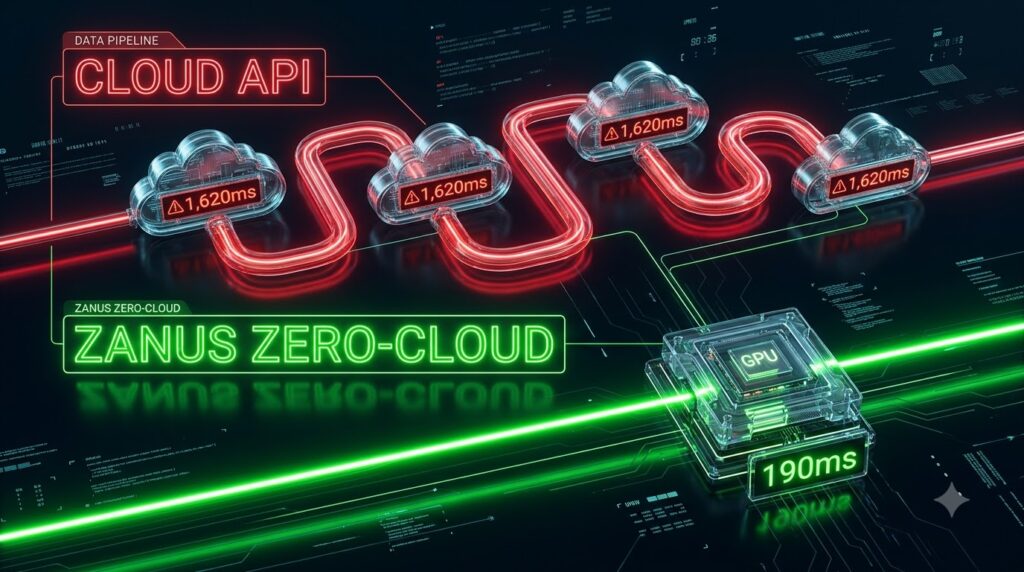
Cloud voice pipelines routinely exhibit total end-to-end response latencies between 1,200ms and 1,800ms. This delay is the unavoidable outcome of multi-hop network transport and remote multi-tenant queueing:
- Ingress Network Transport & Edge Buffering (40–70ms): Incoming audio from the Public Switched Telephone Network (PSTN) reaches a cloud media gateway, where jitter buffering, packet decoding, and WebSocket encapsulation add initial overhead.
- STT Ingestion & Endpointing (100–350ms): Streaming audio buffers traverse public WAN routes to a remote STT API. Acoustic processing and speech endpointing require significant time before emitting a finalized transcript.
- Inter-Service Orchestration Hop (30–80ms): The transcript is serialized and forwarded to a middleware orchestration layer, which packages the payload with prompt templates and long-term conversation context before dispatching an HTTP POST or WebSocket request to an external LLM endpoint.
- LLM Time-To-First-Token / TTFT (150–500ms): Multi-tenant cloud LLMs suffer from variable queueing delays and prefill computation latencies, which spike dramatically during peak usage hours across the cloud provider’s network.
- TTS Synthesis & First-Audio Chunk (100–300ms): Generated tokens stream to a separate cloud TTS engine, which synthesizes audio frames and returns initial PCM/MP3 chunks over the wire.
- Egress Transport & SIP Re-encoding (30–80ms): Audio travels back across public networks to the carrier edge, where it is re-encoded into G.711 or Opus codecs and transmitted to the user’s phone.
Because each layer operates on independent infrastructure across disparate data centers, network transport overhead compounds non-linearly. Tail latency at the 95th percentile (p95) degrades rapidly during peak business hours.
[ PSTN Caller ]
       │ (40-70ms Network Ingress)
       ▼
[ Cloud Media Gateway ]
       │ (100-350ms WAN + Streaming STT)
       ▼
[ Speech-to-Text API ]
       │ (30-80ms Serialization & Orchestration)
       ▼
[ LLM Reasoning API ] ── (150-500ms TTFT Prefill)
       │
       ▼
[ Text-to-Speech API ] ── (100-300ms First-Chunk Synthesis)
       │ (30-80ms Egress Transport)
       ▼
[ PSTN Caller ]  ===> Total Latency: 1,200ms - 1,800ms+ (p95)
The Financial Burden of Cloud API Stacks
The financial challenge of cloud voice AI is just as damaging as the technical one. Instead of capitalizing on fixed compute infrastructure, enterprise organizations pay variable per-minute usage charges stacked across four separate billing layers:
- Telephony Carrier Ingress/Egress: $0.0100 – $0.0150 per minute
- Streaming Speech Recognition (STT): $0.0077 – $0.0120 per minute
- LLM Token Fees (Context + Generation): $0.0150 – $0.0350 per minute
- Neural Text-to-Speech (TTS): $0.0150 – $0.0300 per minute
- Cloud Middleware Platform Markup: $0.0500 – $0.0700 per minute
This results in a blended cost of $0.08 to $0.16 per call minute.
For an enterprise contact center operating 10,000 daily call minutes (300,000 minutes per month), annual operational expenditures for cloud AI APIs reach $255,000 to over $540,000. You are effectively leasing intelligence at retail rates, creating a tax on your growth that scales directly with call volume.
| Pipeline Stage | Representative SaaS Provider | Latency Contribution (p50 / p95) | Variable Cost per Minute |
| Telephony Transport | Twilio / Bandwidth | 40ms / 90ms | $0.0100 – $0.0150 |
| Streaming STT | Deepgram Nova-3 / AssemblyAI | 100ms / 350ms | $0.0077 – $0.0120 |
| LLM Reasoning | OpenAI GPT-4o / Anthropic Haiku | 200ms / 500ms | $0.0150 – $0.0350 |
| Neural TTS | ElevenLabs Flash / Cartesia Sonic | 100ms / 300ms | $0.0150 – $0.0300 |
| Orchestration Layer | SaaS Voice AI Middleware | 30ms / 80ms | $0.0500 – $0.0700 |
| TOTAL PIPELINE | Multi-Vendor Cloud Stack | 470ms / 1,620ms+ | $0.0977 – $0.1620 / min |
Editor’s Perspective: Why Cloud Pipelines Fail at Scale
Deployment Insight: The core flaw in the cloud SaaS voice model is that it treats voice AI as a software integration problem when it is actually an infrastructure problem.
Passing uncompressed audio and token streams across public internet boundaries between four different vendor platforms adds friction at every step. Real-time human conversation cannot tolerate WAN serialization overhead. Until you co-locate media termination, inference compute, and unified memory on local high-speed buses, sub-500ms responsiveness will remain an unachievable marketing claim.
The Zero-Cloud Architecture Alternative: Sub-300ms On-Premise Voice
The Zanus AI Call Center Architecture represents a fundamental shift in how enterprise voice processing is designed. By moving from cloud-hosted APIs to an on-premise, hardware-accelerated local pipeline, it eliminates inter-service network hops and per-minute vendor licensing entirely.
In a zero-cloud architecture, inbound SIP trunks terminate directly on local enterprise media servers (e.g., FreeSWITCH or a self-hosted LiveKit SFU). Audio frames are ingested into host RAM and passed via PCIe Gen5 buses directly into dedicated GPU VRAM. STT recognition, LLM reasoning, and TTS synthesis run within local, co-located CUDA compute contexts.
[ Inbound SIP / PSTN ]
       │ (Local Trunking)
       ▼
[ Enterprise Media Server / Local SFU ]
       │ (Zero-Copy Host RAM to GPU VRAM via PCIe Gen5)
       ▼
┌───────────────────────────────────────────────────────────┐
│              LOCAL GPU SYSTEM (Unified CUDA Memory)       │
│                                                           │
│  ├── Voice Activity Detection (Silero VAD)       [~20ms]  │
│  ├── Streaming STT (TensorRT Whisper / Flux)    [~60ms]  │
│  ├── Local LLM Engine (vLLM FP8 Llama 3.1 8B)   [~70ms]  │
│  └── Neural TTS (Kokoro-82M / ONNX Runtime)     [~40ms]  │
└───────────────────────────────────────────────────────────┘
       │ (Direct Audio Frame Streaming)
       ▼
[ Outbound Local SIP Channel ] ===> Total Latency: 190ms - 300ms (p95)
Breaking Down the Sub-300ms Local Pipeline
By maintaining memory pointers within CUDA unified virtual memory and bypassing public internet transport, a local hardware stack achieves a p50 response latency of ~190ms and a p95 tail latency under 300ms:
- Zero-Copy Ingestion & Local VAD (20ms): Incoming PCM/G.711 audio packets enter host RAM via zero-copy drivers. A lightweight Silero VAD model running on local tensor buffers detects silence thresholds in 200–300ms windows, allowing for instantaneous turn-taking detection.
- TensorRT-Optimized STT (50–80ms): Audio frames stream directly into FP16/INT8 quantized speech models (such as Whisper Turbo or local Deepgram Flux engines) executing on dedicated GPU Streaming Multiprocessors (SMs).
- Optimized Local LLM Serving (40–90ms TTFT): Transcripts feed directly into a local serving engine like vLLM or LMDeploy hosting quantized 8-billion parameter models (e.g., Meta Llama 3.1 8B Instruct FP8). Using PagedAttention, prefix caching, continuous batching, and chunked prefill, TTFT ranges from 40 to 90ms on modern enterprise GPUs like the NVIDIA L40S.
- Local Streaming Speech Synthesis (30–60ms): As initial output tokens emerge from the LLM, they stream into a lightweight, high-fidelity neural TTS model (such as Kokoro-82M or TensorRT-accelerated ONNX engines). Audio frame generation begins on initial sentence fragments, pushing synthesized audio back over local SIP channels within milliseconds.
Hardware Isolation and Resource Allocation
Running high-concurrency STT, LLM, and TTS workloads simultaneously on shared local hardware requires strict compute isolation. Without proper management, GPU memory thrashing and resource contention will cause latency spikes during high-traffic periods.
A zero-cloud architecture solves resource contention through clear hardware separation:
- Hardware Video/Audio Codec Isolation: Media decoding and re-encoding run on dedicated NVDEC/NVENC hardware blocks, keeping media transport off the primary Streaming Multiprocessors.
- Asynchronous Compute Streams via NVIDIA MPS: NVIDIA Multi-Process Service (MPS) isolates GPU SM execution units into dedicated hardware spatial queues. Real-time STT processes are segregated from LLM batch execution tasks, preventing prefill compute spikes from stalling speech recognition.
- PagedAttention KV Cache Pools: Local vLLM instances reserve fixed GPU VRAM allocations. Context histories are managed as virtual page tables, preventing VRAM fragmentation during unexpected calling surges.
- Sub-20ms Interruption Handling (Barge-In): When local VAD detects incoming user speech during agent audio playback, the signal orchestrator instantly drops pending TTS queues and flushes CUDA generation buffers within 20ms, preventing overlapping speech.
| Component Layer | Technology / Model Target | Hardware Execution Context | Average Latency (p50) | Tail Latency (p95) |
| Media Transport / VAD | LiveKit SFU / Silero VAD | CPU Host RAM / PCIe Gen5 | 20 ms | 30 ms |
| Speech Recognition | TensorRT Whisper Turbo / Flux | GPU CUDA SMs (Isolated) | 60 ms | 90 ms |
| LLM Reasoning | Meta Llama 3.1 8B FP8 (vLLM) | GPU Tensor Cores (FP8) | 70 ms | 120 ms |
| Speech Synthesis | Kokoro-82M / ONNX Runtime | GPU Tensor Cores / CUDA | 40 ms | 60 ms |
| TOTAL PIPELINE | Zero-Cloud On-Premise Engine | Local Hardware System | 190 ms | 300 ms |
Real-World Operational Impact: Inbound & Outbound Capabilities
Transitioning to an on-premise architecture isn’t just about speed—it transforms what your contact center can achieve operationally.
Inbound Support & Intelligent Routing
In a cloud environment, retrieving customer context from an internal database means firing off HTTP REST requests across the WAN, adding 200–500ms before the agent even knows who is calling.
With an on-premise deployment:
- Sub-5ms Profile Retrieval: Upon SIP signal termination, the local orchestrator extracts caller ID data (ANI) and queries local database mirrors (e.g., PostgreSQL or Redis) over 10GbE network interfaces, pulling customer profiles, past tickets, and buying context instantly.
- Zero-Cost Context Prompts: Because you aren’t paying per-token API fees, you can inject comprehensive system prompts, policy guidelines, and full interaction histories into the LLM context window without inflating operational costs.
- Warm Human Escalation: If an inquiry requires human intervention, the system initiates a warm SIP transfer, passing full transcript histories and intent state to the human agent’s dashboard before the call connects.
Outbound Campaigns & Compliance Engineering
Outbound automated dialing across cloud voice APIs is notoriously expensive and legally risky. Operating an on-premise stack alters the equation:
- Unconstrained Scale: Outbound campaigns scale across local GPU streams and wholesale SIP trunks. Once hardware costs are amortized, the marginal processing cost per call minute is essentially zero.
- Sub-100ms Answering Machine Detection (AMD): Local acoustic classification models evaluate initial audio frames, identifying automated voicemail systems and adjusting agent behavior within 100ms.
- Automated Compliance Verification: Before dialing, local lead lists are validated against local, continuously updated Do Not Call (DNC) registries and TCPA consent records in your CRM. Automated time-of-day boundary rules enforce calling windows based on area codes without exposing customer phone numbers to third-party APIs.
Data Privacy, Security, and Regulatory Governance
For enterprise organizations in healthcare, financial services, legal, and government sectors, processing voice interactions through multi-tenant cloud APIs introduces severe regulatory exposure.
CLOUD ARCHITECTURE (Data Exposure Risk):
[ Caller ] ──> [ Telecom ] ──> [ SaaS STT ] ──> [ SaaS LLM ] ──> [ SaaS TTS ]
                                  └── Third-party logging, retention, and breach risks

ZERO-CLOUD ARCHITECTURE (Air-Gapped Security Boundary):
┌────────────────────────────────────────────────────────────────────────────┐
│ ENTERPRISE DATA CENTER FIREWALL                                           │
│                                                                            │
│ [ Caller ] ──> [ Encrypted SIPS/SRTP ] ──> [ On-Premise GPU Engine ]       │
│                                                   │                        │
│                                                   ▼                        │
│                                        [ Local PII Redaction ]             │
│                                                   │                        │
│                                                   ▼                        │
│                                        [ AES-256 Storage / HSM ]           │
└────────────────────────────────────────────────────────────────────────────┘
Eliminating Third-Party Data Leakage
Routing customer audio through external SaaS environments forces enterprises to trust third-party data retention, logging, and model-training policies. This creates significant friction under key regulatory regimes:
- HIPAA Compliance: Streaming Protected Health Information (PHI) across third-party voice APIs requires formal Business Associate Agreements (BAAs) with every single vendor in the stack. A breach at any individual API provider exposes the primary enterprise to massive legal liability.
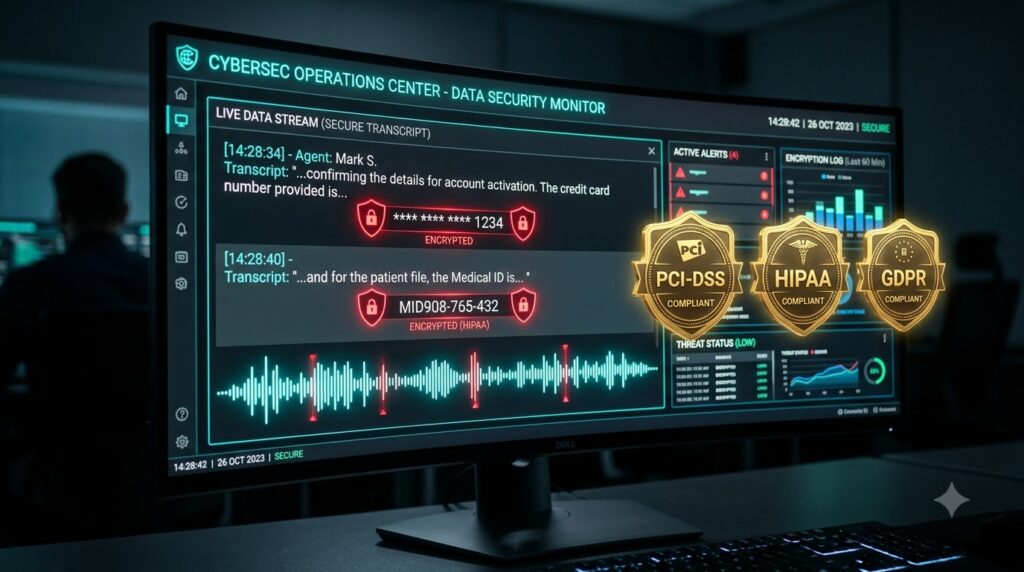
- PCI-DSS Standards: Processing credit card details during voice support calls mandates strict PCI-DSS controls. Streaming unencrypted Primary Account Numbers (PANs) over public networks to external LLMs violates core data handling protocols.
- CCPA / CPRA / GDPR: Privacy regulations grant consumers the right to request full data deletion. Tracing, deleting, and auditing voice transcripts scattered across multiple third-party vendor logs is an operational nightmare.
Local Security Governance
An on-premise architecture establishes an absolute security boundary around telephony and AI workloads:
- Encrypted Media Streams: Telephony signaling and media streams are encrypted using SIPS and SRTP directly to the local data center.
- On-Premise PII/PHI Redaction: Transcripts pass through a local Named Entity Recognition (NER) pipeline that automatically strips credit card numbers, social security records, and health information before writing data to disk.
- Local Hardware Key Management: Recordings and transcripts are encrypted at rest using AES-256 keys managed by on-premise Hardware Security Modules (HSMs). No telemetry or conversation logs ever cross the corporate firewall.
12-Month Financial ROI Model & TCO Analysis
To demonstrate the financial impact of transitioning from cloud API stacks to a local GPU architecture, consider this 12-month Total Cost of Ownership (TCO) evaluation for an enterprise contact center handling 10,000 call minutes per day (300,000 minutes/month or 3.65 million minutes/year).
Operational Workload Baseline
- Daily Volume: 10,000 minutes
- Annual Volume: 3,650,000 minutes
- Peak Concurrent Streams: 80 active full-duplex calls
- Hardware Profile: One enterprise 2U server equipped with dual NVIDIA L40S GPUs (48GB VRAM each) handles 32–40 concurrent full-duplex voice streams. To provide N+1 redundancy and handle peak traffic bursts, the architecture uses two 2U enterprise servers housing a total of four NVIDIA L40S GPUs.
Detailed Financial Breakdown
Option A: Cloud API Stack
- Blended API & Telephony Cost: $0.0800 per minute
- Total Annual Operational Cost: $3,650,000 \times \$0.0800 = \mathbf{\$292,000/year}$
Option B: Zero-Cloud On-Premise Architecture
- Capital Expenditure (CapEx – Year 1 Only):
- 2x Enterprise 2U Servers (Dual AMD EPYC CPUs, 256GB ECC RAM, 4TB Enterprise NVMe): $15,000
- 4x NVIDIA L40S 48GB GPU Accelerators ($8,000 each): $32,000
- Enterprise Networking & Rack Hardware: $3,000
- Total Initial CapEx: $50,000
- Annual Operational Expenditure (OpEx):
- Data Center Colocation & Power (1x 42U Rack, ~3.5kW Draw): $9,600 / year
- Wholesale Direct SIP Trunking ($0.0030 / min): $10,950 / year
- Hardware Maintenance Reserve & Support: $6,000 / year
- Total Annual OpEx: $26,550/year
| Financial Parameter | Cloud API Stack (SaaS) | Zero-Cloud Architecture | Net Advantage |
| Initial Hardware CapEx | $0 | $50,000 | Cloud +$50,000 |
| Variable Cost per Minute | $0.0800 | $0.0030 (SIP Telephony Only) | Zero-Cloud -$0.0770 / min |
| Annual Telephony / API Fees | $292,000 | $10,950 | Zero-Cloud -$281,050 |
| Annual Hosting & Power | $0 | $15,600 | Cloud +$15,600 |
| Year 1 Total Cost (TCO) | $292,000 | $76,550 | Zero-Cloud Saves $215,450 |
| Year 2 Total Cost (TCO) | $292,000 | $26,550 | Zero-Cloud Saves $265,450 |
| 3-Year Cumulative TCO | $876,000 | $129,650 | Zero-Cloud Saves $746,350 |

The Payback Period Calculation
$$\text{Payback Period} = \frac{\text{CapEx}_{\text{Hardware}}}{\left(\frac{\text{TCO}_{\text{Cloud}}}{12}\right) – \left(\frac{\text{OpEx}_{\text{Annual Zanus}}}{12}\right)}$$
$$\text{Payback Period} = \frac{\$50,000}{\left(\frac{\$292,000}{12}\right) – \left(\frac{\$26,550}{12}\right)} = \frac{\$50,000}{\$24,333 – \$2,212} = \mathbf{2.26\text{ Months}}$$
The enterprise fully recovers its initial $50,000 hardware investment within 2.3 months of deployment. Over a 3-year lifecycle, the zero-cloud architecture reduces total voice operating costs from $876,000 to $129,650—achieving an overall 85.2% cost reduction while immunizing the organization against third-party API price increases.
Editor’s Perspective: Strategic Deployment Trade-offs
Operational Impact: Choosing between a cloud API stack and an on-premise architecture is ultimately a strategic trade-off between speed-to-market and operational independence:
- Choose Cloud APIs if: You process under 50,000 total call minutes per year, need to deploy a proof-of-concept in days, and do not handle strict PII/PHI data.
- Choose Zero-Cloud On-Premise if: You handle over 100,000 call minutes per year, require sub-300ms latency for fluid natural conversations, or operate under strict regulatory compliance frameworks.
Implementation Roadmap for Technical Teams
If your organization decides to build or transition to a zero-cloud voice AI deployment, follow this phased implementation path:
┌─────────────────────────────────────────────────────────────┐
│ PHASE 1: Hardware Provisioning & Telephony Direct Trunking  │
│  - Install Dual 2U GPU Servers (e.g., 4x NVIDIA L40S)       │
│  - Establish Direct Encrypted SIP Trunks (SIPS/SRTP)        │
└──────────────────────────────┬──────────────────────────────┘
                               │
                               ▼
┌─────────────────────────────────────────────────────────────┐
│ PHASE 2: Inference Stack Optimization & Tuning              │
│  - Deploy vLLM / LMDeploy with FP8 Llama 3.1 8B             │
│  - Configure TensorRT Whisper Turbo & Kokoro-82M TTS        │
│  - Tune Silero VAD Silence Thresholds (200-300ms)           │
└──────────────────────────────┬──────────────────────────────┘
                               │
                               ▼
┌─────────────────────────────────────────────────────────────┐
│ PHASE 3: Local CRM Integration & Governance Controls         │
│  - Connect Local Databases over 10GbE Network Links         │
│  - Insert On-Premise PII Redaction Engines (NER)            │
│  - Enforce DNC & TCPA Compliance Logic                      │
└──────────────────────────────┬──────────────────────────────┘
                               │
                               ▼
┌─────────────────────────────────────────────────────────────┐
│ PHASE 4: Hardware Isolation & Production Rollout            │
│  - Enable NVIDIA MPS for GPU Spatial Partitioning           │
│  - Execute Phased Traffic Migration & Monitor p95 Latency   │
└─────────────────────────────────────────────────────────────┘
- Phase 1: Hardware Provisioning & Network Termination: Install redundant 2U enterprise GPU servers in your local data center or enterprise colocation rack. Connect redundant 10GbE interfaces to internal database switches and terminate direct encrypted SIP trunks on local media software.
- Phase 2: Local Model Deployment & Optimization: Deploy vLLM or LMDeploy instances serving FP8-quantized 8B parameter models. Bind TensorRT-optimized Whisper models to dedicated CUDA execution streams and configure low-latency streaming neural TTS engines. Tune VAD endpoints to 200–300ms windows.
- Phase 3: Integration & Compliance Rules: Connect the voice orchestrator to local database mirrors via high-speed connectors for instant record retrieval. Insert local PII redaction engines into transcript pipelines and apply automated TCPA/DNC verification rules to outbound scripts.
- Phase 4: Hardware Spatial Isolation & Phased Rollout: Activate NVIDIA Multi-Process Service (MPS) to partition GPU compute units between real-time STT streaming and LLM generation. Benchmark initial live calls to confirm sub-300ms p95 latency under load before scaling traffic to 100% capacity.
Final Recommendation: What Should You Do Next?
Enterprise technology decisions should never be based on marketing hype. They should be driven by unit economics, user experience, and risk mitigation.
- If you are currently spending over $10,000 per month on cloud voice AI APIs: Audit your monthly API usage across STT, LLM, TTS, and orchestration fees. Calculate your total cost per call minute and run a hardware payback model against your actual call volume.
- If your callers are complaining about lag or conversational collisions: Benchmark your current pipeline’s p95 Time-To-First-Token and end-to-end latency. If your latency consistently exceeds 800ms, cloud API network transport is actively damaging your customer experience.
- If you handle sensitive medical, financial, or corporate voice data: Conduct a privacy audit of your current SaaS voice vendors. Determine whether unencrypted customer audio or transcript logs are being stored in external third-party environments.
By shifting from cloud-based SaaS stacks to an on-premise, zero-cloud architecture, enterprises gain complete ownership over their infrastructure, protect customer privacy, deliver fluid sub-300ms interactions, and permanently reduce operational costs.
🔍 Related Enterprise AI Infrastructure & Deployment Guides
If you are evaluating local AI server deployments, TCO models, or security compliance frameworks for your enterprise, explore our related technical reviews:
- Financial & Pricing Breakdown: Compare hardware tier costs and tax incentives in our Zanus AI Server Pricing Guide 2026.
- Data Sovereignty & Security: Learn how air-gapped setups protect local data in our guide on Unlocking Sovereign AI: Why Air-Gapped Zanus AI Servers Win.
- Hardware Architecture: Deep dive into local GPU VRAM, PCIe Gen5 buses, and NVMe arrays in the Zanus AI Hardware Specification Review.
- Full Platform Review: Read our comprehensive evaluation of software OS modules in the Zanus AI Platform Review.
- Appliance vs. Server: Compare turnkey appliances with dedicated nodes in Zanus AI Appliance vs. Dedicated AI Server.
References
- Twilio: Core Latency in AI Voice Agents
- LiveKit: Voice Agent Architecture: STT, LLM, and TTS Pipelines Explained
- Retell AI: How Real-Time Voice AI Actually Works (STT → LLM → TTS)
- PC Server & Parts: Enterprise GPU Server Buying Guide: L40S Sizing for AI Workloads
- vLLM Project: vLLM Distributed LLM Serving Engine Documentation
- LMDeploy: High-Performance LLM Inference & Serving Toolkit
- ElevenLabs: Latency Optimization & Streaming Speech Synthesis Guidelines
- Federal Communications Commission (FCC): Telephone Consumer Protection Act (TCPA) Compliance Rules