Quick Summary
For enterprise decision-makers handling confidential intellectual property, defense contracts, or strictly regulated patient data, deploying Sovereign AI architecture has become an urgent mandate. Public cloud Large Language Models (LLMs) present a growing compliance liability. Zanus AI delivers fully air-gapped, on-premises private AI servers designed to eliminate data exfiltration risks and comply with stringent regulatory mandates (such as CMMC 2.0, NIST SP 800-171, HIPAA, and the EU AI Act).
If your organization must guarantee zero data egress while preserving local document intelligence capabilities, on-premises hardware like Zanus offers a turnkey path to complete data sovereignty.
The 2026 Regulatory Landscape: Data Sovereignty vs. Cloud LLMs
The integration of LLMs into core enterprise workflows has created a sharp operational conflict between computational capability and legal compliance. While cloud AI services provide convenience, they introduce structural vulnerabilities that put sensitive assets at risk—including proprietary source code, patient records, trade secrets, and Controlled Unclassified Information (CUI).
Achieving true sovereign AI requires clear distinctions between three concepts that are frequently conflated:
| Dimension | Conceptual Definition | Operational Scope | Legal & Exposure Risk |
| Data Residency | Physical geographic location where data bits reside at rest or are processed in memory. | Constrained to specific cloud facilities or server regions. | High exposure to parent-company jurisdiction and extraterritorial search warrants. |
| Data Localization | Statutory mandates requiring specific data types to remain within defined national borders. | Enforced through national border controls and regional hosting mandates. | Subject to local regulatory mandates and host-nation judicial orders. |
| Data Sovereignty | Absolute legal jurisdiction and exclusive technical control over the data lifecycle, models, and prompts. | Enforced through hardware-level isolation, local key ownership, and physical air-gaps. | Zero third-party exposure; immune to foreign discovery orders and cloud subpoenas. |
Extraterritorial Jurisdiction and Cloud Exposure
Hosting models in public cloud environments—even within localized regional data centers—leaves organizations exposed to extraterritorial discovery statutes like the United States CLOUD Act. Under these laws, foreign and domestic agencies can compel US-incorporated hyperscalers to surrender stored data regardless of local hosting agreements.
Enforcing Global Regulatory Frameworks
Concurrently, major international compliance frameworks penalize cloud-based data leaks and unmonitored prompt transmissions:
- EU AI Act (Regulation EU 2024/1689): High-risk AI use cases—such as automated screening, financial scoring, and legal document analysis—face stringent mandates under Article 10 (data governance and lineage tracking) and Article 12 (automated operational logging). Non-compliance penalties reach up to €35 million or 6% of global annual turnover. The European Data Protection Board (EDPB) has warned that general-purpose cloud APIs rarely satisfy strict GDPR requirements for complete data erasure or anonymization.
- US Federal & Defense Standards: Executive Memorandum OMB M-24-10 mandates transparent AI inventories and strict privacy management across federal agencies. For Defense Industrial Base (DIB) contractors, CMMC 2.0 Level 2 and NIST SP 800-171 require strict enforcement across 110 security controls. Self-attestation is no longer sufficient; third-party audits (C3PAO) require verifiable hardware-level boundaries when handling CUI.
For enterprises handling high-sensitivity data, multi-tenant public cloud LLMs present acceptable risk levels that are increasingly difficult to justify.
Technical Architecture: How Air-Gapped Zanus AI Servers Work
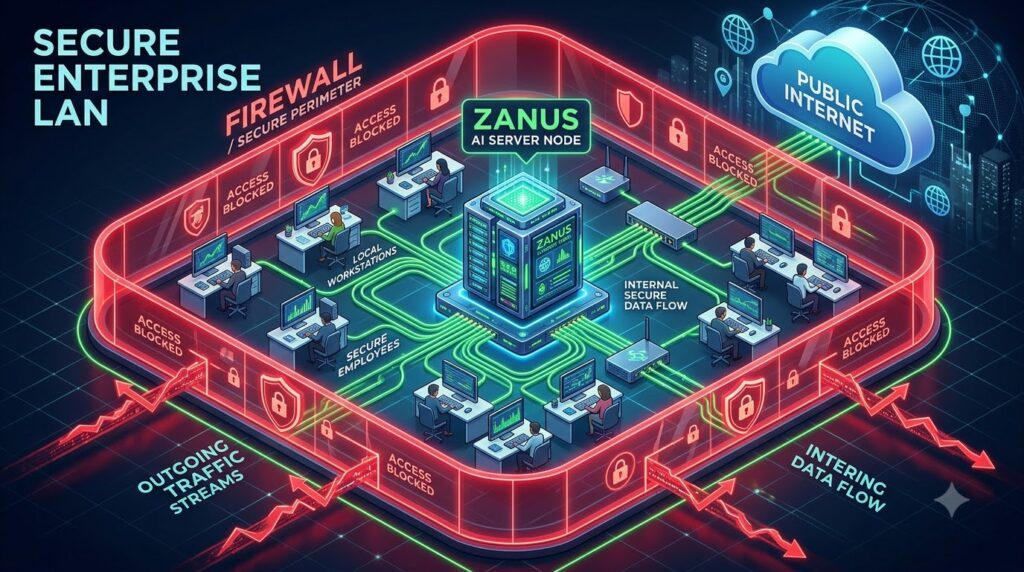
Transitioning away from cloud APIs requires an infrastructure capable of local inference and document indexing with zero outbound dependencies. Zanus AI builds turnkey private hardware appliances running proprietary AI operating systems, local vector databases, and open-weight language models inside the enterprise’s physical perimeter.
+-----------------------------------------------------------------------------------+
|                        ENTERPRISE SECURE LAN PERIMETER                            |
|                                                                                   |
|  +--------------------+         +----------------------------------------------+  |
|  |  User Client / WS  | <-----> |   Local Network Switch (IEEE 802.1X / LDAPS)   |  |
|  +--------------------+         +----------------------------------------------+  |
|                                                        |                          |
|                                                        v                          |
|                                 +----------------------------------------------+  |
|                                 |             ZANUS PRIVATE AI SERVER          |  |
|                                 |                                              |  |
|                                 |  +----------------------------------------+  |  |
|                                 |  | On-Premises Precision Vector Store     |  |  |
|                                 |  | (50M+ Docs, Local ACL Mapping)          |  |  |
|                                 |  +----------------------------------------+  |  |
|                                 |                      |                       |  |
|                                 |                      v                       |  |
|                                 |  +----------------------------------------+  |  |
|                                 |  | Dedicated Hardware / Enterprise GPUs    |  |  |
|                                 |  | (Containerized vLLM/TGI Engine)          |  |  |
|                                 |  +----------------------------------------+  |  |
|                                 +----------------------------------------------+  |
+-----------------------------------------------------------------------------------+
                                         X (NO WAN / EGRESS)
                                         |
                                         v
                                [ PUBLIC INTERNET ]
Physical Hardware Isolation vs. Virtual Cloud Tenants
Public cloud providers use virtual tenant isolation managed by hypervisors and software-defined networks. This setup leaves enterprise data vulnerable to hypervisor escape exploits, cross-tenant side-channel attacks, CPU/GPU cache leakage, and identity misconfigurations.
An air-gapped Zanus server replaces virtual boundaries with physical hardware isolation. Severing all external wide-area network (WAN) connections ensures that zero telemetry data, licensing pingbacks, or diagnostic logs egress to third-party endpoints. All processing occurs on dedicated physical GPUs inside your facility.
Hardware Sizing & Scalability Tiers
To match specific departmental workloads, Zanus structures its hardware options across dedicated deployment tiers:
| Zanus Server Tier | Architectural Configuration | Target Deployment & Capacity |
| Zanus AI Prime | Single-node appliance; dedicated GPU compute; onboard NVMe storage array; native Zanus OS. | Small teams and localized document repositories; low-concurrency RAG search workflows. |
| Zanus AI Quantum | Mid-tier appliance; high-throughput GPU arrangement; expanded unified system memory. | Departmental deployments, multi-user concurrent RAG, and automated workflow execution. |
| Zanus AI Enterprise Cluster (ZAI-PES-7700) | Multi-node cluster; scalable aggregate GPU pools; high-speed interconnects; unified Precision Vector Store. | Enterprise-wide scale; linear throughput scaling (e.g., 2 nodes for 100 concurrent users; 10 nodes for 500+ users). |
On-Premises Local RAG Lifecycle
Retrieval-Augmented Generation (RAG) lets models query internal documentation without sending data off-site. The Zanus AI platform executes the complete RAG lifecycle locally using an integrated Precision Vector Store capable of indexing over 50 million documents:
- Local Ingestion: Internal document repositories (PDFs, SQL databases, CRMs, emails) are ingested over local network connections.
- Access Control Mapping: Document-level Access Control Lists (ACLs) are attached directly to text chunks, mirroring Active Directory/LDAP permission structures.
- Local Embedding Generation: On-premises embedding models process chunks using local GPUs without external API calls.
- Hardware-Accelerated Indexing: Generated vector representations are written to the native Precision Vector Store for fast local searching.
- Contextual Retrieval: Prompts convert to vector search queries, filter against the user’s explicit ACL rights, and inject authorized context into the local prompt buffer.
- Localized Inference Execution: The context-enriched prompt runs inside containerized local engines (such as vLLM or TGI) on internal GPU VRAM, returning synthesized responses with zero outbound data flow.
Security Comparison: Air-Gapped Zanus vs. Public Cloud Subscriptions
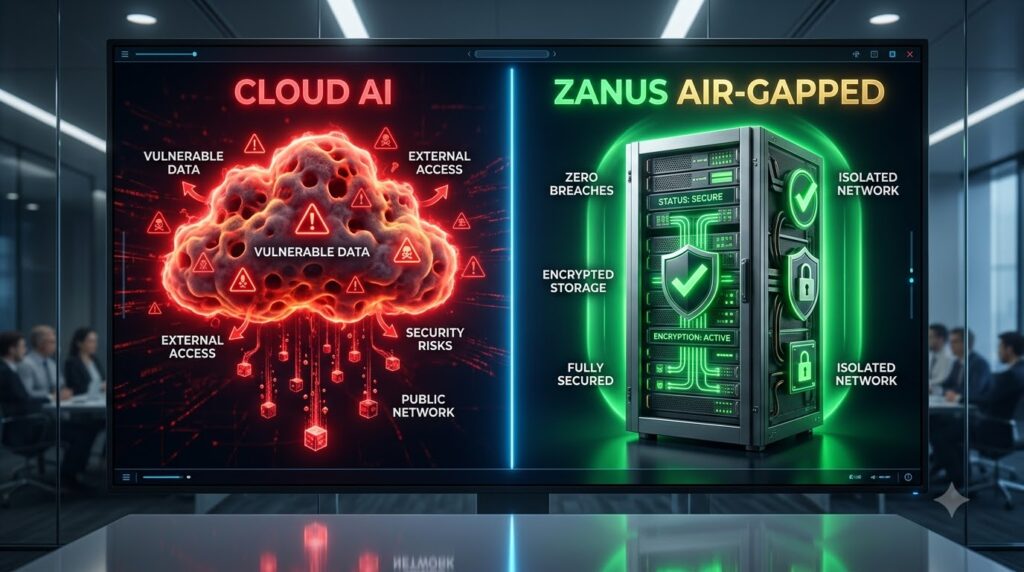
Enterprise IT teams often evaluate enterprise SaaS subscriptions—such as ChatGPT Enterprise or Microsoft Copilot—under the assumption that contractual SLAs fully eliminate security risks. However, cloud architectures retain structural risk factors that are eliminated in air-gapped setups.
Security Vulnerabilities in Cloud AI Subscriptions
- Diagnostic Telemetry and Logging: Cloud providers record API performance metrics, system prompts, and diagnostic metadata. Even when agreements specify that data won’t train general models, prompt content travels through multi-tenant API gateways, logging pools, and edge caches—leaving a digital footprint susceptible to foreign discovery requests or insider threats.
- Data Over-Permissioning via Microsoft Graph: Microsoft Copilot relies on the Graph API to search across SharePoint, Teams, and OneDrive based on user rights. In many organizations, broad access settings, stale sharing links, and inherited permissions lead to permission sprawl. Copilot inherits these flaws, surfacing sensitive compensation data, internal legal discussions, or strategic plans to unauthorized users.
- API Key Leakage and Prompt Injections: Cloud setups rely on third-party API tokens that can be exposed through developer environments or compromised code repositories. Additionally, indirect prompt injection attacks can manipulate cloud-connected AI agents into transmitting data to unauthorized external webhooks.
Comparative Feature Matrix
| Security & Compliance Feature | Public Cloud AI (e.g., ChatGPT Enterprise) | Cloud Workspace AI (e.g., Microsoft Copilot) | Zanus Air-Gapped Private Server |
| Physical Boundary | Multi-tenant public cloud data centers | Multi-tenant Azure cloud infrastructure | Owned, on-premises physical hardware appliance |
| Network Requirement | Continuous outbound HTTPS/WAN connection | Continuous connection to Microsoft 365 cloud | 100% Air-Gapped; zero outbound WAN traffic |
| Data Perimeter | Sent over public networks to vendor edge services | Processed through Microsoft Graph / Azure APIs | Confined entirely to internal local network |
| Access Rights Control | User-managed API scopes | High risk from broad inherited Graph rights | Local row-level ACL enforcement |
| Telemetry Exposure | Diagnostic logs stored by third-party vendor | Diagnostic metadata retained in vendor cloud | Local, immutable logs; zero vendor access |
| Extraterritorial Risk | High; subject to vendor-directed subpoenas | High; subject to US CLOUD Act discovery | Zero; physical ownership prevents foreign discovery |
| Cost Predictability | Per-user/month SaaS or dynamic token fees | Per-user/month recurring enterprise subscription | Fixed capital asset; zero per-token or monthly fees |
| Defense Alignment | Requires complex FedRAMP High configurations | Requires dedicated GCC High cloud tenants | Native physical isolation aligns with NIST SP 800-171 |
Editor’s Take & Implementation Guide
Editor’s Perspective: Why Infrastructure Wins Over API Keys
If your enterprise processes sensitive proprietary data, operates within regulated defense frameworks, or faces stringent European data governance rules,
Then adopting an air-gapped on-premises platform like Zanus AI provides a more reliable security posture than relying on public cloud SLAs,
Because physical control over GPUs, vector stores, and local network boundaries structurally removes third-party legal exposure, prompt logging risks, and unexpected API changes.
Offline Maintenance and Updating
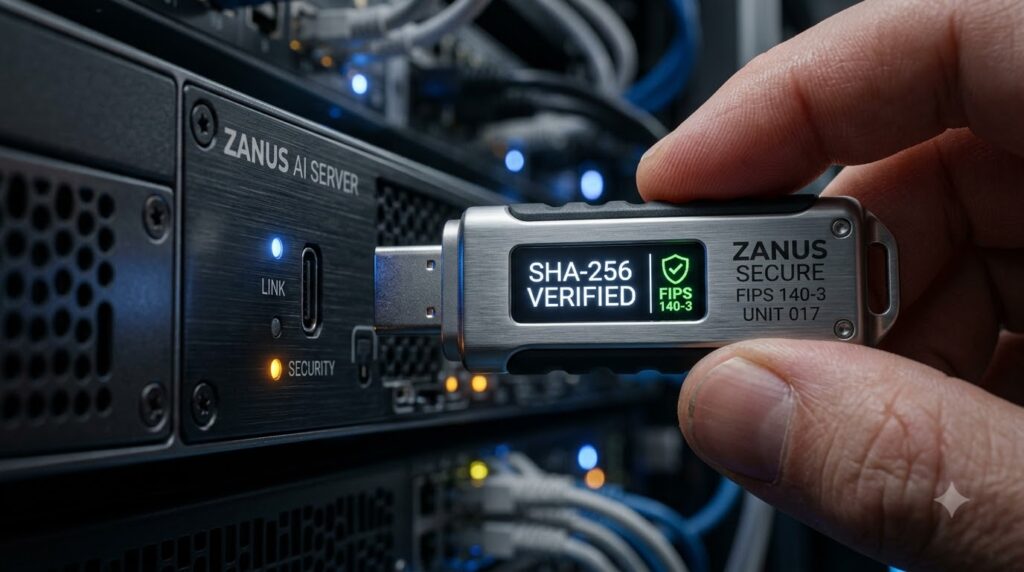
Maintaining an air-gapped system requires clear processes for applying security patches and updated model weights without opening network vulnerabilities. A standardized offline pipeline includes:
- Package Acquisition: Downloading signed software updates and open-weight models using an isolated, internet-connected staging machine.
- Integrity Checks: Validating SHA-256 checksums and digital signatures against official vendor keys, alongside static binary analysis.
- Encrypted Transfer: Writing approved updates to FIPS 140-3 validated, hardware-encrypted physical media.
- Local Patching: Connecting physical media to the server’s console port to run automated internal update scripts. Enterprise Clusters apply rolling updates across nodes to maintain system availability.
- Media Sanitization: Sanitizing transfer drives according to NIST SP 800-88 standards prior to reuse.
Regulatory Compliance Alignment
Deploying Zanus private hardware simplifies compliance across core framework standards:
- NIST SP 800-171 / CMMC 2.0 Level 2: Directly addresses key control families including Access Control (3.1) via Active Directory ACL mapping, Audit & Accountability (3.3) through local immutable logging, Media Protection (3.8) using local FIPS-compliant NVMe encryption, and System Protection (3.13) through physical network isolation.
- HIPAA Security Rule: Keeps Electronic Protected Health Information (ePHI) strictly within internal systems during local RAG searches. This avoids sending ePHI to third-party endpoints and removes the need for external Business Associate Agreements (BAAs) for AI processing.
- SOC 2 Type II: Supports core Trust Services Criteria—including Security (by removing public API vectors), Confidentiality (by securing stored vectors with local ACLs), and Availability (by insulating local inference from cloud outages and third-party rate limits).
Strategic Recommendations: 90-Day Enterprise Roadmap
To move from public cloud dependence to sovereign AI infrastructure, enterprise technology leaders should consider a phased 90-day plan:
- Phase 1: Shadow AI Audit & Endpoint Containment (Days 1–30)Audit network activity to identify unapproved employee use of external cloud LLMs. Update acceptable-use policies to restrict sending sensitive code, financial records, CUI, or patient data to public APIs, while blocking unapproved outbound AI endpoints at the firewall level.
- Phase 2: Workload Mapping & Sizing (Days 31–60)Identify high-risk workflows subject to regulatory oversight. Estimate document storage needs, vector database volumes, and expected concurrent usage to select the appropriate server tier—such as Zanus Prime for small teams or the ZAI-PES-7700 Cluster for organization-wide deployments.
- Phase 3: Air-Gapped Deployment & Pilot Validation (Days 61–90)Install hardware appliances in access-controlled server rooms with strict physical firewall rules blocking external WAN routing. Sync local Active Directory permissions, build the Precision Vector Store using local document ingestion, and test offline updating and logging pipelines.
🔍 Related Enterprise AI Security & Deployment Guides
For IT leaders, CISOs, and procurement teams designing sovereign AI infrastructure, explore our related deep-dive guides:
- Pricing & Financial ROI: Review hardware investment tiers and cloud token savings in our Zanus AI Server Pricing & TCO Guide 2026.
- Comprehensive Platform Analysis: Read our full technical review of local model engines and OS architecture in the Zanus AI Comprehensive Platform Review.
- Security & Audit Review: Learn how local systems isolate corporate data in our Zanus AI Security & Compliance Review.
- Government & Defense Solutions: Explore tailored deployment models for federal standards in Zanus AI for Defense & Government Agencies.
- Hardware Architecture: Examine local GPU topologies, NVMe RAID storage, and power specs in Zanus AI Hardware Specifications.
Final Verdict
- Choose Cloud Workspace AI (e.g., Microsoft Copilot) if your organization works almost entirely with non-sensitive corporate documents, accepts public cloud SLAs, and prioritizes quick deployment across general office productivity tools over hardware-level control.
- Choose Air-Gapped Zanus AI Hardware if you operate in defense, healthcare, legal, or high-tech manufacturing, where regulatory compliance, complete data ownership, protection from foreign legal discovery, and zero outbound data flow are mandatory operational requirements.
References
- European Parliament & CouncilRegulation (EU) 2024/1689 laying down harmonised rules on artificial intelligence (EU AI Act)https://eur-lex.europa.eu/legal-content/EN/TXT/?uri=CELEX:32024R1689
- National Institute of Standards and Technology (NIST)NIST SP 800-171 Rev. 2: Protecting Controlled Unclassified Information in Nonfederal Systems and Organizationshttps://csrc.nist.gov/pubs/sp/800/171/r2/upd1/final
- Office of Management and Budget (OMB)Memorandum M-24-10: Advancing Governance, Innovation, and Risk Management for Agency Use of Artificial Intelligencehttps://www.whitehouse.gov/wp-content/uploads/2024/03/M-24-10-Advancing-Governance-Innovation-and-Risk-Management-for-Agency-Use-of-Artificial-Intelligence.pdf
- Zanus AIPrivate AI Servers & On-Premises Systems for Enterprisehttps://zanusai.com/
- Zanus AI DocumentationZanus Enterprise Multi-Node Cluster Architecture (SKU: ZAI-PES-7700)https://zanusai.com/how-it-works/
- Cybersecurity and Infrastructure Security Agency (CISA)Cross-Sector Cybersecurity Performance Goals and CMMC 2.0 Guidancehttps://www.cisa.gov/resources-tools/resources/cross-sector-cybersecurity-performance-goals
- U.S. Department of Health & Human Services (HHS)Summary of the HIPAA Security Rulehttps://www.hhs.gov/hipaa/for-professionals/security/index.html