Is Zanus AI worth it? That is the critical financial and architectural question many enterprise technology leaders and procurement officers ask before deploying an on-premises AI appliance. Managing modern institutional workflows or highly regulated corporate portfolios means handling a continuous trail of sensitive information, where unpredictable token latency and volatile cloud-first billing quickly hit financial and operational ceilings.
For a long time, the software industry pushed a single cloud-first directive. However, feeding private corporate data or regulated personal identifiable information (PII) into public cloud AI engines creates massive legal and compliance nightmares under strict modern frameworks.
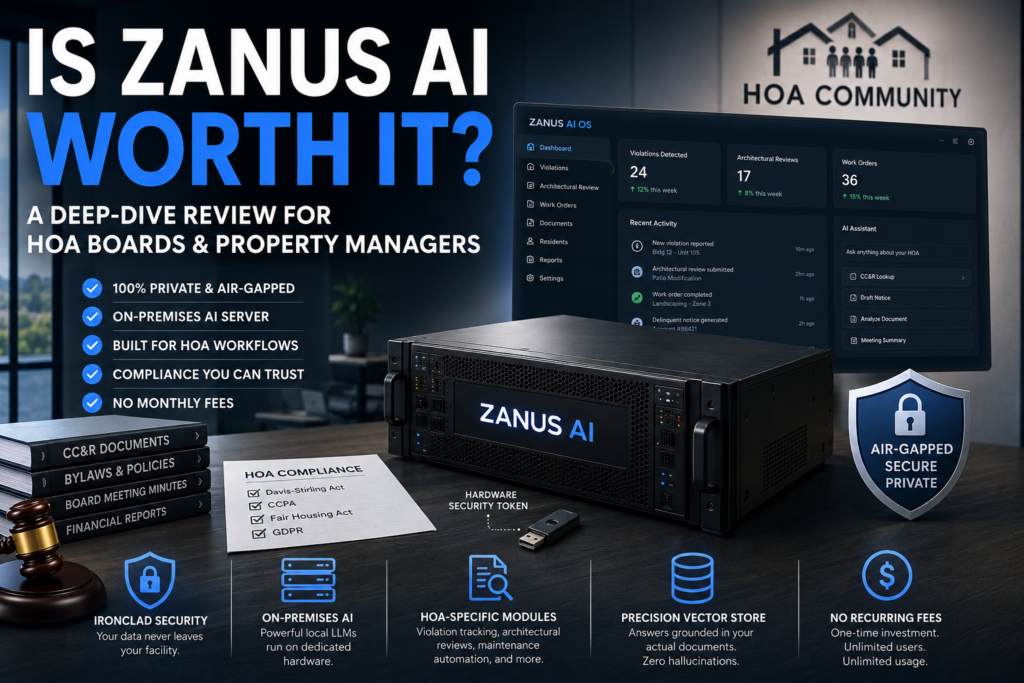
For a long time, the software industry pushed one answer: move everything to the cloud. But feeding private homeowner data into cloud-based AI engines like ChatGPT or Claude creates major compliance nightmares under regulations like California’s Davis-Stirling Act or the Fair Housing Act.
Zanus AI takes a completely different path. Headquartered in Fort Lauderdale, Florida, the company offers a fully private, “air-gapped” on-premises AI system. It delivers local language models (LLMs) packed inside a physical server box that sits directly in your office.
This review breaks down exactly how Zanus AI performs, who it is built for, and whether it justifies the upfront hardware investment.
Is Zanus AI Worth It? Product Overview
Is Zanus AI Worth It for Large HOA Communities?
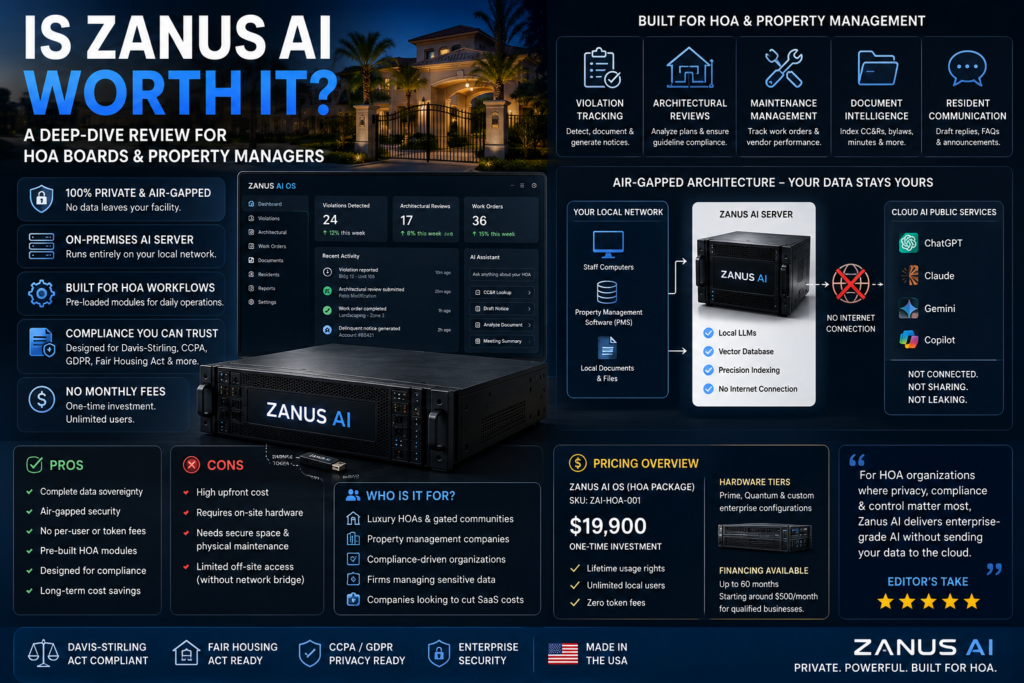
Zanus AI is not a cloud subscription or a software download. It is a physical, turn-key hardware and software deployment engineered to run completely within your local area network (LAN). When you buy Zanus AI, a physical server arrives pre-configured with the Zanus AI OS, dedicated enterprise GPUs, and multiple local language models.
By pulling the plug on the internet entirely, Zanus AI guarantees that your homeowner records, corporate financial data, and board meeting histories never leave your physical facility. It connects directly to your existing property management software (PMS) stack—such as Yardi, AppFolio, Buildium, or Vantaca—via local REST APIs and secure webhooks to analyze workflows without exposing data to third-party tech giants.
Best For
- Luxury HOAs and High-End Communities: Perfect for gated communities, luxury condo associations, and master-planned developments housing high-profile residents where data leaks are unacceptable.
- Compliance-Driven Organizations: Ideal for property management firms operating under strict regional privacy guidelines like the Davis-Stirling Act, CCPA, or GDPR.
- Firms Looking to Cap AI Spending: Built for companies tired of variable per-seat software-as-a-service (SaaS) monthly licensing fees and unpredictable token costs.
Key Strengths & Features
1. Ironclad Air-Gapped Security
The biggest advantage of Zanus AI is its complete physical isolation from the public internet. The system requires a physical USB hardware token to activate locally. Because it does not exchange data with external servers, it removes the threat of remote data breaches or cloud-based leaks. Your risk of exposing sensitive resident data to external AI training models drops to zero.
2. Tailored HOA Business Modules
Unlike generic AI platforms that require weeks of prompt engineering, the Zanus AI OS (specifically SKU: ZAI-HOA-001) comes pre-loaded with over 15 built-in, industry-specific operational modules.
- Automated Violation Tracking: It scans field reports, flags violations against your specific community CC&Rs, and drafts legally precise warning letters.
- Architectural Review Processing: The local AI analyzes architectural plans and resident modification PDFs, instantly comparing them to community design guidelines to recommend a preliminary approval or denial.
- Smart Maintenance Coordination: It categorizes incoming maintenance tickets, monitors vendor completion timelines, and alerts managers to overdue work orders if a contractor shifts their schedule.
3. Precision Vector Store (Zero Hallucinations)
Generic cloud AI tools often guess or hallucinate when they do not know an answer. Zanus AI addresses this through its Precision Vector Store. It localizes, indexes, and anchors all answers strictly to your community’s actual documentation—including decades of board meeting minutes, bylaws, and financial audits. If a rule isn’t in your uploaded files, the AI will not invent it.
Limitations
Upfront Hardware Requirements
Because Zanus AI relies on local computation, it requires installing physical rackmount hardware (such as the 8U Zanus AI Prime server) on-site. While the server is optimized for quiet office environments and uses standard wall outlets, your team still needs a secure physical space—like a locked supply closet or utility room—to house the equipment safely.
Local Network Access Constraints
An air-gapped system means security comes at the expense of external mobility. Out of the box, employees can only access the Zanus AI interface when connected to the office’s secure local network (LAN). If your property managers spend most of their days traveling between remote properties without a secure local network link back to the main office, accessing the system requires setting up a dedicated local network bridge.
Pros & Cons
Pros
- Complete Data Sovereignty: Homeowner PII and financial records remain 100% private and localized inside your facility.
- No Recurring Token Fees: Unlimited reasoning, document analysis, and chat queries with zero per-user or per-month price creeping.
- Built-In Compliance: Architecture naturally satisfies the stringent fiduciary and privacy requirements of the Davis-Stirling Act and the Fair Housing Act.
- Turn-Key Industry Modules: Ready to handle architectural reviews, maintenance tracking, and CC&R indexing on day one without complex coding.
Cons
- High Initial Capital Expense: Requires a larger upfront financial investment compared to cheap monthly cloud software subscriptions.
- Physical Footprint: Requires local server space, physical asset tracking, and baseline hardware environment monitoring.
- Limited Off-Site Access: Restricts processing capabilities to your local network perimeter unless advanced local network routing is configured.
Pricing
Zanus AI shifts your software budget from an ongoing operational expense (OPEX) to a tangible corporate asset (CAPEX).
- Zanus AI OS (HOA Package – SKU: ZAI-HOA-001): $19,900.00 (One-time investment. Includes lifetime usage rights, unlimited local users, and zero token fees).
- Hardware Tier Options: Custom enterprise pricing depending on hardware capacity. System tiers include Zanus AI Prime (handles 2,000,000+ documents and 50,000+ video hours) and Zanus AI Quantum for larger multi-property management portfolios.
- Financing: Equipment leasing and structured financing options are available for up to 60 months (starting around $500/month for qualified business accounts).
Technical Specifications: Zanus AI Prime (ZAI-PRS-7700)
| System Component | Enterprise Specifications |
| Form Factor | 8U Rackmount Server (Desktop or server rack placement compatible) |
| Compute Architecture | Integrated Enterprise AI GPU Array optimized for deep local reasoning |
| Storage Architecture | Ultra-fast NVMe flash storage configured in RAID 10 |
| Data Protection | Local real-time data mirroring with hot-swappable drive support |
| Baseline Capacity | Indexes over 2,000,000 documents and 50,000 hours of operations video |
| Maximum Expandability | Scalable up to 50,000,000+ documents via Petabyte-level LTO storage options |
| Operational Sound Level | Ultra-quiet cooling array optimized for standard office environments |
Alternatives
Cloud-Based Real Estate AI Agents (e.g., Haven AI)
If your organization manages a high volume of lower-cost scattered rental properties and does not handle highly restricted corporate governance data, cloud platforms like Haven AI provide fast setup via standard internet browsers. However, you sacrifice long-term data privacy and subject your firm to monthly per-seat subscription price increases.
Standard PMS Built-In Automation (e.g., Yardi / AppFolio)
Most modern property management software platforms offer their own baseline automation and cloud-based AI helper tools. These tools are convenient for basic data entry, but they lack the deep contextual reasoning of an independent vector store and do not offer air-gapped protection for sensitive internal board files.
Editor’s Take
If your management firm handles luxury properties or sits under strict regulatory observation where exposing homeowner data carries severe legal liabilities, then investing in Zanus AI is one of the smartest long-term operational moves you can make, because it completely eliminates third-party cloud data exposure while permanently wiping out unpredictable monthly SaaS subscription fees.
Final Verdict
Should your organization buy Zanus AI?
If you are a solo property manager handling a handful of single-family rentals, the hardware costs and local setup requirements of Zanus AI are likely overkill. You will be better served using standard cloud-based property management tools.
However, for established property management firms, luxury condo boards, and large-scale HOAs managing multi-million dollar portfolios, Zanus AI is a premier solution. It successfully proves that you can automate complex community operations without turning your residents’ private information over to the cloud.
Next Step: Audit your current staff’s use of public cloud AI tools. If team members are currently pasting sensitive board documents or delinquent resident records into tools like ChatGPT, request a private hardware demonstration from Zanus AI to test their local workflow integration models.
Enterprise Infrastructure & Deployment Frameworks
Before committing to a physical hardware footprint or budgeting your local migration roadmap, cross-reference your financial models with our comprehensive AI infrastructure deep-dives:
- Zanus AI Review: On-Premises Server Setup & Hardware Tech – Read our complete technical review of the Zanus AI OS, YOLOv8 frame processing efficiency, and localized multimodal RAG performance benchmarks.
- Enterprise AI Hardware Buying Guide: Best AI Appliances 2026 – Evaluate pre-validated hyperconverged infrastructure (HCI) options, single-point factory support lifecycles, and navigate production software licensing boundaries.
- Enterprise AI Deployment Report: On-Premises Blueprint & Checklist – Review a comprehensive 24-week cluster roadmap, precise thermodynamic BTU calculations for Blackwell nodes, and a production-ready go-live checklist.
If you’re evaluating Zanus AI, these guides may also help: