Manual vs. AI property inspections have become one of the biggest debates among HOA managers looking to improve compliance while reducing inspection costs.
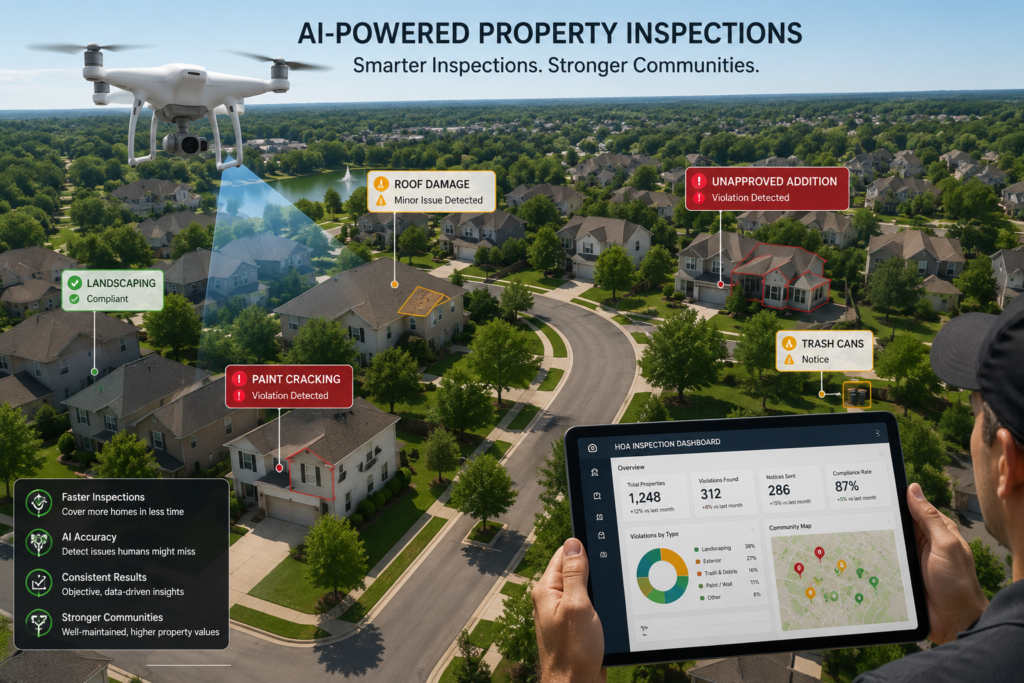
This guide evaluates the critical transition from traditional manual drive-bys to automated AI-driven visual inspections. We will analyze the hidden costs of human error, the technical limitations of pure software setups, and why a hybrid Human-in-the-Loop (HITL) architecture is the most reliable strategy for modern property management workflows.
Manual vs AI Property Inspections: Key Differences
In community association management, reliability is frequently mismeasured by how often an inspector drives down a street. True enforcement reliability relies on four measurable, data-driven parameters:
- False Negatives (Missed Violations): Architecture or landscape issues that pass unnoted, accelerating property degradation.
- False Positives (Incorrect Flags): Valid property setups mistakenly marked as violations, causing administrative waste and resident friction.
- Inspection Consistency: The statistical variance of property evaluations across different weeks, sections, or individual inspectors.
- Legal Admissibility: The evidentiary value, geometric precision, and chronological integrity of your property data if challenged in court.
According to data tracking from the Community Associations Institute (CAI), while roughly 67% of community associations deploy digital management systems, only 23% have successfully automated their violation workflows. This execution gap exposes boards to inconsistent enforcement claims.
| Reliability Metric | Operational Impact | Technical Target |
| False Negative Rate | Undetected structural or aesthetic wear; lowered property value. | Less than 3% of actual community issues. |
| False Positive Rate | Erroneous warnings that frustrate homeowners and trigger complaints. | Less than 1% of issued notices. |
| Consistency Deviation | Unequal rule enforcement; open exposure to selective enforcement lawsuits. | Standard Deviation → 0 across all sectors. |
| Evidence Admissibility | Case dismissal during litigation; legal expenses and reputational damage. | 100% compliant with FAA Part 107 and local privacy laws. |
Why Do Traditional Manual Inspections Suffer from Systemic Blind Spots?
Traditional drive-by or walk-through inspections rely entirely on human vision and manual logging. While familiar, this approach introduces systematic vulnerabilities that undermine data accuracy.
1. The Cost of Inspection Fatigue
Human visual focus degrades rapidly during extended physical patrols, particularly during harsh weather. After two hours of walking or driving a community, an inspector’s ability to identify minor structural shifts—like initial chimney cracks, slight roof tile shifting, or early invasive plant growth—drops significantly. This directly inflates your false negative rate.
2. Cognitive Bias and Selective Enforcement Claims
Inspectors do not work in a vacuum. Personal interactions, history with residents, and implicit biases influence manual logging. If an inspector overlooks a lawn issue for a friendly neighbor but penalizes a resident who frequently challenges board decisions, the HOA becomes vulnerable to selective enforcement lawsuits. In court, proving that rules were applied inconsistently can instantly invalidate an HOA’s enforcement authority.
3. Physical Access Barriers
Inspectors standing at street level cannot evaluate high-altitude or obstructed property areas, such as upper-floor gutters, valleys on sloped roofs, or modifications hidden behind tall perimeter fences. Boards are left with two high-risk options: ignore these sections until costly structural damage occurs, or face workers’ compensation and Errors & Omissions (E&O) liabilities by sending staff onto steep roof structures.
What Are the Algorithmic Limits of Pure Artificial Intelligence?
Automated platforms leveraging computer vision offer rapid processing scales, but deploying standalone AI without human oversight introduces distinct technical vulnerabilities.
1. Context Blindness and False Flags
Computer vision engines process flat pixel matrices and struggle with dynamic ambient lighting conditions. For example, a harsh tree shadow cast across a stucco wall can easily be misclassified by an algorithm as toxic mold or cracked paint. Similarly, seasonal grass discoloration during dry spells can trigger automated violation notices for poor lawn maintenance, sparking immediate disputes from homeowners.
2. The Absolute Absence of Operational Discretion
HOA guidelines require contextual judgment that software cannot replicate. A vehicle parked briefly on a lawn might indicate an urgent medical situation; construction materials staged in a driveway could belong to a municipal utility crew fixing public infrastructure. A standalone AI system automates enforcement blindly, lacks situational awareness, and generates tone-deaf notices that damage community relations.
3. Fiduciary and Data Security Risks
Delegating ultimate enforcement choices entirely to software can constitute a breach of a board member’s fiduciary duty. Because courts do not recognize algorithmic assertions as expert testimony, automated penalties issued without human validation lack legal standing. Furthermore, processing private community imagery through unverified open-source models risks leaking sensitive homeowner information and violating local data privacy mandates.
The Ultimate Operational Architecture: Human-in-the-Loop (HITL)
To balance rapid processing with legal defensibility, high-performing HOAs use a Human-in-the-Loop (HITL) framework. In this architecture, AI serves as an engine for wide-scale data collection and filtering, while a professional property manager serves as the final authority for compliance decisions.
Here is how the standardized HITL workflow converts raw property imagery into actionable, legally sound compliance records:
1.Automated Field Data Capture:Phase 1: Scale.
High-resolution commercial drones or vehicle-mounted cameras survey the community, capturing geo-referenced telemetry and imagery across all properties uniformly.
2.Computer Vision Sifting:Phase 2: Filtering.
The AI engine processes raw visual data, matching real-time property conditions against the association’s governing rules to highlight potential compliance exceptions.
3.Human Verification Dashboard:Phase 3: Human Override.
Flagged anomalies are directed to the property manager’s dashboard. The manager reviews contextual factors, filters out false alerts (like shadows or temporary staging), and approves valid infractions.
4.Algorithmic Refinement:Phase 4: Feedback Loop.
Every manual correction or override decision is securely fed back into the local model. The software updates its recognition parameters, dropping the system’s false positive rate over time.
How Do Automated Workflows Compare financially?
Moving away from manual processing cuts administrative overhead and shortens violation resolution timelines significantly.
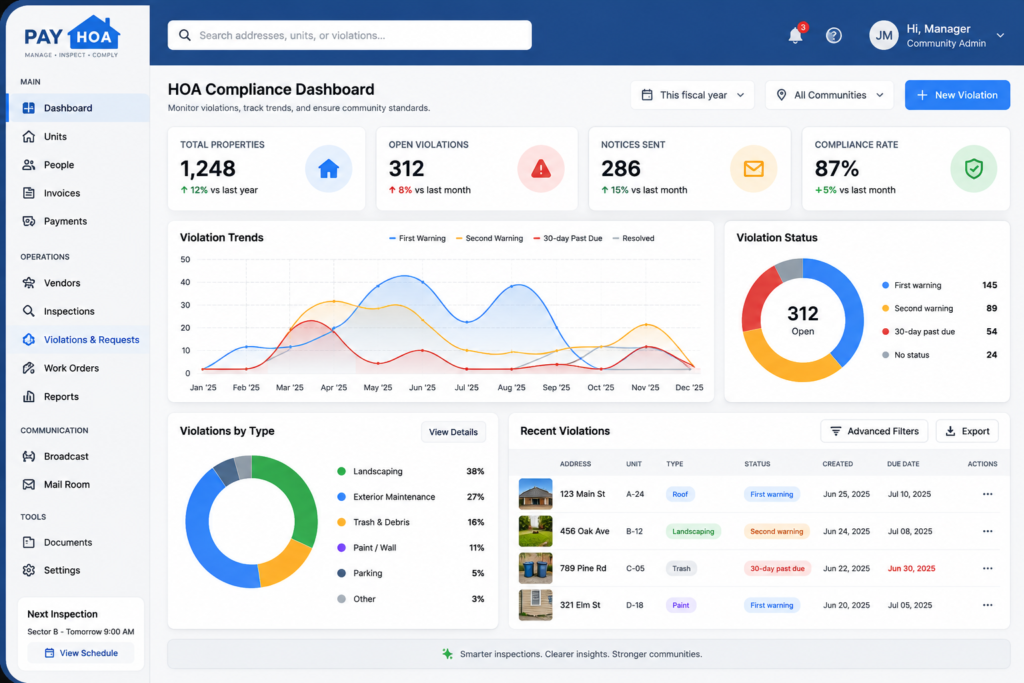
Our review of automated compliance software reveals distinct operational improvements over traditional methods:
| Performance Criterion | Manual Inspections | Pure Standalone AI | Hybrid HITL Workflow |
| Notice Compilation Time | ~22 Minutes per issue (Manual entry, photo pairing, rule matching). | < 1 Second (Instant generation based on raw machine flags). | < 2 Minutes (AI pre-populates metadata; manager clicks to verify). |
| Average Resolution Cycle | 21 Days (Due to patrol delays and physical paperwork friction). | Unpredictable (Extended by resident disputes over errors). | 6.3 Days (Accelerated by automated reminders and tracking). |
| 30-Day Fine Collection Rate | ~41% (Inconsistent follow-up loops and missing records). | Low (Disputed frequently by homeowners due to false flags). | 78% (Driven by clear photo evidence and embedded digital payments). |
| Legal Risk Reductions | Baseline exposure (High due to subjective data collection). | Elevated exposure (Risk of fiduciary failure and privacy claims). | 40% to 55% Reduction in total association liability exposure. |
Legal Analysis: Navigating Courtroom Admissibility and Privacy Laws
If an infraction leads to litigation, your evidence determines the outcome. Courts assess the structural integrity, handling history, and collection methods of your data.
1. Documented Checklists vs. Telemetry Logs
A hand-written log from a ground inspection is easily challenged by defense counsel. Attacking attorneys often focus on the lack of objective measurements, memory gaps, and potential bias.
Conversely, 3D aerial data generated via photogrammetry provides verifiable physical evidence. When backed by unalterable timestamps and precise GPS coordinates, this data creates an objective history of the property condition that withstands aggressive cross-examination.
The FAA Part 107 Mandate: Any drone flight conducted for HOA business purposes constitutes a commercial operation. All flights must be managed by an FAA-licensed Remote Pilot in Command. Data collected from unlicensed flights or inside restricted airspace without LAANC clearance is considered illegally obtained and is inadmissible in court.
2. Managing Vertical Curtilage Boundaries
The space directly surrounding a home—the curtilage—carries strict expectations of privacy. If an association drone operates below the roofline or hovers near fenced backyards and windows, the court may classify the operation as civil trespass or an invasion of privacy.
To safeguard operations, boards must implement an explicit drone policy:
- Maintain a standard transit altitude above 200 feet.
- Restrict cameras from capturing interior spaces.
- Provide advance notice to the community regarding scheduled flights.
3. Neutralizing Selective Enforcement Claims
As established in landmark cases like White Egret Condominium, Inc. v. Franklin (1979), an association’s failure to apply rules uniformly strips it of enforcement authority.
HITL platforms eliminate this risk by scanning the entire community uniformly during an inspection cycle. If a challenge emerges, the HOA can present comprehensive data showing that every home was evaluated against the exact same rules, protecting the association from claims of bias.
Editor’s Take: The Ultimate Verdict on HOA Inspection Tech
If your community wants to reduce legal vulnerabilities, lower administrative workloads, and ensure consistent rule enforcement, then you should implement a hybrid Human-in-the-Loop platform backed by certified drone data, because this configuration combines wide-area automated tracking with the indispensable judgment of a professional manager.
What you should do next:
- Audit Your Records: Evaluate your past 12 months of violation notices to find your baseline dispute rates.
- Draft a Clear Drone Policy: Update your community rules to outline pilot licensing, flight paths, and privacy guardrails before launch.
- Run a Hybrid Pilot: Deploy an automated HITL system on a single section of your community to measure time savings before rolling it out across the entire association.
Continue Reading
If you’re exploring how AI is transforming HOA property management, these related guides provide a broader perspective on today’s inspection technologies and compliance workflows:
- Best AI Property Inspection Software for HOAs (2026) – Compare the leading AI-powered inspection platforms, their key features, and which solutions fit different HOA management needs.
- Zanus AI Review: Is “AI in a Box” the Ultimate Solution for HOA Property Inspections? – An in-depth review of Zanus AI’s offline architecture, privacy-first design, and real-world suitability for HOA compliance inspections.
- Best AI Supply Chain Software (2026) – While focused on a different industry, this guide explores how AI-driven automation improves operational efficiency, offering valuable insights into broader enterprise AI adoption.