
The hype surrounding the OpenClaw Mirage in late 2025 exemplifies the widening chasm between speculative venture marketing and stable systems engineering. Driven by hype-fueled commentators proclaiming it a “24/7 Jarvis,” the framework achieved viral growth, briefly peaking at over 250,000 GitHub stars and causing global stock shortages of Apple Mac Minis as enthusiasts rushed to host local agents. However, under the hood, the reality of deploying OpenClaw in production tells a completely different story—one plagued by architectural latency, cost explosion, and severe security hazards.
Architectural Genesis and the $16M Crypto Rug-Pull
Originally conceived by Austrian programmer Peter Steinberger under the name “Warelay” (a basic WhatsApp-to-Claude API bridge), the project embraced the controversial paradigm of “vibe coding”—a philosophy prioritizing rapid, LLM-generated code over deterministic software design. While celebrated by early adopters, “vibe coding” quickly devolved into a derogatory label within professional software engineering circles, synonymous with unmaintainable, untested, and structurally fragile codebases.
The project’s governance has been chaotic, marked by intellectual property disputes and operational failures. Following a trademark cease-and-desist demand from Anthropic, the project was forced to hastily rebrand from Clawdbot to Moltbot on January 27, 2026, before settling on OpenClaw three days later. During the transition to Moltbot, Steinberger attempted to rename the GitHub organization and X handles simultaneously. In a catastrophic 10-second window, automated monitoring bots hijacked the original names, launching a fraudulent Solana-based token named $CLAWD. This exploit peaked at a $16 million market capitalization, culminating in a rug-pull that wiped out community assets.
Further compounding its rocky reputation, the highly publicized “Moltbook Deception”—where multi-agent frameworks supposedly developed an autonomous religion—was exposed as pre-scripted human theater designed to drive media speculation. The real-world consequences, however, are very real: in March 2026, the Chinese government banned state agencies and state-owned enterprises from deploying OpenClaw, citing unauthorized data deletions and extreme energy consumption. Simultaneously, a landmark ruling by the Hangzhou Intermediate People’s Court established that replacing human workers with unverified AI systems like OpenClaw is not a lawful justification for termination under Chinese labor laws.
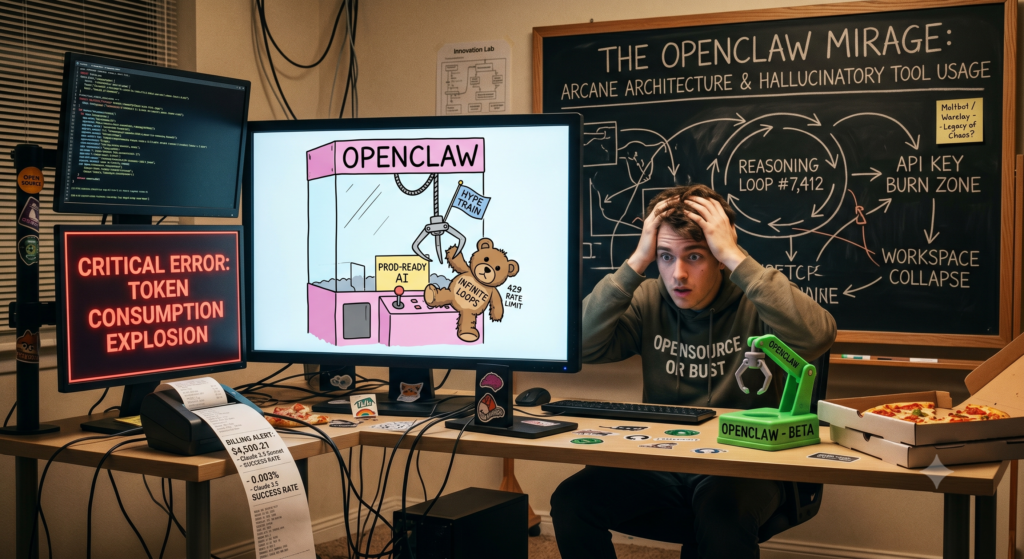
Destructive Algorithmic Loops: The $350 Financial Trap
Because OpenClaw relies on a non-deterministic “reason-act-observe” loop without strict execution boundaries, any minor failure in tool feedback can trap the framework in recursive execution failures. Production environments have identified three distinct, destructive loop patterns:
- The Retry Storm: Occurs during transient external API timeouts or rate-limiting. Lacking backoff limits, OpenClaw immediately retries the exact same failed command, appending each failure log to the active context window and driving up costs exponentially.
- The Context Avalanche: Triggered when local file scans return massive, uncompressed payloads. The agent instantly saturates its context window, consuming its entire token budget simply reading its own history, rendering it incapable of reasoning.
- The Verification Loop: Driven by “AI anxiety,” the agent completes a task but becomes trapped in an infinite cycle of checking its own work, spot-correcting minor details via shell commands, and re-verifying indefinitely.
Because modern LLMs produce highly convincing explanations, these loops can run for hundreds of turns before surfacing an obvious error. In one documented production incident, a runaway subagent executed 809 consecutive turns over 3.5 hours, burning $350 on a single task before manual intervention halted the process.
A Playground for Hackers: Direct & Indirect Prompt Injections
Operating without robust sandboxing or strict data-control boundary isolation, OpenClaw processes data and control commands within the same execution channel. This makes it a prime target for severe security vulnerabilities:
- The Clinejection Attack: Demonstrates how easily an agentic triage bot can be manipulated into executing arbitrary system commands simply via a crafted GitHub issue title.
- Indirect Injections via Web/Email: If OpenClaw is configured to browse the web or read incoming emails, threat actors can embed hidden instructions in the HTML or email body. When parsed, these injections override the primary system contract (
SOUL.md), allowing attackers to exfiltrate active session logs and local credentials. - Rich Messaging Exploits: Attackers can craft custom
.vcf(vCard) contact files containing malicious prompts in truncated contact fields. When processed, the metadata flattens into the primary prompt, executing hidden privileged tools (like bash or git commands) without user knowledge.
Empirical security matrix testing reveals that the choice of the underlying cognitive model heavily dictates the vulnerability profile. While the base framework running on GPT-5.4-Mini effectively blocked final exfiltration, it remained highly vulnerable to environment reconnaissance (71.43%). Meanwhile, the QClaw variant (built on Claude Sonnet) achieved an alarming 85.71% success rate in credential access and extraction, blindly following semantically layered instructions to retrieve authentication logs from context files.
Token Bloat and the Macroeconomics of Failure
While OpenClaw carries no upfront licensing costs, the token volume required to sustain its autonomous cycles is financially prohibitive. Every single cognitive cycle requires rebuilding the entire local state, loading the core system prompt (SOUL.md, averaging 4,000 tokens), active tool schemas, the last forty turns of conversation history, and the local memory file (MEMORY.md).
On premium models like Claude Sonnet, the static overhead costs roughly $0.012 per turn just to establish identity. As the conversation progresses, cumulative context regularly bloats to 50,000 to 80,000 input tokens per turn. For individual developers, the most deceptive cost vector is the “idle heartbeat trap”—background processes checking calendars or monitoring emails on a five-minute interval will consume roughly $5.00 per day doing absolutely nothing.
Operational Reality: Traditional Automation vs. OpenClaw Mirage
When evaluated side-by-side against traditional automation tools like Zapier, n8n, or standard Cron jobs, the gap between OpenClaw’s marketing narrative and operational reality becomes stark:
| Workflow Attribute | Traditional Automation (Zapier, n8n) | OpenClaw Autonomous Framework |
|---|---|---|
| Setup Friction | Low to Moderate; UI-driven OAuth setups | High; complex Docker configs, manual API keys, SQLite blocks |
| Consistency | 100% predictable; executes exact instructions | Volatile; prone to memory decay, drift, and prompt manipulation |
| Maintenance | Minimal; static cloud API endpoints | 2–4 hours/week managing breaking releases and plugin conflicts |
| Resource Use | Negligible; hosted cloud execution | High; CPU spikes over 100%, idles at 5-10W locally |
Furthermore, OpenClaw interacts terribly with upstream model providers, frequently triggering HTTP Error 429 (Too Many Requests). Instead of executing an elegant queue based on the provider’s retry-after header, OpenClaw’s aggressive watchdog rule (injecting x-should-retry: false if wait times exceed 60 seconds) instantly aborts the task, forces a hard local cooldown, and requires a manual user reset from scratch.
Ultimately, OpenClaw Mirage represents the quintessential trap of current AI agent development: a “vibe-coded” system that often demands more human hours to monitor, troubleshoot, and fund than it actually saves in human labor.
AI Review Zones Verdict: A Costly Playground, Not an Enterprise Worker
At AI Review Zones, we don’t just report the news—we stress-test the reality. After thoroughly diving into the open-source architecture of the OpenClaw framework, our verdict is clear: OpenClaw is a classic product of “FOMO engineering” and speculative hype. It is an impressive tech demo for developers who enjoy debugging system configurations at 2 AM, but it is currently a financial and security liability for production deployments.
While social media influencers and tech evangelists paint a utopian picture of fully autonomous digital employees replacing human labor, they conveniently omit the part where an unoptimized reasoning loop can wipe out your monthly cloud API budget over a lunch break. The complete absence of secure sandboxing, combined with its vulnerability to indirect prompt injections via basic web browsing or email triaging, makes running OpenClaw on any machine with sensitive credentials a dangerous gamble.
Our Recommendation: If you are looking to automate core operations for your business in 2026, skip the autonomous agent hype train for now. Stick to robust, deterministic workflow automation tools like n8n or Zapier. They may lack the “vibe” of a self-thinking Jarvis, but they execute commands exactly as intended—without trying to start an autonomous AI religion or burning a $350 hole in your credit card.