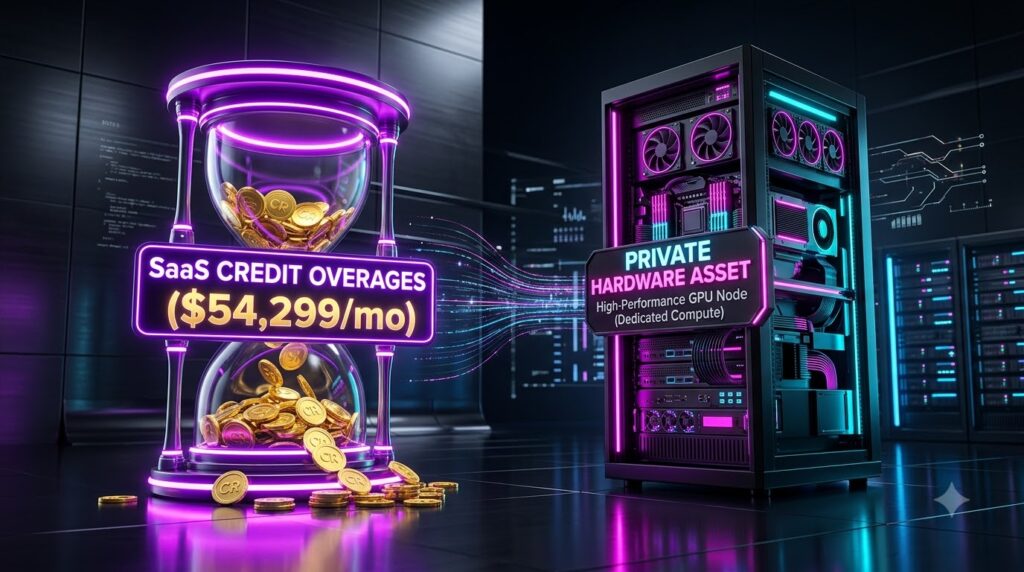
Executive Summary: The Hidden Economics of Multi-Agent SaaS Platforms
When conducting a comprehensive Lindy AI review and evaluating autonomous agent workflows, the enterprise software market is undergoing a structural shift. Organizations are moving away from simple, single-turn chatbots and rigid Robotic Process Automation (RPA) tools toward autonomous multi-agent operational platforms. Tools like Lindy AI, Zapier Central, and Relevance AI represent a new software category: digital teammates capable of executing multi-step reasoning, navigating web browser user interfaces, and orchestrating complex workflows across disparate business applications. By connecting directly to corporate email inboxes, calendar infrastructure, CRM databases, and telephony networks, these agentic systems aim to automate end-to-end operational functions.
However, moving from predictable per-seat licensing to consumption-based AI metering introduces significant financial complexity. Enterprise technology buyers, COOs, and support leaders frequently run into friction during post-pilot scaling phases. This friction stems primarily from dual-metered pricing models that combine base workspace subscriptions with abstract credit consumption, unbundled telephony per-minute surcharges, and model inference markups.
While turnkey, no-code agent platforms offer rapid initial setup for administrative workflows, their economic efficiency degrades on high-throughput operational workloads. As monthly volume scales into tens of thousands of automated voice calls and back-office updates, variable credit overages and telephony markups cause costs to escalate non-linearly. Enterprise buyers must evaluate the total cost of ownership (TCO), latency profile, and data sovereignty trade-offs of cloud-hosted AI agents against private, co-located zero-cloud infrastructure.
Quick Summary & Buying Verdict
| Feature / Metric | Managed Cloud SaaS (Lindy AI) | Co-Located Private GPU Node |
| Primary Value | Rapid deployment, no-code builder, turnkey integrations | Sub-300ms latency, zero marginal credit fees, complete data control |
| Best For | Mid-market teams, low-to-moderate monthly volume (<10k tasks) | Enterprise-scale operations (>50k tasks/mo or >5k call minutes) |
| End-to-End Latency | 900ms – 1,950ms (p95) | 200ms – 360ms (p95) |
| Data Sovereignty | SOC 2 / HIPAA (Data traverses external APIs) | 100% Air-gapped within internal perimeter |
| 3-Year TCO (High Vol) | ~$1.95 Million (Driven by credit overages) | ~$204,800 (Capital hardware amortisation + wholesale bandwidth) |
Editor’s Take
Choose Lindy AI if you need an operational AI team up and running within hours without dedicated engineering overhead, and your monthly workload remains within standard plan credit allocations.
Transition to private or developer-first infrastructure the moment your operational volume breaches 5,000 voice minutes or 20,000 back-office executions per month. Beyond this threshold, SaaS credit markups systematically erode margin efficiency.
Deconstructing Lindy AI Capabilities & Architecture
Lindy AI functions as an autonomous agent platform designed to act as an executive assistant and operational teammate. Its core technical architecture connects multi-modal foundation models with native application connectors and browser-use drivers.
[ Inbound Trigger (Email/Voice/CRM) ]
                │
                ▼
  [ Lindy Multi-Agent Orchestrator ]
        │               │
        ├─► [ LLM Reasoning Engine (GPT-4o/Claude) ]
        ├─► [ Vision Computer-Use Engine ]
        └─► [ Native Connectors / MCP Tools ]
                │
                ▼
[ Execution: Voice PSTN / Draft Email / Database Update ]
Core Capability Portfolio
- Voice Agents (Lindy Phone): Supports automated inbound and outbound telephony powered by foundation models like GPT-4o. The platform manages real-time voice interactions, call transfers, virtual number provisioning, and multilingual processing across more than 30 languages.
- Email Triage & Natural Voice Drafting: Connects natively to email providers (Gmail, Microsoft Outlook) to prioritize messages, filter support queues, and draft contextual responses matching the user’s historical writing style.
- Meeting Intelligence: Joins video conferences to record audio, produce structured transcripts, generate summaries, extract action items, and reconcile conflicts across internal and external calendars.
- CRM & Enterprise Connectors: Integrates with systems like HubSpot, Salesforce, Notion, and Slack. Through integration partners and adoption of the Model Context Protocol (MCP), Lindy connects to thousands of software tools to update database records automatically.
- Computer Use & Browser Automation: Advanced tiers use vision-language models to navigate web application user interfaces, fill out forms, operate legacy web software lacking public APIs, and extract structured data from unformatted web pages.
- Multi-Agent Workflow Orchestration: Enables modular sub-agent architectures where specialized agents collaborate sequentially. For example, a triaging agent evaluates an incoming lead, triggers a data-fetching agent to pull context from a CRM, and signals an execution agent to send a tailored SMS or draft a follow-up email.
Ease of Use vs. Operational Customization Limits
The platform’s primary strength lies in operational accessibility. Featuring a visual drag-and-drop workflow builder, natural-language prompt configuration, and pre-built templates for common tasks (such as medical SOAP notes or sales follow-ups), non-technical operators can build automated workflows in minutes without writing code.
┌─────────────────────────────────────────────────────────────────┐
│                     Operational Trade-off                        │
├────────────────────────────────┬────────────────────────────────┤
│    Visual Accessibility        │   Deterministic Control        │
│    (Fast Setup, No-Code)       │   (High Abstraction Risk)      │
└────────────────────────────────┴────────────────────────────────┘
However, this abstraction imposes clear operational limits. Because Lindy hides the underlying execution graph, enterprise engineers cannot modify low-level prompt token allocation, implement custom state-caching layers, or fine-tune programmatic retry loops. Unlike developer-first orchestrators or open-source frameworks (such as n8n or custom Python microservices), Lindy offers limited deterministic state-machine controls. When an agent encounters edge cases during web browser navigation or API schema shifts, execution relies on probabilistic model reasoning rather than hard-coded fallback pathways. This can lead to unpredictable execution failures in strict enterprise environments.
Analyzing Lindy AI Pricing Tiers & Hidden Costs
A thorough financial evaluation of Lindy AI requires looking past baseline plan prices to examine the consumption mechanics that drive variable monthly expenditures.
Official Pricing Tiers
Lindy AI structures its commercial software plans across four core tiers:
- Plus Plan ($49.99/mo or $30/user/mo): Designed for individual productivity, providing 3,000 pooled workspace credits per user per month and support for up to 2 connected inboxes.
- Pro Plan ($99.99/mo or $100/user/mo): Targeted at power users, providing 15,000 credits per user per month, support for 3 connected inboxes, model selection privileges, and browser computer-use capabilities.
- Max Plan ($199.99/mo or $200/user/mo): Built for heavy operational workloads, providing 35,000 credits per user per month and support for up to 5 connected inboxes.
- Enterprise Plan (Custom Pricing): Tailored for organization-wide deployments requiring dedicated security and governance controls. Includes custom credit pools, single sign-on (SSO), SCIM provisioning, centralized agent management, audit logging, dedicated onboarding, and HIPAA compliance supported by a signed Business Associate Agreement (BAA).
Metering Systems and Hidden Surcharges
Lindy enforces two parallel consumption meters that drive variable overages:
- Variable Workspace Credit Consumption: Task execution costs depend on computational complexity, model selection, and token usage. Simple tasks (tool updates, single email drafts) consume 2 to 250 credits per step. Intermediate tasks (daily support triaging, research summaries) consume 250 to 1,000 credits. Advanced operations (building complex HTML artifacts, multi-step browser tasks) burn 1,000 to 2,500 credits per execution. Using frontier models (such as GPT-4o or Claude 3.5 Sonnet) increases credit consumption compared to lighter open-weight models.
- Credit Overages and Top-Ups: When a workspace exhausts its pooled credit allocation, credit-dependent automated tasks pause. Administrators must purchase top-up blocks sold at $10 per 1,000 credits ($0.01 per credit).
- Unbundled Telephony Surcharges: Voice capabilities operate outside the standard credit pool. Virtual phone numbers incur a baseline line-rental fee of $10/month per number. Outbound and inbound calls carry an additional per-minute surcharge starting at approximately $0.19 per minute for standard domestic US destinations when using GPT-4o.
- Concurrency Limits: Lower-tier plans restrict concurrency on voice interactions (e.g., locking Pro plans to a single active call), forcing teams that require parallel call handling to upgrade to Business or Enterprise tiers.
Cost Structure Breakdown
| Plan / Line Item | Base Price | Included Allowance | Overage & Surcharge Mechanics | Key Constraints |
| Plus Tier | $49.99 / user / mo | 3,000 credits / mo | $10 per 1,000 extra credits | Max 2 connected inboxes |
| Pro Tier | $99.99 / user / mo | 15,000 credits / mo | $10 per 1,000 extra credits | Max 3 inboxes; adds Computer Use |
| Max Tier | $199.99 / user / mo | 35,000 credits / mo | $10 per 1,000 extra credits | Max 5 inboxes; heavy automation |
| Enterprise Tier | Custom Contract | Custom pooled pool | Negotiated credit blocks | Adds HIPAA BAA, SSO/SCIM, Audit Logs |
| Virtual Phone Lines | $10.00 / line / mo | Line rental only | Billed per assigned phone line | Required for telephony |
| Voice Duration | ~$0.19 / minute | Unbundled | Billed on active call duration | Rates depend on underlying LLM |
Mid-Market Financial Modeling Scenario
To evaluate the true cost of Lindy AI at scale, let’s examine a mid-market enterprise running a combined customer support and sales operations workflow.
Modeling Parameters
- Team Allocation: 10 operational users on the Max Plan ($199.99/user/month).
- Voice Telephony Volume: 10,000 automated customer calls per month, averaging 3 minutes per call (30,000 total call minutes) across 10 dedicated phone lines. Each call triggers a post-call workflow (CRM update, call summary, follow-up email) that burns an average of 250 workspace credits.
- Email & Support Volume: 50,000 automated email triage and support ticket workflows per month, burning an average of 50 credits per task.
Monthly Expense Breakdown (Total: $54,299.90)
┌─────────────────────────────────────────────────────────┐
│ [██████████████████████████████████████████] Credit Overages: $46,500 (85.6%) │
│ [█████] Voice Minute Fees: $5,700 (10.5%)              │
│ [█] Seat Subscriptions: $1,999.90 (3.7%)                 │
│ [░] Virtual Lines: $100.00 (0.2%)                       │
└─────────────────────────────────────────────────────────┘
Financial Calculation
- Base Seat Subscriptions: 10 seats × $199.99 = $1,999.90 / month
- Dedicated Virtual Phone Lines: 10 lines × $10.00 = $100.00 / month
- Voice Minute Surcharges: 30,000 minutes × $0.19 = $5,700.00 / month
- Gross Credit Requirements:
- Post-Call Processing: 10,000 calls × 250 credits = 2,500,000 credits
- Email & Support Tasks: 50,000 tasks × 50 credits = 2,500,000 credits
- Total Required: 5,000,000 credits / month
- Included Plan Credits: 10 seats × 35,000 credits = 350,000 credits / month
- Net Billable Credit Overage: 5,000,000 – 350,000 = 4,650,000 overage credits
- Credit Overage Expenditure: (4,650,000 / 1,000) × $10.00 = $46,500.00 / month
- Total Monthly Expense: $1,999.90 + $100.00 + $5,700.00 + $46,500.00 = $54,299.90 / month
- Annual Expense: $54,299.90 × 12 = $651,598.80 / year
Operational Impact
Baseline seat subscriptions account for less than 4% of total operational expenditures for high-volume deployments. Over 96% of costs are driven by variable credit overages and voice minute surcharges.
Lindy AI vs. Zero-Cloud On-Premise Voice & Agent Hardware
As operational AI workloads grow, technology decisions shift from managed SaaS platforms toward private zero-cloud hardware infrastructure.
Conversational Latency & Execution Pipelines
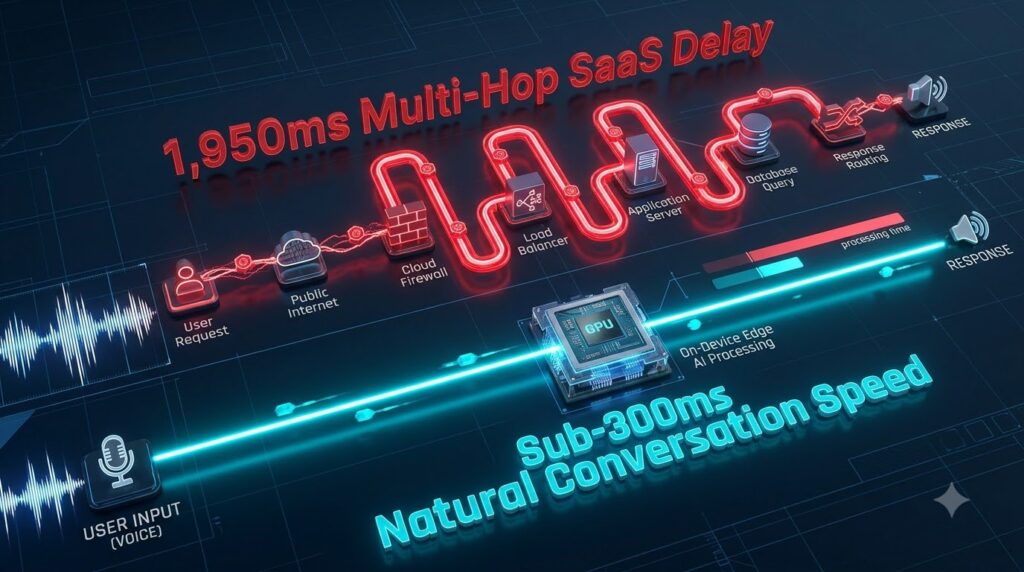
Natural human conversation relies on turn-taking pauses between 200ms and 500ms. When response latency exceeds 800ms, interaction flow degrades, causing caller interruption and drop-offs.
Cloud platforms like Lindy AI rely on a multi-hop API architecture: caller audio streams over public phone networks to a cloud Speech-to-Text (STT) service, passes through SaaS orchestration middleware, runs through a cloud Large Language Model (LLM), synthesizes via a cloud Text-to-Speech (TTS) engine, and streams back across the network. This multi-hop pipeline creates cumulative delays resulting in typical response latencies between 900ms and 1,950ms.
By contrast, a zero-cloud local architecture co-locates all pipeline components on a dedicated local GPU server node. By pairing optimized local streaming STT (e.g., Whisper Large-v3-Turbo) with open-weight reasoning models (e.g., vLLM-served Llama 3.2 11B) and low-latency local TTS engines (e.g., Kokoro-82M) directly in GPU memory (VRAM), network transit bottlenecks are removed. This architecture achieves end-to-end response times under 300ms, matching natural human conversational speeds.
Cloud Multi-Hop Pipeline (900ms - 1950ms)
[ PSTN Audio ] ──► [ Cloud STT ] ──► [ SaaS Middleware ] ──► [ Cloud LLM ] ──► [ Cloud TTS ] ──► [ PSTN Return ]

Co-Located Private Hardware (200ms - 360ms)
[ PSTN Audio ] ──► [ Local GPU: STT ──► Local LLM (vLLM) ──► Local TTS ] ──► [ PSTN Return ]
Latency Profile Comparison
| Execution Stage | Multi-Hop Cloud SaaS Stack (Lindy) | Co-Located Private GPU Node | Operational Bottleneck |
| Audio Capture & VAD | 30 – 50 ms | 10 – 20 ms | Local Voice Activity Detection avoids network framing delay |
| Speech-to-Text (STT) | 120 – 250 ms | 50 – 80 ms | Streaming cloud WebSocket vs. local GPU Whisper Turbo |
| LLM First-Token Latency | 350 – 800 ms | 80 – 150 ms | Multi-tenant cloud API queue vs. local vLLM KV-cache |
| Text-to-Speech (TTS) | 100 – 250 ms | 40 – 70 ms | Cloud TTS API rendering vs. local C++ audio generation |
| Transport Middleware | 300 – 600 ms | 20 – 40 ms | SaaS API routing vs. direct WebRTC/SIP streaming |
| Total End-to-End Latency | 900 – 1,950 ms (p95) | 200 – 360 ms (p95) | Private hardware removes multi-hop latency compounding |
Data Security, Privacy, and Compliance
Data governance is essential in regulated industries like healthcare, finance, and legal services.
Lindy AI implements strong cloud security controls, including encryption at rest and in transit, SOC 2 Type II compliance, GDPR alignment, and HIPAA compliance backed by a signed Business Associate Agreement (BAA) on Enterprise plans. The platform guarantees that customer data is isolated and excluded from model training sets. However, because Lindy operates as a managed cloud middleware, sensitive customer interactions and Protected Health Information (PHI) still cross external API boundaries and third-party endpoints.
A zero-cloud private hardware deployment changes the security model completely. By executing speech processing, LLM reasoning, and database updates on local servers within an air-gapped network, data never leaves company control. This eliminates third-party vendor risks, cross-border data transfer concerns, and external logging vulnerabilities, making compliance with strict HIPAA, PCI-DSS, or GDPR standards simpler.
Financial Model: 3-Year Total Cost of Ownership (TCO)
To compare long-term economics, we model a 3-year TCO using the high-volume operational scenario outlined above (10,000 monthly voice calls and 50,000 monthly email workflows).
Private Infrastructure Assumptions
- Hardware Acquisition: 2x enterprise GPU server nodes (e.g., dual NVIDIA H100 or quad RTX 5090 configurations running vLLM Llama-3.2, local Whisper STT, and local TTS) plus redundancy hardware: $65,000 one-time CapEx.
- Wholesale SIP Telephony Trunking: Direct wholesale PSTN trunking rates (e.g., Twilio or Telnyx direct trunking at ~$0.008/minute without SaaS markups): 30,000 call minutes/month = $300/month ($3,600/year).
- Co-location and Utilities: 4U data center rack space, redundant power allocation, and dedicated bandwidth: $1,500/month ($18,000/year).
- DevOps & System Maintenance: Allocated engineering resources for local stack updates, model tuning, and hardware maintenance: $25,000/year.
3-Year Cumulative Spend Comparison
| TCO Cost Line Item | Year 1 Spend | Year 2 Spend | Year 3 Spend | Cumulative 3-Year TCO |
| Lindy Managed Cloud SaaS | ||||
| Base Subscriptions (10 Max Seats) | $23,998.80 | $23,998.80 | $23,998.80 | $71,996.40 |
| Virtual Phone Numbers (10 Lines) | $1,200.00 | $1,200.00 | $1,200.00 | $3,600.00 |
| Per-Minute Voice Surcharges | $68,400.00 | $68,400.00 | $68,400.00 | $205,200.00 |
| Credit Overages (5M Tasks/mo) | $558,000.00 | $558,000.00 | $558,000.00 | $1,674,000.00 |
| Onboarding & Setup Fee | $1,500.00 | $0.00 | $0.00 | $1,500.00 |
| Lindy AI Total Spend | $653,098.80 | $651,598.80 | $651,598.80 | $1,956,296.40 |
| Private Zero-Cloud Hardware | ||||
| Enterprise GPU Server Hardware | $65,000.00 | $0.00 | $0.00 | $65,000.00 |
| Wholesale SIP Trunking | $3,600.00 | $3,600.00 | $3,600.00 | $10,800.00 |
| Co-location, Power, & Bandwidth | $18,000.00 | $18,000.00 | $18,000.00 | $54,000.00 |
| Allocated DevOps Maintenance | $25,000.00 | $25,000.00 | $25,000.00 | $75,000.00 |
| Private GPU Total Spend | $111,600.00 | $46,600.00 | $46,600.00 | $204,800.00 |
Financial Takeaway
Over a 3-year window, running a high-volume operational workflow on Lindy AI accumulates approximately $1.95M in software and usage expenses. Deploying private GPU hardware requires an upfront capital outlay but caps 3-year expenses at roughly $204,800—delivering an ~89% total cost reduction at scale.

Strategic Recommendations: When to Use Lindy AI vs. Private Infrastructure
Choosing between managed cloud SaaS and private infrastructure depends on operational scale, internal engineering resources, latency requirements, and compliance constraints.
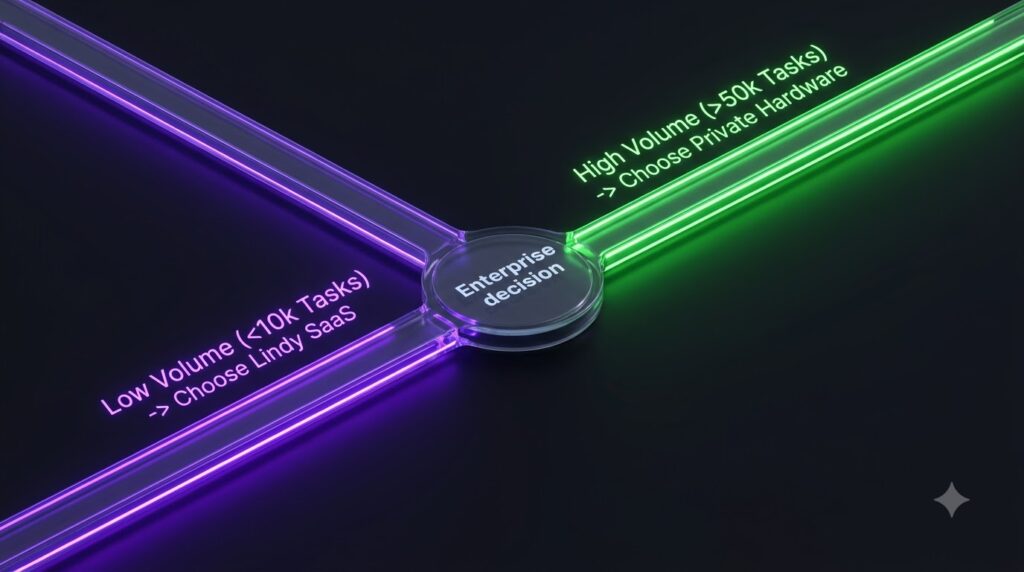
           [ Evaluate Operational Volume ]
                          │
         ┌────────────────┴────────────────┐
         ▼                                 ▼
   Low Volume                       High Volume
(< 1,000 calls / mo)             (> 5,000 calls / mo)
         │                                 │
         ▼                                 ▼
[ Adopt Lindy AI SaaS ]          [ Private GPU Infrastructure ]
 • Fast time-to-market            • Sub-300ms latency
 • Zero engineering setup         • Complete data sovereignty
 • Managed cloud updates          • ~89% lower 3-year TCO
Decision Matrix
| Decision Vector | Adopt Lindy AI Managed SaaS | Upgrade to Private Hardware |
| Monthly Telephony Volume | Low to Moderate (< 1,000 calls / mo) | High Volume (> 5,000 calls / mo) |
| Monthly Task Volume | Under 10,000 executions / mo | Over 50,000 executions / mo |
| Latency Tolerance | Accepts turn-taking pauses > 1,000 ms | Requires sub-300 ms human response speeds |
| Engineering Capacity | No dedicated ML or DevOps engineers | In-house DevOps & AI infrastructure engineering |
| Data Governance | Standard cloud security (SOC 2, HIPAA BAA) | Air-gapped data sovereignty mandatory |
| Capital Allocation Strategy | Prefers operational flexibility (OpEx) | Prefers hardware capital amortisation (CapEx) |
| Workflow Determinism | Flexible, semi-structured tasks | Strict deterministic state-machine requirements |
Practical Deployment Guidance
Deploy Lindy AI When:
- Speed-to-Market is the Top Priority: You need administrative AI assistants up and running quickly across executive schedules, email inboxes, and team meetings without waiting for internal development cycles.
- Operational Volumes are Modest: Monthly task usage stays within baseline plan credit allowances, avoiding usage overages.
- Engineering Capacity is Limited: Your organization lacks dedicated ML or DevOps engineers to build and maintain custom open-source models, WebRTC media servers, and GPU infrastructure.
- Tasks are Semi-Structured: Workflows focus on administrative tasks (drafting emails, summarizing meetings, updating CRM fields) where probabilistic execution is acceptable.
Transition to Private Infrastructure When:
- Workloads Reach Enterprise Scale: Monthly volume surpasses 5,000 voice minutes or 20,000 automated tasks, causing credit overages and voice markups to exceed dedicated hardware costs.
- Low Latency Drives Core Outcomes: You operate interactive voice workflows (outbound sales, live customer support) where multi-hop cloud delays (>1,000ms) hurt conversation quality and conversion rates.
- Strict Data Sovereignty is Required: You operate under strict regulatory mandates requiring complete control over PII and PHI, making transmission across external API providers a compliance risk.
- Deterministic Logic is Required: Workflows demand strict execution paths, guaranteed fallbacks, and custom system integrations that probabilistic cloud agents cannot consistently deliver.
Managed platforms like Lindy AI offer a convenient starting point for testing agentic automation and streamlining daily administrative tasks. However, as organizations scale these workflows across core operations, moving to private infrastructure or developer-managed pipelines becomes essential for controlling costs, protecting sensitive data, and ensuring reliable performance.
Frequently Asked Questions (FAQ)
What causes Lindy AI credits to drain quickly?
Credit consumption depends on task complexity, the underlying LLM selected, and the number of step interactions. Complex web browser navigation, multi-step agent reasoning, or using frontier models like Claude 3.5 Sonnet burn significantly more credits per step than simple single-action tasks or basic email drafts.
Is Lindy AI HIPAA compliant for healthcare workflows?
Yes, but HIPAA compliance and a signed Business Associate Agreement (BAA) are available exclusively on custom Enterprise plans. Lower-tier plans (Plus, Pro, Max) are not configured for PHI handling under HIPAA guidelines.
How does Lindy AI handle browser automation when website layouts change?
Lindy uses vision-language models to interpret UI elements visually rather than relying purely on static HTML selectors. While this improves resilience against minor design changes, major layout shifts can still cause probabilistic reasoning errors, requiring manual prompt or workflow adjustments.
🔍 Related Enterprise AI Hardware & Agent Infrastructure Guides
For COOs, VPs of Infrastructure, and IT leaders evaluating AI agents, voice servers, and local hardware deployments, explore our related technical reviews and financial benchmarks:
- Zero-Cloud Voice AI: Discover sub-300ms local voice agent processing in The Zero-Cloud Zanus AI Call Center Architecture.
- Hardware Pricing & TCO: Compare dedicated hardware tiers and payback models in Zanus AI Server Pricing Guide 2026.
- Cloud API Tokens vs Hardware: Analyze token inflation math in Stop Wasting Millions on Cloud Tokens: Zanus AI Server ROI Guide.
- SambaNova RDU vs GPU: Evaluate alternative accelerator silicon in SambaNova SN40L Pricing & TCO Guide 2026.
- Healthcare HIPAA AI: Compare BastionGPT cloud enclaves with private servers in BastionGPT vs On-Premise Medical AI Benchmark.
Related Guides & Comparisons
- Top Enterprise AI Agent Frameworks Compared
- How to Build Low-Latency Voice Agents with Open-Source Models
- Private GPU Server Deployment Guide for Enterprise AI
Action Plan & Next Steps
- Audit Your Current Task Volume: Estimate your monthly call minutes, email triages, and database updates to project your total credit consumption.
- Calculate Your Projected Overage: Use the financial model above to evaluate whether your workload stays within standard plan limits or triggers variable surcharges.
- Start a Trial or Request a Demo: Test Lindy AI on a small administrative workflow to evaluate its visual workflow builder and execution accuracy before scaling.
- Evaluate Private Infrastructure: If your volume exceeds 5,000 call minutes per month, consult your infrastructure team to review the TCO of co-located GPU nodes.
References
- Lindy AI Official Pricing & Plans Documentation. Lindy AI Pricing
- Lindy AI Platform Features & Enterprise Architecture Overview. Lindy AI Enterprise Solutions
- Lindy Developer Documentation & Credit Consumption Guides. Lindy Documentation
- Zapier Integration & Agent Tooling Overview for Lindy AI. Zapier Lindy Integration
- CloudTalk Lindy AI Commercial Breakdown & Analysis. CloudTalk Lindy AI Review
- Real-Time Voice AI Latency Benchmarks & Hardware Architecture Guide. Prodinit Voice AI Latency Architecture
- GPU Infrastructure Requirements for Real-Time Speech Inference. Spheron Voice AI GPU Infrastructure
- Low-Latency Self-Hosted Voice Agent Benchmarks & Case Studies. Reddit Local AI Hardware Showcase