
Quick Summary
When evaluating the Top 10 AI Supply Chain Software landscape in 2026, modern global supply chains operate in an environment defined by persistent geopolitical friction, shifting tariff schedules, and ongoing material volatility. The era of static, deterministic planning and batch-processed inventory runs is over.
In 2026, enterprise platforms are shifting toward continuous planning digital twins, agentic AI automation, and multimodal telematics ingestion. Deploying artificial intelligence across global supply chain architectures is no longer a pilot project—it delivers measurable operational improvements, including up to 35% reductions in inventory carrying costs, 15% drops in overall logistics expenses, and 65% gains in service delivery performance.
This guide evaluates the leading enterprise AI supply chain platforms to help technology leaders, supply chain officers, and operations executives select the right architecture for their technical and operational footprints.
Comparative Market Matrix
| Software Platform | Core Focus / Primary Use Case | Key AI/ML Capabilities | Target Business Size | Standout Feature | Free Trial / Demo | Best Suited Industry |
| Blue Yonder | End-to-End Planning & Execution Orchestration | Cognitive Solutions, Digital Twins, Agentic AI | Global Enterprise | Seamless planning-to-execution loop | Demo Required | Retail, FMCG, Discrete Manufacturing, 3PL |
| o9 Solutions | Integrated Business Planning (IBP) & Decision Intelligence | Digital Brain, Graph Data Model (APEX), AI Scenarios | Large Enterprise / Fortune 500 | Enterprise Knowledge Graph (P&L alignment) | Demo Required | Consumer Products, High-Tech, Automotive, Life Sciences |
| Kinaxis Maestro | Multi-Echelon Concurrent Planning & Orchestration | Always-On Concurrent Engine, AI Demand Sensing | Enterprise & Upper Mid-Market | Instantaneous network-wide what-if simulation | Demo Required | Automotive, High-Tech, Industrial, Aerospace |
| Oracle Fusion Cloud SCM | Unified Cloud SCM, ERP & Operational Execution | Planning Advisor AI Agents, Machine-Learned Replenishment | Enterprise & Mid-Market | Deep native integration across Oracle Cloud ERP | Demo Required | Discrete & Process Manufacturing, Industrial Goods |
| OMP (Unison Planning) | Process Industry SCP & Multi-Constraint Scheduling | UnisonIQ Agentic AI, Recipe & Batch Optimization | Global Enterprise | Deep process-industry constraint modeling | Demo Required | Chemicals, Life Sciences, FMCG, Metals & Packaging |
| project44 (Movement) | Real-Time Transportation Visibility Platform (RTTVP) | Machine-Learned PTA (~95% accuracy), Disruption Navigator | Enterprise & Mid-Market | Massive carrier network scale (240k+ connections) | Demo Required | Global Logistics, Retail, FMCG, Manufacturing |
| FourKites | Visibility, Intelligent Control Tower & Risk Orchestration | AI Digital Workers, Predictive Transit Risk Scoring | Enterprise & Mid-Market | Collaborative cross-ecosystem exception handling | Demo Required | CPG, Food & Beverage, Retail, Chemical Freight |
| Logility (Aptean) | Decision-Centric S&OP, Demand Sensing & Inventory | Decision Intelligence, Machine-Learned Forecasts | Mid-Market & Enterprise | Fast implementation and time-to-value | Demo Required | Food & Beverage, Life Sciences, Specialty Chemicals |
| Coupa | Strategic Network Design & Spend Management | Prescriptive Network Optimization (LlamaSoft Engine) | Enterprise & Mid-Market | Unification of spend analytics and network design | Demo Required | Retail, High-Tech, Manufacturing, Procurement |
| Manhattan Associates | Unified Warehouse, Transportation & Labor Execution | Active AI Engine, Dynamic Route & Labor Optimization | Enterprise & Mid-Market | Deep convergence of WMS, TMS, and distribution | Demo Required | Retail, E-Commerce, Consumer Goods, 3PL |
Top Enterprise AI Supply Chain Platform Reviews
1. Blue Yonder
Best for End-to-End Execution and Large-Scale Retail/Logistics
Product Overview
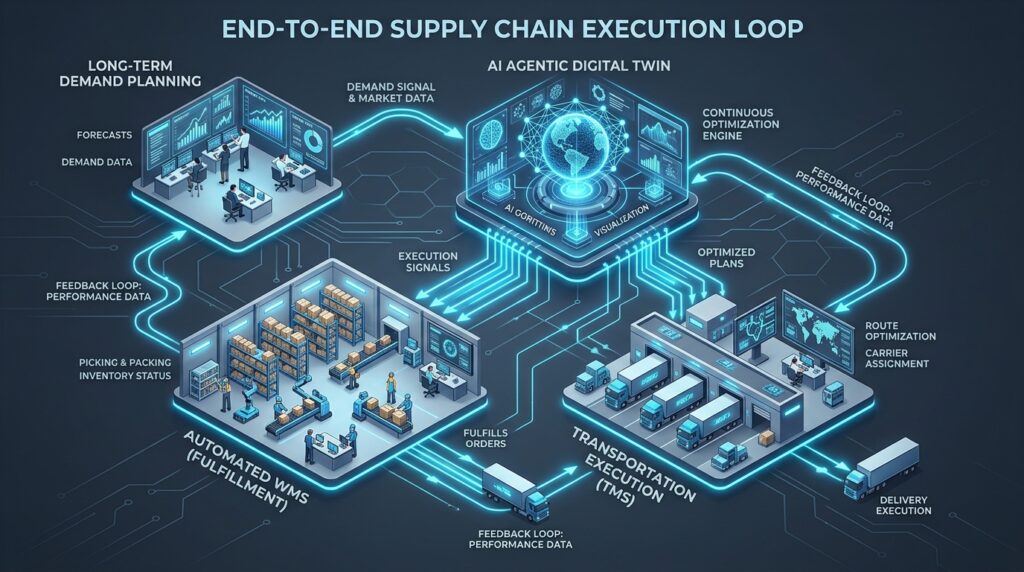
Blue Yonder provides an integrated, cloud-native supply chain planning and execution architecture built on a unified enterprise data layer. The platform bridges long-term demand planning, real-time transportation management (TMS), warehouse operations (WMS), and omni-channel order fulfillment into a single operational loop.
       [ Long-Term Demand Planning ]
                    │
                    ▼
       [ Blue Yonder Digital Twin ]
         ├── AI Agentic Automation
         └── Machine Learning Signals
                    │
                    ▼
 ┌──────────────────┴──────────────────┐
 │                                     │
 ▼                                     ▼
[ Warehouse (WMS) ]         [ Transportation (TMS) ]
Key Strengths
- Unified Execution Loop: Seamlessly connects demand sensing directly to physical execution nodes (warehouses and carriers).
- Cognitive Engine: The Blue Yonder Digital Twin uses agentic AI to simulate network disruptions and execute automated rerouting without requiring constant planner intervention.
- Proven Enterprise Scale: Documented ROI in high-volume environments, including carrier cost reductions of up to 7% at global 3PLs like DHL.
Limitations
- Implementation Complexity: Broad suite rollouts demand significant organizational change management and IT resources.
- Execution Scope Constraints: Mid-execution carrier re-tendering options can be restrictive if deployed separately from Blue Yonder’s native TMS environment.
Pricing
Custom enterprise licensing based on functional deployment, transaction volumes, and managed network nodes.
Editor’s Take
If your enterprise operates high-volume, multi-echelon retail, CPG, or 3PL distribution networks, then Blue Yonder offers one of the most mature choices available, because its ability to connect real-time demand signals directly to warehouse and transportation execution eliminates the operational lag typical of legacy platforms.
2. o9 Solutions
Best for Strategic Financial-to-Operational Alignment (IBP)
Product Overview
o9 Solutions operates as an enterprise decision-intelligence platform built for Integrated Business Planning (IBP), commercial analytics, and revenue management. It translates financial goals, sales targets, and physical supply constraints into an executive decision dashboard.
Key Strengths
- Graph Data Architecture: Its proprietary Digital Brain platform uses the APEX Enterprise Knowledge Graph to map commercial, financial, and operational variables simultaneously.
- Rapid Trade-Off Simulation: Enables executive teams to model the multi-million-dollar impacts of macro trends—such as sudden tariff adjustments or raw material spikes—in minutes.
Limitations
- Substantial Data Preparation: Populating the graph model requires extensive master data governance and transformation before deployment.
- High Total Cost of Ownership: Software licensing and integration services sit at the higher end of the enterprise software spectrum.
Pricing
Custom enterprise pricing structure, typically scoped around revenue throughput and organizational complexity.
Editor’s Take
If your primary operational challenge is a breakdown between financial planning and actual supply capacity, then o9 Solutions is an exceptional investment, because its graph-based platform forces cross-functional alignment faster than traditional relational-database tools.
3. Kinaxis Maestro
Best for Concurrent Multi-Echelon Planning and Rapid What-If Simulations
Product Overview
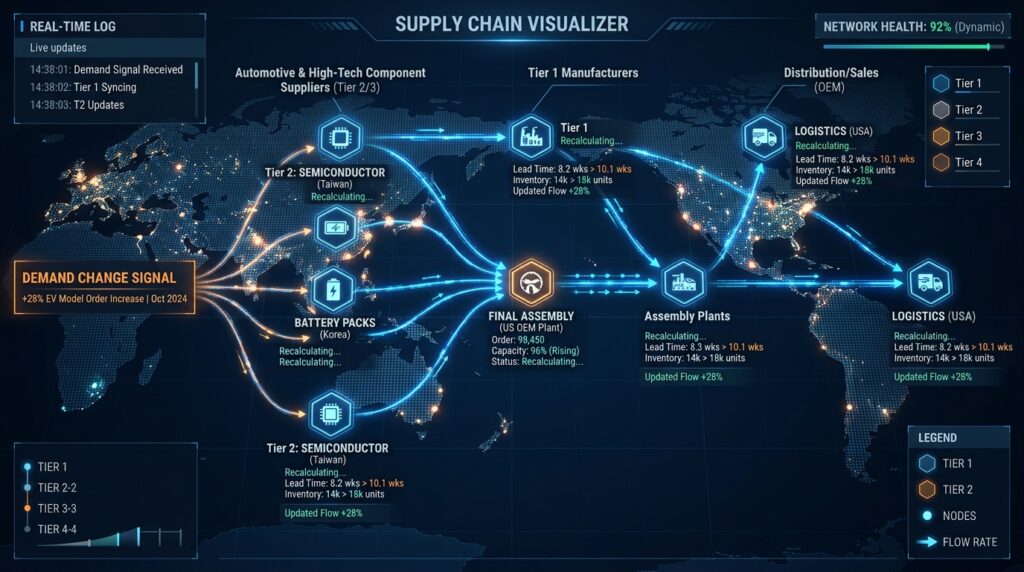
Kinaxis Maestro (formerly RapidResponse) is a supply chain orchestration engine built around continuous planning. Rather than processing batch schedules overnight, Maestro’s “Always-On” engine recalculates network dynamics instantly whenever an operational variable changes.
Key Strengths
- Patented Concurrent Engine: A change in downstream demand immediately updates production schedules, material requirements, and capacity constraints across the entire supply chain.
- Agentic AI Assistance: Machine learning agents scan for network exceptions and surface actionable resolution choices before disruptions impact customer delivery.
Limitations
- Integration Overhead: Connecting Maestro to non-native, highly fragmented legacy ERP landscapes can require custom API middleware.
- Administrative Learning Curve: High system flexibility requires dedicated, highly trained internal administrators.
Pricing
Enterprise subscription licensing mapped to network nodes, user roles, and system footprint.
Editor’s Take
If your organization manufactures complex discrete products with multi-tiered bills of materials (e.g., Automotive, Aerospace, High-Tech), then Kinaxis Maestro should top your shortlist, because its real-time concurrent calculation capabilities remove the latency inherent in traditional batch-run planning systems.
4. Oracle Fusion Cloud SCM
Best for Standardized Oracle Cloud ERP Environments
Product Overview
Oracle Fusion Cloud SCM is an end-to-end supply chain planning and execution suite native to the Oracle Cloud ERP ecosystem. It covers multi-echelon demand forecasting, inventory management, manufacturing execution, and logistics within a shared data model.
Key Strengths
- Single Data Architecture: Native integration across Oracle Cloud ERP, Financials, and Procurement eliminates data transformation pipelines.
- Embedded Planning Advisor: Integrated AI agents continuously review operational data to flag lead-time deviations, forecast anomalies, and configuration errors.
Limitations
- Heterogeneous Landscape Friction: Extending the platform into non-Oracle ERP or legacy environments often requires building custom API connectors.
- Static Carrier Tendering: Transportation allocation options rely more on predefined rules engines than dynamic real-time market spot-tendering.
Pricing
Tiered module pricing integrated into Oracle Cloud Enterprise Licensing agreements.
Editor’s Take
If your corporate IT architecture is already centered on Oracle Cloud ERP, then Oracle Fusion Cloud SCM is the most sensible deployment path, because leveraging its single data model avoids the integration maintenance costs associated with third-party planning tools.
5. OMP (Unison Planning)
Best for Complex Process Manufacturing and Batch/Recipe Environments

Product Overview
OMP’s Unison Planning platform provides specialized supply chain planning optimized for process manufacturing operations. It integrates long-term strategic planning, S&OP, campaign scheduling, and detailed floor execution into a single operational interface.
Key Strengths
- Process-Specific Constraint Engine: Modeled specifically to resolve complex batch processing variables, including recipe dynamics, shelf-life degradation, tank storage limits, and co-product yields.
- UnisonIQ Agentic AI: Automatically identifies process bottlenecks and recalculates production campaigns to minimize downtime and changeover waste.
Limitations
- Niche Application: Less suited for purely discrete assembly environments focused on complex mechanical BOM structures.
- Organizational Change Effort: Implementing detailed campaign scheduling requires extensive operational alignment between plant engineers and supply chain planners.
Pricing
Custom enterprise pricing based on plant count, system modules, and organizational footprint.
Editor’s Take
If you run continuous or batch process operations (Chemicals, Life Sciences, FMCG, Metals), then OMP is often superior to generalist planning tools, because its optimization algorithms are built specifically for complex recipe and yield constraints.
6. project44 (Movement)
Best for Global Real-Time Freight Visibility and Predictive ETA Tracking
Product Overview
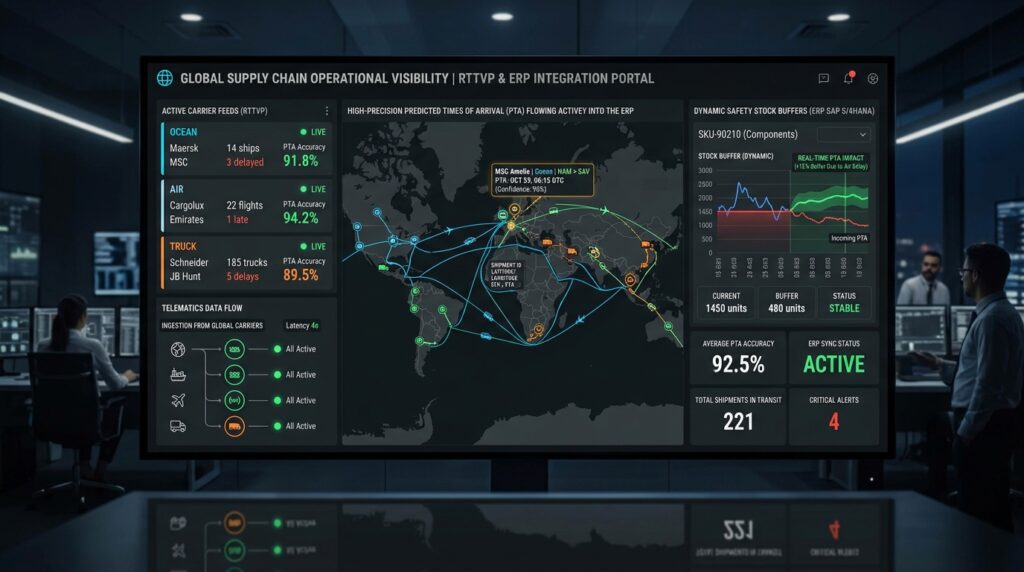
project44 Movement is an enterprise Real-Time Transportation Visibility Platform (RTTVP). It aggregates ocean, air, rail, truckload, and parcel telemetry data, converting raw signals into predictive transportation insights.
Key Strengths
- Carrier Network Reach: Connects directly to over 240,000 carrier networks globally.
- High-Accuracy PTA: Machine-learning engines clean raw telematics signals to deliver Predicted Time of Arrival updates at roughly 95% precision, helping cut warehouse dwell times by up to 20%.
Limitations
- Visibility-Focused Scope: project44 provides visibility and tracking; it is not a functional TMS for executing carrier freight tenders, contract negotiations, or freight settlements.
- Carrier Data Quality Dependency: Accuracy relies heavily on downstream carrier compliance with telematics and API data-sharing standards.
Pricing
Volume-based subscription models scaled on total annual shipment counts and tracked transportation modes.
Editor’s Take
If your supply chain suffers from transit blind spots and high demurrage/detention costs, then project44 is an essential operational layer, because feeding its high-accuracy PTAs directly into your planning engines reduces the need for expensive safety stock buffers.
7. FourKites
Best for Collaborative Control Towers and Supply Chain Exception Management

Product Overview
FourKites provides supply chain tracking, predictive transit analysis, and intelligent control tower applications. The system tracks movement across logistics networks, distribution facilities, and supplier nodes to provide end-to-end exception management.
Key Strengths
- AI Digital Workers: Automated software agents track freight movements, evaluate delay risks, and trigger automated alerts to carriers and receiving facilities.
- Cross-Ecosystem Collaboration: Simplifies communication between shippers, third-party logistics providers, and end customers within a single dashboard.
Limitations
- Strategic Planning Limitations: Designed primarily for execution visibility and short-term exception handling rather than multi-year S&OP network design.
Pricing
Custom enterprise pricing based on annual load volume, tracked modes, and active system modules.
Editor’s Take
If your logistics team spends too much time manually tracking down freight delays across multiple carriers, then FourKites provides immediate operational relief by automating exception workflows and carrier updates.
8. Logility (Aptean)
Best for Mid-Market Process Industry Planning
Product Overview
Logility (an Aptean company) provides a Decision Intelligence Platform that simplifies demand forecasting, inventory optimization, and S&OP execution. It gives mid-market businesses continuous, machine-learned planning tools without the extreme implementation overhead of tier-1 platforms.
Key Strengths
- Fast Time-to-Value: Out-of-the-box machine learning engines deliver rapid deployment cycles and an intuitive user experience.
- Targeted Process Functionality: Strong operational alignment with food & beverage, consumer products, and specialty chemical mid-market operations.
Limitations
- Integrator Ecosystem: Features a smaller network of global systems integration partners compared to legacy enterprise giants.
Pricing
Modular subscription pricing tailored to mid-market enterprise scope and operational footprint.
Editor’s Take
If you are a mid-market manufacturer seeking advanced demand sensing and inventory optimization without a multi-year IT implementation, then Logility is a compelling option, because it delivers essential AI planning capabilities in a streamlined, cost-effective package.
9. Coupa
Best for Strategic Supply Chain Network Design and Spend Optimization
Product Overview
Coupa unifies strategic supply chain network design (via its acquired LlamaSoft technology) with Business Spend Management (BSM) and procurement analytics. The platform helps enterprise teams model structural footprint adjustments alongside procurement data.
Key Strengths
- Prescriptive Network Optimization: Evaluates complex structural scenarios—including nearshoring choices, tax dynamics, landed costs, and carbon offsets—using optimization algorithms.
- Spend and Risk Integration: Links physical inventory flows directly to corporate spend, vendor risk, and procurement analytics.
Limitations
- Non-Execution Scope: Built for strategic network design and tactical planning; it is not meant for real-time warehouse execution or daily shop floor scheduling.
Pricing
Enterprise licensing structured around spend volume, optimization modules, and user scale.
Editor’s Take
If your business is restructuring its global network footprint or evaluating nearshoring options, then Coupa is a powerful tool, because it links supply chain network design directly to corporate procurement and spend analytics.
10. Manhattan Associates
Best for Converged Distribution, Warehouse (WMS), and Transportation (TMS) Execution
Product Overview
Manhattan Associates delivers software built for distribution execution, warehouse management (WMS), transportation management (TMS), and omnichannel fulfillment. The cloud-native Manhattan Active platform unites warehouse management directly with outbound logistics execution.
Key Strengths
- Execution Convergence: Unifies warehouse labor management, picking routines, and transportation tendering within a single processing platform.
- Active AI Optimization: Uses machine learning algorithms to dynamic-route picking paths, schedule dock appointments, and maximize trailer space utilization.
Limitations
- High Implementation Overhead: Requires significant technical expertise, system configuration, and capital investment to deploy fully.
Pricing
Custom enterprise licensing structured around facility footprints, throughput volumes, and active platform modules.
Editor’s Take
If you operate high-volume fulfillment distribution hubs or complex omnichannel retail fulfillment centers, then Manhattan Associates remains the industry benchmark, because its ability to optimize warehouse operations alongside outbound transportation execution is unmatched.
Buying Advice & Enterprise Selection Framework

Selecting enterprise supply chain software requires matching platform architectures to your specific operational drivers rather than chasing generic feature lists.
                          [ Define Primary Operational Bottleneck ]
                                             │
      ┌──────────────────────────────────────┼──────────────────────────────────────┐
      ▼                                      ▼                                      ▼
[ High BOM / Assembly ]             [ Complex Process / Batch ]             [ Multi-Carrier Logistics ]
  • Kinaxis Maestro                   • OMP (Unison)                          • project44 / FourKites
  • Blue Yonder                       • Logility                              • Manhattan Associates
Strategic Recommendations by Enterprise Situation
Scenario 1: High-BOM Discrete Manufacturing (Automotive, High-Tech, Aerospace)
- The Challenge: Managing multi-tiered assembly components where a delay in a single sub-component halts the entire production line.
- Primary Recommendation: Kinaxis Maestro or Blue Yonder.
- Reasoning: These platforms specialize in continuous, multi-echelon concurrent planning. When a supplier lead time drifts, the system instantly recalculates component availability and adjustments across all bill-of-materials layers.
Scenario 2: Batch and Process Operations (Chemicals, Pharmaceuticals, CPG, Metals)
- The Challenge: Balancing campaign schedules while managing recipe constraints, shelf-life restrictions, tank storage, and variable yield outputs.
- Primary Recommendation: OMP (Unison Planning) or Logility.
- Reasoning: Generalist planning tools often struggle with process industry realities like tank fill constraints or yield variations. OMP is built specifically to handle these physical continuous-manufacturing rules out of the box.
Scenario 3: Large-Scale Retail and Omnichannel Execution
- The Challenge: Coordinating dynamic order fulfillment across distribution centers, physical retail locations, and carrier networks while keeping inventory carrying costs down.
- Primary Recommendation: Blue Yonder or Manhattan Associates.
- Reasoning: Both vendors excel at unifying planning with physical execution. Manhattan leads in high-throughput warehouse and distribution environments, while Blue Yonder excels across multi-echelon inventory and replenishment planning.
Scenario 4: Global Logistics Visibility and Exception Management
- The Challenge: Eliminating blind spots across ocean, air, and over-the-road freight movements to cut demurrage costs and improve customer arrival estimates.
- Primary Recommendation: project44 or FourKites.
- Reasoning: Implementing a full ERP or planning suite transformation takes time, whereas project44 and FourKites can layer over your existing TMS and ERP tools quickly to deliver real-time predictive tracking and exception handling.
Editor’s Perspective: Critical Implementation Realities
Deployment Insight: The Data Governance Reality Check
Installing an AI-driven supply chain platform will not fix bad data. The primary failure mode in enterprise AI deployments is poor master data quality.
If your organization’s ERP master files contain inaccurate supplier lead times, incorrect bill-of-material quantities, or outdated pallet dimensions, an AI engine will simply automate bad execution decisions faster. Prioritize cleaning your foundational master data alongside software vendor procurement—not after contract signing.
Frequently Asked Questions
What is the primary difference between traditional supply chain planning and agentic AI planning?
Traditional supply chain planning relies on batch-processed algorithms that run at fixed intervals (e.g., nightly or weekly) and require planners to manually investigate variances and execute plan updates across ERP systems. Agentic AI platforms continuously analyze real-time data streams, detect deviations automatically, evaluate multi-variable trade-offs, and execute corrective choices (such as re-tendering a shipment or adjusting a reorder point) within set corporate governance boundaries.
Why shouldn’t an enterprise simply rely on standard ERP supply chain modules?
While modern cloud ERP systems handle transactional record-keeping, procurement workflows, and order management well, they often lack the advanced computational power required for real-time concurrent planning, complex process constraint optimization, or predictive transit visibility. Dedicated AI planning platforms layer on top of ERP engines to provide deeper analytical depth and rapid what-if scenario testing.
How do real-time visibility platforms (RTTVPs) integrate with enterprise supply chain planning platforms?
Visibility platforms like project44 and FourKites collect raw telematics, port signals, and carrier telemetry, converting them into precise, machine-learned Predicted Times of Arrival (PTA). These updated transit metrics are ingested by planning engines like Kinaxis, Blue Yonder, or OMP, which automatically adjust downstream inventory buffers, production start times, and labor schedules based on actual freight positions.
Final Recommendation
- Choose Kinaxis Maestro if your business requires continuous, real-time concurrent planning across complex, multi-tiered assembly networks.
- Choose Blue Yonder if you need an end-to-end planning platform that connects demand sensing directly to warehouse and transportation execution.
- Choose OMP if you run continuous or batch process manufacturing operations with complex recipe and yield constraints.
- Choose o9 Solutions if your executive team needs to align financial P&L targets directly with operational supply capacity and scenario planning.
- Deploy project44 or FourKites alongside your enterprise software stack if tracking accuracy, demurrage reduction, and real-time logistics visibility are your top operational priorities.
Next Steps for Technology Decision-Makers:
- Audit Master Data Integrity: Evaluate lead times, BOM accuracy, and vendor master data before initiating platform procurement.
- Identify Primary Operational Constraints: Determine whether your main operational bottleneck stems from strategic planning lag, physical warehouse/transportation execution, or transit visibility.
- Request Targeted Proof-of-Concept (PoC) Demos: Challenge software vendors to run scenario simulations using your organization’s actual historical supply chain data rather than standardized vendor demonstration models.
To evaluate how enterprise supply chain platforms compare with underlying AI compute infrastructure, bare-metal hosting, and MLOps pipelines, explore our technical benchmarks across the enterprise tech ecosystem:
- Enterprise AI Infrastructure & Decision Matrices: Compare hosting paradigms in our Bare-Metal vs Workstation vs Serverless GPU Decision Matrix and evaluate cloud unit economics in the AWS EC2 vs RunPod vs Hyperbolic Review.
- Custom LLM Deployment & MLOps Pipelines: Learn how serverless workers deploy specialized reasoning models in Deploying Serverless DeepSeek-R1 on RunPod with vLLM and calculate private GPU requirements in the Sovereign LLM Hardware Sizing Guide on Lambda.
- Bare-Metal Performance & Bandwidth: Host single-tenant private models in Deploying DeepSeek-R1 on NovoServe Bare-Metal and eliminate cloud transit overhead in How to Slash Cloud Egress Fees. Bookmark AI Review Zones for continuous enterprise software benchmarks.
References
- Oracle Corporation. Oracle Named a Leader in 2026 Gartner® Magic Quadrant™ for Supply Chain Planning Solutions. oracle.com
- OMP. OMP Positioned Highest in 2026 Gartner® Magic Quadrant™ for Supply Chain Planning Solutions: Process Industries. omp.com
- Blue Yonder. Blue Yonder Named a Leader in 2026 Gartner® Magic Quadrant™ for Supply Chain Planning Solutions: Discrete Industries. blueyonder.com
- o9 Solutions. 2026 Gartner® Magic Quadrant™ Evaluation for Supply Chain Planning Solutions. o9solutions.com
- Logility / Aptean. Aptean (Logility) Positioned as a Leader in 2026 Gartner® Magic Quadrant™ for Process Industries. logility.com
- project44. Movement Platform Architecture and Transit Visibility Benchmark Analysis. project44.com
- Gartner Peer Insights. Enterprise Supply Chain Planning Software Reviews & Market Ratings. gartner.com