
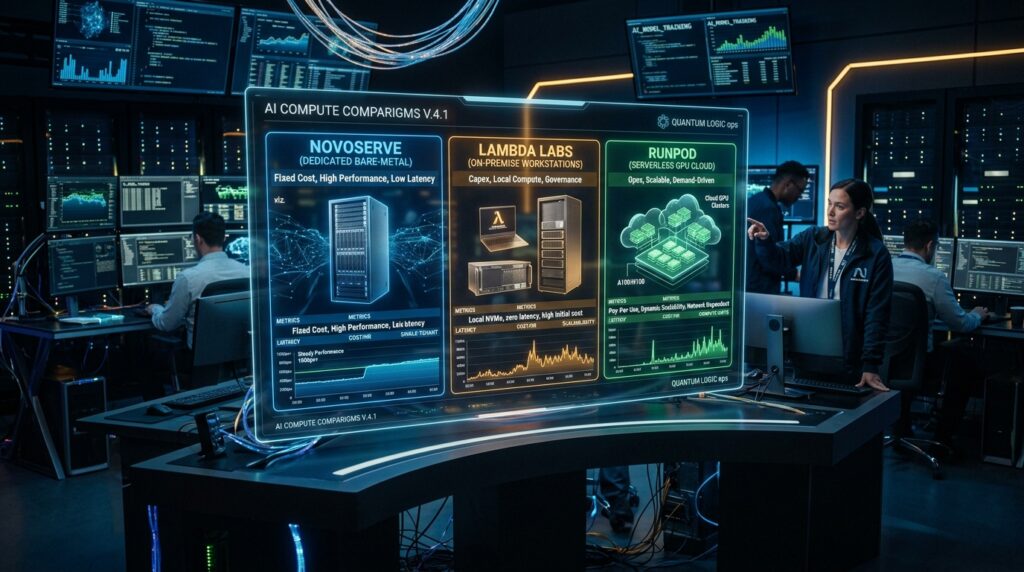
When building an enterprise compute strategy for Bare-Metal vs Workstation vs Serverless GPU infrastructure in 2026, as generative AI models and multi-agent systems transition from research prototypes into high-throughput production environments, enterprise technology leaders face a stark realization: compute efficiency dictates software gross margins. High Bandwidth Memory (HBM) allocation demands have squeezed standard server DRAM wafer supply, driving up memory and NAND flash costs across the supply chain. At the same time, unoptimized inference pipelines can quickly become an enterprise’s largest variable line item.
Evaluating where to host GPU workloads is no longer just a technical preference for DevOps. It is a core strategic decision. This guide breaks down the three dominant compute delivery paradigms—Dedicated Unmetered Bare-Metal, On-Premise Workstations/Clusters, and Secondary Serverless Cloud Platforms—to help enterprise decision-makers choose the right infrastructure path.
Quick Summary & Executive Decision Matrix
| Dimension | Dedicated Unmetered Bare-Metal (e.g., NovoServe) | On-Premise Workstation / Cluster (e.g., Lambda) | Secondary / Serverless Cloud (e.g., RunPod, Hyperbolic) |
| Execution Layer | Single-tenant physical host | Enterprise-owned physical hardware | Elastic container instances |
| Hypervisor Tax | 0% (Direct PCIe / NVLink) | 0% (Direct physical access) | 3% to 8% (Container virtualization) |
| Cost Model | Predictable flat monthly fee | Upfront CAPEX + Data Center OPEX | Pay-per-active-second |
| Network Egress | Unmetered (Included in flat rate) | Zero vendor fee (Internal network) | Variable / Platform dependent |
| Provisioning Speed | Hours to 1 Day | Weeks (Procurement & Racking) | Sub-second to Minutes |
| Target Utilization | 60% to 100% Continuous Load | 70% to 100% Steady-State | Intermittent / Bursty (< 50%) |
| Data Sovereignty | High (Dedicated isolated tenant) | Maximum (Air-gapped internal) | Moderate (Multi-tenant cloud) |
1. Bare-Metal vs Workstation vs Serverless GPU Architecture Analysis
                              ENTERPRISE GPU COMPUTE TAXONOMY
                                             |
       +-------------------------------------+-------------------------------------+
       |                                     |                                     |
       v                                     v                                     v
+-------------------------------+   +-------------------------------+   +-------------------------------+
|  DEDICATED UNMETERED BARE-METAL|   |  ON-PREMISE WORKSTATION/CLUSTER|   |  SECONDARY / SERVERLESS CLOUD |
|    (e.g., NovoServe Platform) |   |   (e.g., Lambda Hardware)     |   |  (e.g., RunPod / Hyperbolic)  |
+-------------------------------+   +-------------------------------+   +-------------------------------+
| • 0% Hypervisor overhead      |   | • 100% Data Sovereignty & PII |   | • Pay-per-second execution    |
| • Unmetered Network Pipeline  |   | • Zero Variable Egress Fees   |   | • Scale-to-Zero capability    |
| • Fixed Monthly Cost          |   | • High Upfront CAPEX          |   | • Fast Cold-Start Deployments |
| • Ideal for 24/7 Production   |   | • Ideal for Air-Gapped R&D    |   | • Ideal for Spiky / Fine-Tune |
+-------------------------------+   +-------------------------------+   +-------------------------------+
Dedicated Unmetered Bare-Metal Architecture
Dedicated bare-metal GPU infrastructure provisions physical hardware directly to a single enterprise tenant. By eliminating Type-1 or Type-2 hypervisors (such as KVM or ESXi), the host operating system directly manages PCIe root complexes and system memory.
For continuous Large Language Model (LLM) matrix operations, removing virtual vCPU scheduling and memory translation penalties yields a 15% to 25% throughput uplift compared to virtualized public cloud instances on identical silicon.
Beyond raw execution speed, dedicated bare-metal platforms like NovoServe solve a major enterprise pain point: network egress volatility. Rather than charging per gigabyte for outbound traffic—which can trigger unexpected cost spikes during continuous API streaming—bare-metal providers offer dedicated, unmetered physical pipes (typically 1 Gbps to 10 Gbps per host). This makes bare-metal the baseline of choice for continuous, 24/7 production inference.
Editor’s Perspective:
If your primary operational risk is unpredictable monthly cloud bills caused by scaling user requests, unmetered bare-metal removes the variable pricing penalty entirely without requiring you to build out your own data center.
On-Premise GPU Workstations and Private Clusters
On-premise infrastructure—ranging from localized liquid-cooled workstations (such as Lambda Vector systems) to full co-location data center racks—operates on a classic Capital Expenditure (CAPEX) model.
The rationale for on-premise hardware centers on absolute data sovereignty and regulatory compliance (e.g., HIPAA, GDPR, SOC2, ITAR). Because training data and proprietary model weights remain on hardware owned and physically managed by the enterprise, external cloud exposure is completely eliminated.
Over a standard 3-year depreciation cycle operated at high utilization, on-premise compute yields a low marginal cost per GPU hour. However, it exposes the enterprise to component supply chain friction, hardware obsolescence, and facility maintenance costs ($100–$350 per kW/month for power and cooling).
Operational Insight:
Owning hardware makes sense when dataset privacy is non-negotiable. But remember to factor in ongoing operational maintenance—hardware deprecation and component replacements can quickly offset theoretical compute savings if engineering teams are forced to act as data center admins.
Secondary / Serverless GPU Cloud Architectures
Serverless GPU platforms, such as RunPod and Hyperbolic, abstract physical infrastructure behind containerized execution environments. Workloads are packaged as container images deployed onto managed clusters that automatically scale worker nodes up or down based on incoming request queue depths.
The primary technical advantage here is scale-to-zero agility. Rapid container initialization frameworks allow serverless instances to resume from snapshots and load model weights into VRAM with sub-200ms cold starts.
The financial trade-off is a higher active rate per compute hour in exchange for paying nothing when the system is idle. This makes serverless ideal for erratic user traffic, bursty micro-fine-tuning runs, or periodic batch processing.
2. Total Cost of Ownership (TCO) & Inflection Points
Evaluating infrastructure expenditure requires analyzing both upfront capital and ongoing operational line items across four main areas:
$$\text{TCO} = \text{CAPEX} + \sum_{m=1}^{N} (\text{OPEX}_{\text{compute}, m} + \text{OPEX}_{\text{facility}, m} + \text{OPEX}_{\text{egress}, m})$$
Where $N$ represents the total operational lifespan in months.
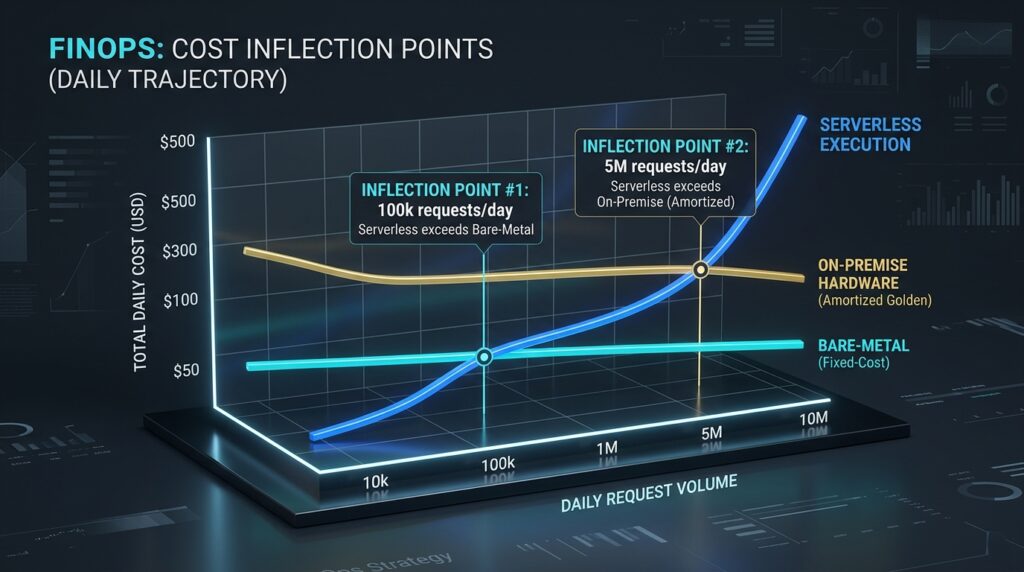
                        INFRASTRUCTURE FINANCIAL TRAJECTORY
  Monthly Cost ($)
    ^
    |                                                                       / [Serverless Cloud]
    |                                                                      /  (RunPod Active Exec)
    |                                                                     /
    |                                              INFLECTION POINT 2    /
    |                                             (~500k req/day)       /
    |                                                   |              /
    |                                                   v             /
    |                                             +------------------+
    |                                            /  [Bare-Metal]     |
    |                                           / (NovoServe Fixed)  |
    |                     INFLECTION POINT 1   /                     +-- [On-Premise Cluster]
    |                    (~100k req/day)      /                          (Lambda Amortized)
    |                          |             /
    |                          v            /
    |                    +-----------------+
    |                   /   [Serverless]   |
    |                  /                   |
    +-----------------+--------------------+--------------------------------------------------->
    Phase A (10k req/day)      Phase B (500k req/day)                   Phase C (10M req/day)
    [Low Duty Cycle: <15%]     [Baseline Load: ~68%]                    [Hyper-Scale: >92%]
Inflection Point 1: Serverless to Bare-Metal (~100,000 Requests/Day)
When application traffic is low or spiky (Phase A), serverless platforms offer excellent cost protection because idle infrastructure incurs zero charge.
However, once daily request volume approaches 100,000 requests/day, total GPU utilization moves into a continuous baseline demand exceeding 60% to 66% capacity. At this threshold, serverless billing becomes inefficient.
When a workload runs continuously above a 60% duty cycle, paying premium active-execution rates on serverless becomes significantly more expensive than locking in a fixed-rate bare-metal server. Shifting baseline production to dedicated bare-metal (such as NovoServe fixed monthly instances) caps monthly expenditures and protects software gross margins.
Inflection Point 2: Bare-Metal to On-Premise Clusters (>5,000,000 Requests/Day)
Migrating from managed bare-metal servers to enterprise-owned hardware requires balancing capital allocation against administrative overhead. On-premise deployments demand heavy upfront CAPEX alongside facilities management.
While owned hardware amortizes well at massive scale (>5M requests/day), volatile component pricing can introduce unexpected hurdles. Fluctuations in enterprise SSD prices and DDR5 memory modules make hardware procurement planning more complex. Managed bare-metal providers absorb these hardware inflation and depreciation risks, making bare-metal a compelling alternative to building out internal co-location space.
3. Production-Ready Hybrid Infrastructure Architecture
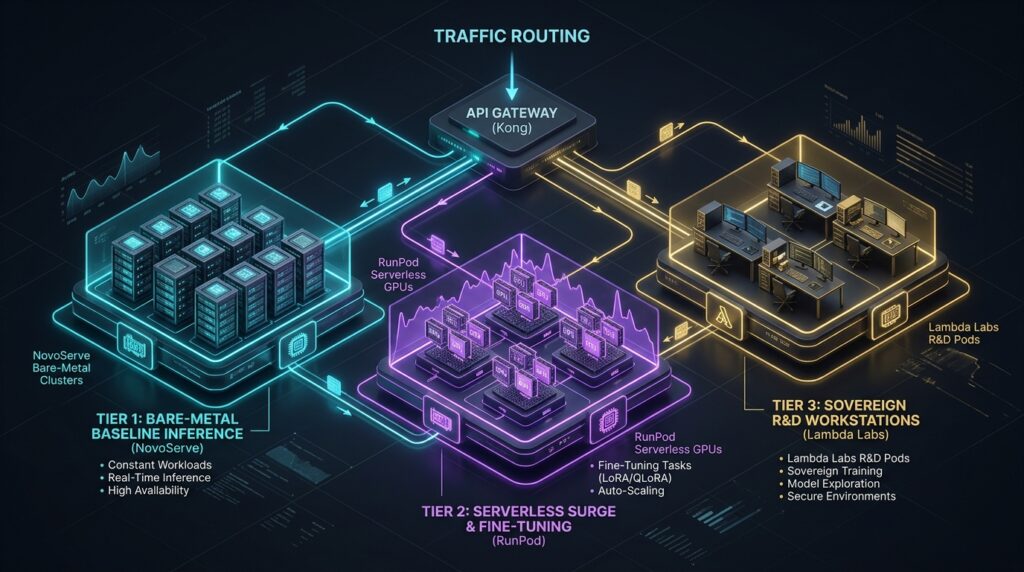
Enterprise AI operations rarely rely on a single infrastructure provider. The most efficient design is a Tri-Tier Hybrid Architecture that routes workloads based on capacity needs, latency targets, and data sensitivity.
                          [ Enterprise User Request Ingress ]
                                           |
                                           v
                       +---------------------------------------+
                       |   API Gateway & Dynamic Traffic Router |
                       |   (Latency & Queue Depth Inspector)   |
                       +---------------------------------------+
                                           |
            +------------------------------+------------------------------+
            |                              |                              |
            | (Baseline Production)        | (Surge / Spike Traffic)      | (Sensitive Datasets)
            v                              v                              v
+-----------------------+      +-----------------------+      +-----------------------+
|  TIER 1: BARE-METAL   |      |   TIER 2: SERVERLESS  |      |   TIER 3: ON-PREMISE  |
|      (NovoServe)      |      |       (RunPod)        |      |     (Lambda Labs)     |
|                       |      |                       |      |                       |
| • vLLM Primary Nodes  |      | • FlashBoot Workers   |      | • Core IP R&D         |
| • Unmetered Egress    |      | • Auto-scale 0 -> N   |      | • Local Dataset Prep  |
| • 24/7 API Inference  |      | • Bursty Fine-Tuning  |      | • Air-Gapped Models   |
+-----------------------+      +-----------------------+      +-----------------------+
Tier 1: Baseline Inference Engine (NovoServe Dedicated Bare-Metal)
- Role: Serves continuous baseline API requests, live streaming LLM queries, and high-concurrency production workflows.
- Setup: Dedicated bare-metal chassis (e.g., HPE or Supermicro systems) housing multi-GPU configurations running bare-metal Linux with direct vLLM or TensorRT-LLM engines.
- Networking: Dedicated, unmetered network links (5 Gbps to 10 Gbps) linked to edge gateways, delivering zero-egress token streaming without bandwidth limits or overage penalties.
Tier 2: Elastic Surge & Fine-Tuning Engine (RunPod Serverless Cloud)
- Role: Absorbs traffic spikes that exceed Tier 1 capacity, executes async batch pipelines, and handles periodic LoRA/QLoRA fine-tuning.
- Setup: Containerized serverless worker instances utilizing snapshot management for sub-200ms cold starts.
- Networking: Auto-scaling endpoints that trigger when Tier 1 queue depths or latency metrics breach defined thresholds (e.g., Time-to-First-Token TTFT > 150ms).
Tier 3: Sovereign R&D & Core Training (Lambda Labs Workstations/Clusters)
- Role: Pre-trains proprietary models, evaluates experimental architectures, and processes confidential enterprise data.
- Setup: Liquid-cooled workstations or dedicated co-location racks connected via high-speed NVLink interconnects.
- Networking: Air-gapped internal network segment behind zero-trust access controls, synchronizing verified model checkpoints outward to the production registry.
4. Final Recommendation & Strategic Guidance
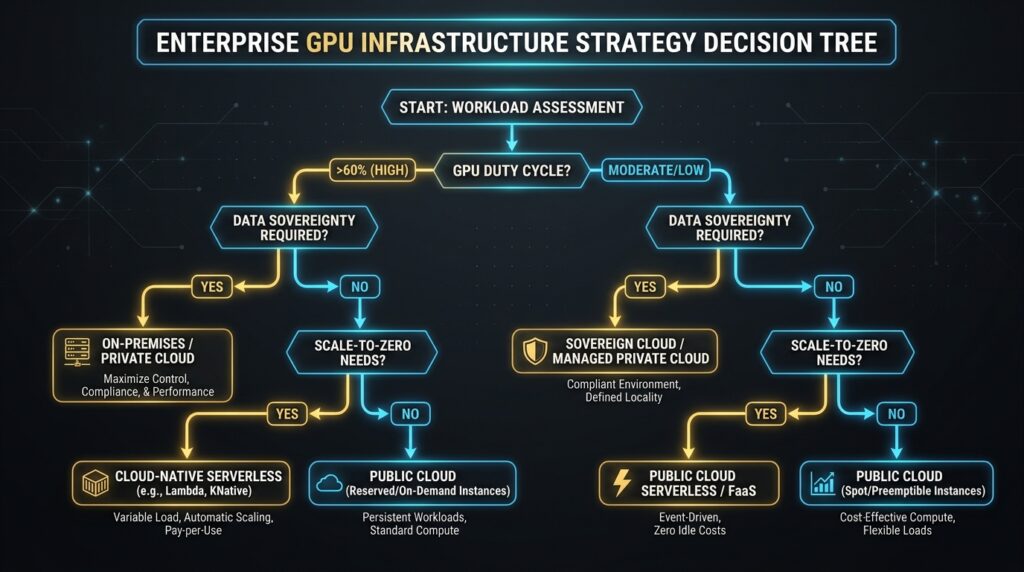
                Is your average GPU Duty Cycle > 60%?
                                 |
                 +---------------+---------------+
                 |                               |
              [ YES ]                         [ NO ]
                 |                               |
                 v                               v
    Is Air-Gapped Data Isolation          USE SECONDARY SERVERLESS CLOUD
    Strictly Required?                    (RunPod / Hyperbolic)
                 |                        • Scale-to-Zero Efficiency
         +-------+-------+                • Pay-Per-Second Billing
         |               |                • Zero Idle Cost
      [ YES ]         [ NO ]
         |               |
         v               v
   USE ON-PREMISE   USE DEDICATED UNMETERED BARE-METAL
   WORKSTATIONS     (NovoServe)
   (Lambda Labs)    • Fixed Monthly Cost / Zero Egress
   • Complete Control• 15-25% Virtualization Uplift
   • Zero Cloud Fee • Ideal for 24/7 API Serving
Choose Dedicated Unmetered Bare-Metal (e.g., NovoServe) if:
- Your sustained GPU duty cycle consistently exceeds 60%.
- Your business model streams large volumes of outbound API token data, making variable cloud egress charges an operational risk.
- You need maximum compute throughput per dollar without hypervisor delays.
- You prefer predictable, flat monthly OPEX over long-term capital lockup.
Choose On-Premise Workstations or Clusters (e.g., Lambda) if:
- Strict compliance frameworks (HIPAA, GDPR, ITAR) require complete physical control over sensitive IP and data pipelines.
- Your engineering team conducts continuous foundation model pre-training with stable, long-term utilization.
- You operate in-house data center facilities equipped for high-density power and cooling.
Choose Secondary Serverless Cloud (e.g., RunPod / Hyperbolic) if:
- Your traffic is highly erratic, spiky, or early-stage, with average GPU duty cycles under 50%.
- Scale-to-zero performance is required to avoid paying for idle infrastructure during off-peak hours.
- You need elastic, burstable compute for asynchronous batch pipelines or periodic fine-tuning jobs.
To evaluate specific platforms, hardware configurations, and network economics within each layer of the decision matrix, explore our technical benchmarks across the enterprise AI infrastructure ecosystem:
- Tier 1 — Dedicated Bare-Metal & Egress Optimization: Learn how to eliminate cloud exit taxes in How to Slash Cloud Egress Fees, deploy production models in Deploying DeepSeek-R1 on NovoServe Bare-Metal, and review flat-rate hosting models in NovoServe vs Hetzner vs DigitalOcean Review.
- Tier 2 — Secondary Cloud & Serverless Execution: Master worker deployments in Deploying Serverless DeepSeek-R1 on RunPod with vLLM and compare provider unit economics in AWS EC2 vs RunPod vs Hyperbolic Review.
- Tier 3 — On-Premise Workstations & Private Clusters: Calculate hardware VRAM requirements in Sovereign LLM Hardware Sizing Guide on Lambda and evaluate hardware CAPEX vs OPEX in Turn-Key vs DIY GPU Nodes TCO Analysis. Bookmark AI Review Zones for continuous MLOps coverage.
References
- NovoServe B.V.Bare Metal Hosting & Global Dedicated Server Infrastructure Solutionshttps://www.novoserve.com
- NovoServe B.V.The Impact of Global Hardware and Memory Trends on Dedicated Infrastructurehttps://www.novoserve.com/news
- RunPod Inc.RunPod AI Developer Cloud: Serverless GPU Specifications and Billing Modelhttps://www.runpod.io
- Lambda Labs Inc.Deep Learning Infrastructure, Vector Workstations, and GPU Cloud Specificationshttps://lambdalabs.com
- Hyperbolic LabsOpen-Access GPU and Decentralized LLM Inference Platform Documentationhttps://hyperbolic.xyz
What to Do Next
- Audit Your GPU Duty Cycle: Calculate your average compute utilization across a 30-day window. If your duty cycle is consistently above 60%, audit your current cloud invoice to see how much you are paying for variable execution and network egress.
- Benchmark Your Ingress Bottlenecks: Measure your application’s Time-to-First-Token (TTFT). Test whether hypervisor latency on virtualized cloud instances is impacting your live inference SLAs.
- Draft a Hybrid Architecture Plan: If you run continuous production workloads alongside spiky batch fine-tuning, benchmark a dual-tier setup using dedicated unmetered bare-metal for baseline traffic and serverless instances for surge capacity.