
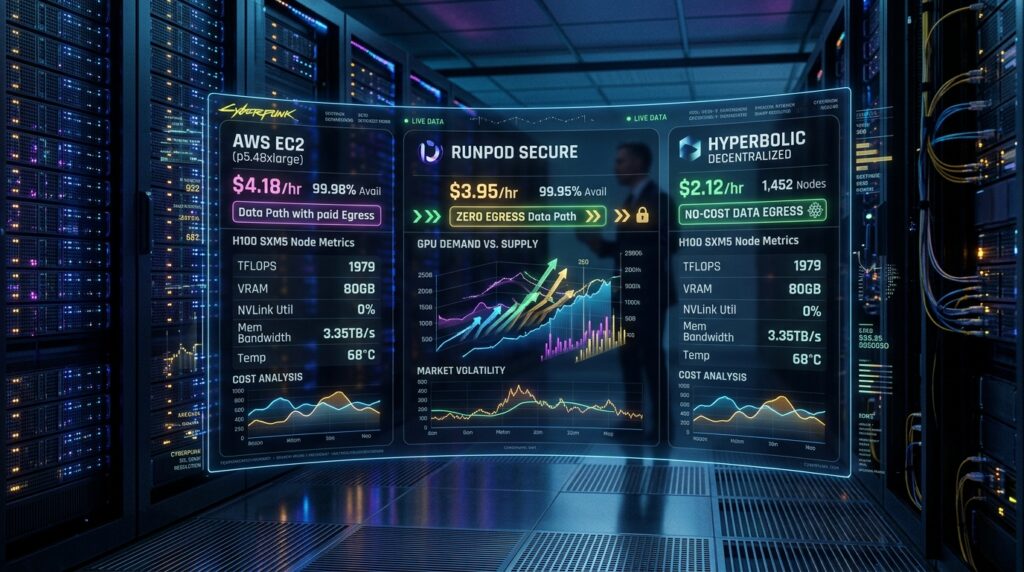
When evaluating an AWS EC2 vs RunPod vs Hyperbolic infrastructure strategy in 2026, selecting compute infrastructure is no longer a straightforward choice between legacy hyperscalers. Enterprise MLOps teams and infrastructure architects face a structural market shift: an economic and technical divergence between incumbent cloud giants, specialized secondary GPU clouds, and decentralized compute networks.
As frontier model architectures stabilize around specialized Mixture-of-Experts (MoE) designs, the real challenge moves from raw parameter scale to unit economics, network topologies, and risk management.
Choosing between AWS EC2, RunPod, and Hyperbolic isn’t about finding a single “best” platform—it’s about matching your specific compute workload to the right infrastructure layer.
Quick Summary
| Provider Tier | Top Workload Fit | Key Advantage | Chief Trade-off |
| AWS EC2 (Hyperscaler) | Multi-node distributed pre-training (>70B) | 3,200 Gbps EFA v2 networking; strict SOC 2/HIPAA compliance | Highest raw hourly rates; expensive network egress fees |
| RunPod Secure Cloud | Single-node fine-tuning & enterprise LoRA | 56% lower cost than AWS On-Demand; zero egress fees | Restricted multi-node scale-out capacity |
| RunPod Community Cloud | Non-sensitive hyperparameter sweeps | Maximum hourly savings (up to 65% off AWS) | Zero SLA guarantees; unverified host physical security |
| Hyperbolic (Decentralized) | Asynchronous batch inference & fault-tolerant tasks | Cost-effective pricing; cryptographic execution verification (PoSP) | Public WAN latency; reliant on hardware TEEs for privacy |
Unit Economics: Pricing & Hidden Overhead
Evaluating compute infrastructure strictly by listed hourly GPU rates creates budget overruns. Total Cost of Ownership (TCO) must factor in raw rental fees alongside network egress, storage state retention, and minimum usage terms:
$$\text{TCO} = \text{Compute Execution} + \text{Network Egress} + \text{Active Storage} + \text{Idle Storage Overhead}$$
Hourly GPU Benchmark Comparison
The price spread between virtualized hyperscaler instances and lean secondary execution environments is substantial across common hardware accelerators:
| Accelerator SKU | Hardware Spec | AWS On-Demand | AWS 1-Yr Savings Plan | RunPod Secure Cloud | RunPod Community | Hyperbolic Marketplace |
| NVIDIA H100 80GB | SXM5 / NVLink 4 | $6.88 / hr | $2.97 / hr | $2.99 / hr | $2.69 / hr | $3.20 / hr |
| NVIDIA A100 80GB | SXM4 / NVLink 3 | $3.43 / hr | $2.37 / hr | $1.49 / hr | $1.39 / hr | $1.80 / hr |
| NVIDIA L40S 48GB | PCIe Gen5 | $1.86 / hr | $1.17 / hr | $0.99 / hr | $0.79 / hr | $0.95 / hr |
| 8x H100 Node | SXM5 Cluster | $55.04 / hr | $23.78 / hr | $23.92 / hr | $21.52 / hr | $25.60 / hr |
Calculating the Margin Impact
Running an NVIDIA H100 SXM accelerator on RunPod Secure Cloud ($2.99/hr) delivers a 56.5% cost reduction compared to AWS On-Demand ($6.88/hr).
For long-term, non-committal execution, RunPod Community Cloud ($2.69/hr) remains 9.4% cheaper than a locked-in 1-Year AWS Savings Plan ($2.97/hr), completely bypassing capital lockup risks.
For mid-tier workloads like fine-tuning on an NVIDIA L40S, moving from an AWS g6e.xlarge instance ($1.86/hr) to RunPod Secure ($0.99/hr) saves 46.8% per hour.
Cost of a 72-Hour Fine-Tuning Run (64x NVIDIA H100 SXM Cluster):
├── AWS EC2 (p5.48xlarge On-Demand):  $31,703
├── Hyperbolic Decentralized Cloud:   $14,745  (-53.5%)
├── RunPod Secure Cloud:              $13,778  (-56.5%)
└── RunPod Community Cloud:           $12,395  (-60.9%)
The Fine Print: Egress and Storage Multipliers
- Data Egress: AWS charges $0.05 to $0.09 per GB for outbound internet transfers. Offloading a 2TB fine-tuned model checkpoint from AWS to an external registry costs roughly $175 in bandwidth alone. RunPod and Hyperbolic enforce a zero-egress model, permitting unlimited checkpoint transfers.
- Storage Footprint: AWS EBS GP3 volumes cost a flat $0.08/GB/month plus provisioned IOPS fees. RunPod charges $0.10/GB/month for active Pod storage, but doubles this rate to $0.20/GB/month for stopped Pods to discourage storage squatting. Unmonitored, stopped container states on RunPod can quietly erode compute savings.
Editor’s Perspective:
Compute cost shouldn’t be evaluated in a vacuum. If your workflow requires pulling fine-tuned 70B adapter weights across regions multiple times a day, AWS egress penalties can quickly offset your volume discounts. Secondary clouds turn bandwidth into an operational non-factor.
Hardware Interconnects, Storage I/O & SLAs
Performance bottlenecks vary depending on your workload type. Multi-node distributed pre-training is usually bound by network latency during gradient synchronization (AllReduce), whereas high-throughput batch inference is limited by memory bandwidth and disk read performance.
                       Interconnect Architecture

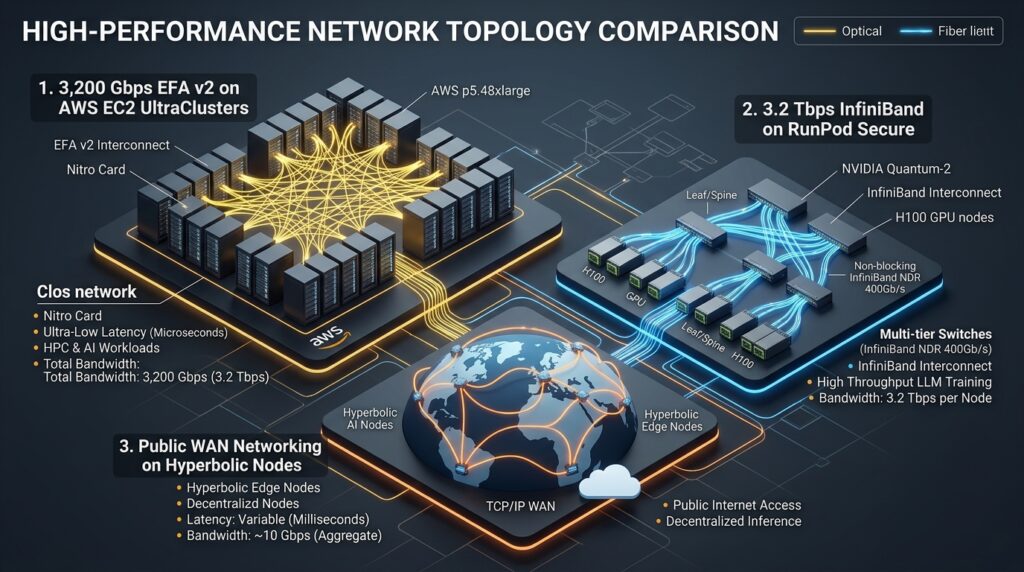
       AWS EC2 (P5)               RunPod Secure            Hyperbolic
┌─────────────────────────┐  ┌─────────────────────┐  ┌─────────────────┐
│     8x H100 SXM5        │  │    8x H100 SXM5     │  │ H100 PCIe Nodes │
│  (NVSwitch - 900 GB/s)  │  │ (NVLink Mesh Host)  │  │ (Local PCIe)    │
└────────────┬────────────┘  └──────────┬──────────┘  └────────┬────────┘
             │                          │                      │
    3,200 Gbps EFA v2          3.2 Tbps InfiniBand       Public Internet
  (GPUDirect RDMA Scale)      (Local Data Center)       (WAN Connectivity)
Network Topologies & Scale-Out Bandwidth
AWS P5 instances (p5.48xlarge) connect eight NVIDIA H100 SXM GPUs using internal NVSwitch architecture at 900 GB/s bi-directional throughput. For multi-node execution, AWS relies on 3,200 Gbps EFA v2 networking backed by Nitro v5 hardware interface cards, enabling low-latency GPUDirect RDMA scaling across thousands of GPUs in EC2 UltraClusters.
RunPod Secure features identical intra-node SXM NVLink topologies. Multi-node capability inside dedicated RunPod Clusters uses 3.2 Tbps InfiniBand or RoCEv2 fabrics. However, instant, self-serve multi-node cluster scaling remains constrained to smaller node footprints without specialized enterprise arrangements.
Hyperbolic operates across an open network of independent provider nodes. While individual hosts may support intra-node NVLink, inter-node traffic flows over the public internet. Lacking unified RDMA fabrics or specialized switches, Hyperbolic cannot support multi-node Tensor Parallelism without encountering severe communication bottlenecks.
Platform Performance Summary
| Architecture Metric | AWS EC2 (p5/g6e) | RunPod Secure Cloud | RunPod Community | Hyperbolic Marketplace |
| Availability SLA | 99.99% Multi-AZ SLA | 99.9% Single-Region SLA | None (Best Effort) | Dynamic Consensus |
| SLA Remedy | Financial Service Credits | Support Escalation | None | Token Slashing |
| VM Cold-Start Time | 2 – 5 Minutes | 20 – 30 Seconds | 30 – 90 Seconds | 1 – 5 Minutes |
| Local Disk IOPS | 4.4M Read IOPS (NVMe) | Native Host NVMe | Variable Host SSD | Host Dependent |
| Inter-Node Fabric | 3,200 Gbps EFA v2 | 3.2 Tbps InfiniBand | Public WAN | Unstructured Internet |
Security, Multi-Tenancy & Compliance
Deploying AI models on sensitive enterprise data requires strict boundary isolation and verifiable security compliance.
                  Isolation & Security Boundary

  AWS EC2 Nitro          RunPod Secure            Hyperbolic TEE
┌───────────────┐      ┌───────────────┐        ┌───────────────┐
│ Hardware ASIC │      │ Dedicated     │        │ Encrypted     │
│ Enclave       │      │ Bare-Metal    │        │ CPU/GPU RAM   │
├───────────────┤      ├───────────────┤        ├───────────────┤
│ Hypervisor    │      │ Linux Cgroups │        │ Untrusted     │
│ Isolation     │      │ & Namespaces  │        │ Host System   │
└───────────────┘      └───────────────┘        └───────────────┘
Hardware Isolation Models
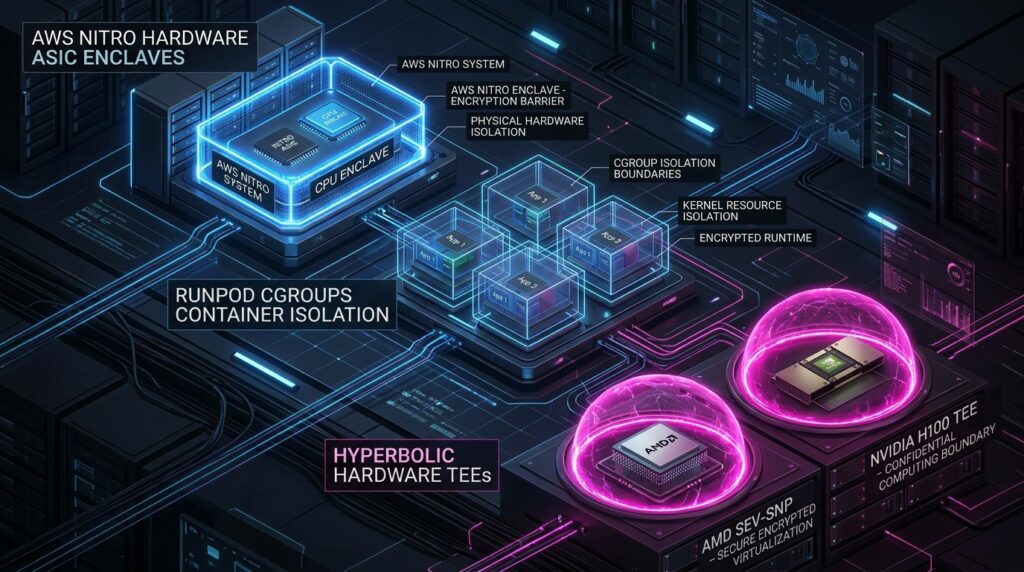
- AWS EC2: Uses the proprietary Nitro System, which offloads virtualization management to dedicated ASIC hardware. Nitro physically separates guest VMs from host software, making host inspection by AWS operators or third parties architecturally impossible.
- RunPod Secure: Runs workloads in single-tenant environments inside audited tier-3/4 data centers. While host access is maintained by RunPod engineers, guest workloads are separated using Linux cgroups and container namespaces.
- RunPod Community Cloud: Runs on shared, unverified multi-tenant hardware operated by independent hosts. Machine owners possess root access to the physical host, unencrypted memory, and local disks, making this tier unsuitable for proprietary enterprise data.
- Hyperbolic: Secures untrusted physical hosts using Hardware Confidential Computing (TEEs). Leveraging features like AMD SEV-SNP and NVIDIA H100 TEE enclaves, memory pages are encrypted directly on the processor silicon. Data remains encrypted in transit and at rest, decrypting exclusively within isolated execution memory.
Verifying Decentralized Execution: Proof of Sampling
To prevent malicious host nodes on a decentralized network from returning corrupted output to save electricity, Hyperbolic implements a Proof of Sampling Protocol (PoSP) developed with researchers from UC Berkeley and Columbia University.
Rather than running every execution twice (100% overhead) or building heavy Zero-Knowledge proofs (zkML), PoSP probabilistically selects a strategic sample (~1–5%) of inference requests for validation by independent nodes. Hosts must post financial collateral to participate. If a sampled host output deviates from the validator consensus, the provider’s collateral is automatically slashed.
AWS EC2 vs RunPod vs Hyperbolic: Platform Breakdown
1. AWS EC2 (p5 & g6e Series)
Best For: Enterprise multi-node pre-training and regulated, high-compliance production workloads.
AWS EC2 Rating:
[████████████████████] Ease of Use:      8/10
[████████████████████] Scalability:     10/10
[████████████████████] Infrastructure:  10/10
[████████████████████] Value for Money:  5/10
Key Strengths
- Unmatched 3,200 Gbps EFA v2 networking supports low-latency multi-node scaling across thousands of GPUs.
- Comprehensive compliance certifications (SOC 1/2/3, ISO 27001, HIPAA, FedRAMP High, PCI-DSS) backed by formal BAAs.
- Nitro hardware hypervisors guarantee complete isolation from multi-tenant noise and host access.
Key Limitations
- Highest baseline On-Demand pricing across all provider tiers.
- Strict data egress fees penalize large dataset moves and model transfers.
2. RunPod (Secure vs. Community)
Best For: Rapid single-node fine-tuning, parameter-efficient LoRA sweeps, and scalable serverless inference endpoints.
RunPod Rating:
[████████████████████] Ease of Use:      9/10
[████████████████████] Scalability:      7/10
[████████████████████] Infrastructure:   8/10
[████████████████████] Value for Money:  9/10
Key Strengths
- Up to 60% savings compared to legacy hyperscaler On-Demand pricing.
- Zero data egress fees simplifies checkpoint management.
- Serverless execution using FlashBoot technology enables sub-200ms cold starts.
Key Limitations
- Limited self-serve multi-node cluster expansion compared to hyperscaler UltraClusters.
- Stopped container instances incur doubled storage costs ($0.20/GB/month) if left unmonitored.
3. Hyperbolic Cloud
Best For: Cost-effective asynchronous batch inference, fault-tolerant execution, and non-sensitive token workloads.
Hyperbolic Rating:
[████████████████████] Ease of Use:      7/10
[████████████████████] Scalability:      7/10
[████████████████████] Infrastructure:   6/10
[████████████████████] Value for Money:  9/10
Key Strengths
- Highly competitive hourly rates on open-access marketplace nodes.
- Proof of Sampling Protocol (PoSP) provides cryptographic verification for output integrity.
- Leverages hardware TEE enclaves to preserve data privacy on third-party hosts.
Key Limitations
- Lack of unified high-speed fabrics prevents distributed multi-node fine-tuning across regions.
- Relies on smart contract mechanics rather than traditional corporate SOC 2 certifications.
ROI Framework & Workload Routing Guide
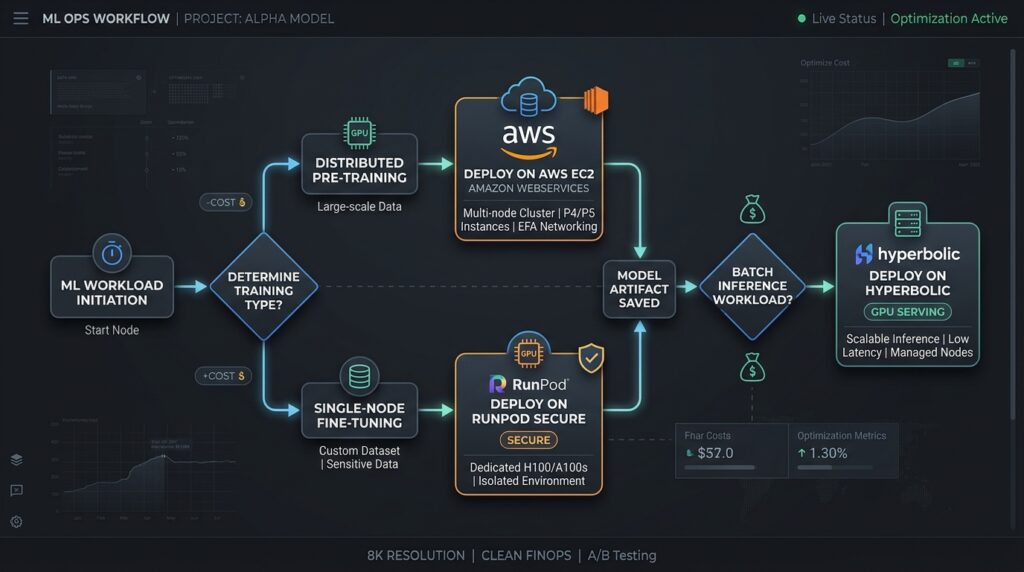
To optimize infrastructure spending, match each workload type to its most cost-effective compute platform:
                          Workload Decision Engine

                        Is the task multi-node training?
                                  │
                 ┌────────────────┴────────────────┐
                YES                                NO
                 │                                 │
     Use AWS EC2 (P5/EFA v2)           Is data highly confidential?
   (Prioritize Interconnect)                       │
                                   ┌───────────────┴───────────────┐
                                  YES                              NO
                                   │                               │
                          Use RunPod Secure               Use Hyperbolic /
                       (Prioritize Compliance)         RunPod Community Cloud
                                                       (Maximize Cost Savings)
Scenario A: Large Scale Pre-Training (>70B Models)
- Recommended Infrastructure: AWS EC2 (
p5.48xlargevia Capacity Blocks). - Rationale: Distributed training across large clusters is bottlenecked by network latency during gradient exchanges. AWS EFA v2 networking with GPUDirect RDMA prevents GPU idle time during synchronization steps.
Scenario B: Concurrent LoRA / QLoRA Fine-Tuning Sweeps
- Recommended Infrastructure: RunPod Secure Cloud (or Community Cloud for non-sensitive datasets).
- Rationale: Parameter-efficient fine-tuning jobs fit comfortably within single-node memory footprints (48GB–80GB VRAM). RunPod’s zero egress fees and flexible per-second billing eliminate unnecessary idle charges.
Scenario C: High-Volume Asynchronous Batch Inference
- Recommended Infrastructure: Hyperbolic Decentralized Cloud.
- Rationale: Offline document processing, vector embeddings, and bulk generation are fault-tolerant tasks that don’t require inter-node fabrics. Hyperbolic’s PoSP verification ensures output integrity at significantly reduced hourly rates.
Final Recommendation
- Choose AWS EC2 if: You are scaling distributed multi-node LLM training runs across hundreds of GPUs, or require strict SOC 2, ISO, or HIPAA compliance guarantees.
- Choose RunPod Secure if: You want to reduce infrastructure spend by over 50% on single-node fine-tuning, LoRA sweeps, or fast-scaling serverless APIs without compromising data privacy.
- Choose Hyperbolic if: You run high-volume, asynchronous batch inference jobs and want maximum capital efficiency backed by cryptographic output verification.
Next Step: Review your active compute deployments. Route single-node fine-tuning tasks to secondary providers like RunPod, and migrate fault-tolerant batch inference pipelines to decentralized marketplaces to capture immediate unit-cost savings.
To evaluate how cloud GPU pricing compares with dedicated bare-metal hosting, on-premise hardware, and unmetered network economics, explore our technical benchmarks across the enterprise AI ecosystem:
- GPU Hardware & On-Premise Sizing: Calculate VRAM and interconnect specs in our Sovereign LLM Hardware Sizing Guide on Lambda, evaluate Turn-Key vs DIY GPU Nodes TCO Analysis, and review baseline hardware in our DeepSeek-R1 Hardware Review.
- Bare-Metal Infrastructure & Bandwidth Optimization: Learn how dedicated servers host local LLMs in Deploying DeepSeek-R1 on NovoServe Bare-Metal and discover how to eliminate egress fees in How to Slash Cloud Egress Fees.
- Hosting & Platform Comparisons: Review flat-rate hosting models in our NovoServe vs Hetzner vs DigitalOcean Review. Bookmark AI Review Zones for continuous MLOps and cloud infrastructure benchmarks.
References
- AWS EC2 On-Demand Pricing & Instance Types
- AWS EC2 P5 Instances & Nitro Architecture
- RunPod GPU Cloud Pricing & Infrastructure Overview
- RunPod Enterprise Security & Compliance Whitepaper
- Hyperbolic Platform Overview & Proof of Sampling (PoSP) Specifications
- Hyperbolic Verification Framework & Research Documentation
- NVIDIA H100 Tensor Core GPU Architecture & TEE Security Specifications