
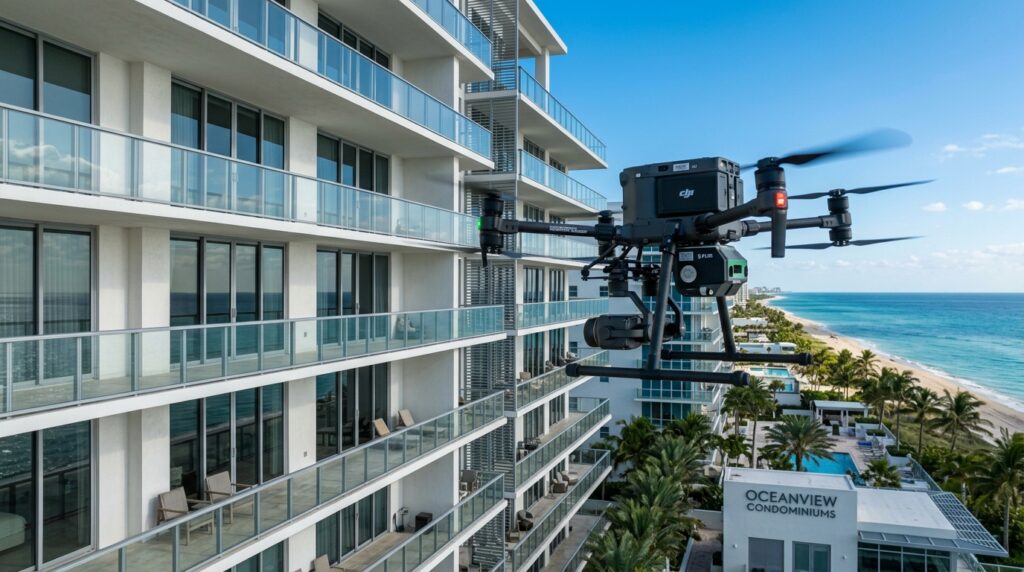
Discover how to automate hoa property inspections and milestone structural audits as most homeowners associations (HOAs) and property management firms do not need another high-level tech presentation.
Most homeowners associations (HOAs) and property management firms do not need another high-level tech presentation. They need a concrete way to eliminate the operational bottlenecks, rising labor liabilities, and skyrocketing insurance premiums that damage their balance sheets every day.
Buying cloud-based software or subscribing to generic AI APIs is deceptively simple. Integrating an inspection system that complies with tightening state regulations, protects resident privacy, and runs without crushing data-transfer bottlenecks is where most organizations struggle.
Choosing the wrong architecture can lock your operation into years of data leaks and unpredictable token billing. Choosing a localized, autonomous physical server framework allows property management directors and system integrators to quietly improve operational efficiency, secure multi-unit portfolios, and protect board members from direct personal liability starting from day one.
This guide provides the technical and operational blueprint to transition from manual visual walkthroughs to an automated, sovereign edge-AI drone inspection workflow.
The Operational Crisis of HOA Inspections: Regulatory Pressure and DIY Risks
Managing physical infrastructure across extensive residential master-planned communities or multi-story condominium associations via manual, ground-level inspections is an operational nightmare. Relying on property managers, regional maintenance staff, or engineers to physically walk sites, climb ladders, and manually log exterior conditions introduces extreme visual fatigue, safety liabilities, and subjective assessment errors.
Minor exterior defects—such as localized concrete spalling, hairline stucco cracking, or joint sealant failures—are easily missed during ground sweeps. Left unaddressed, these minor anomalies rapidly escalate into major structural issues or emergency remediation orders. Furthermore, manual vertical facade work drives up workers’ compensation premiums and liability insurance for property management firms.
The Regulatory Catalyst: Florida SB-4D and SB 154
Following the Champlain Towers South collapse, the regulatory landscape has tightened significantly. Enacted laws like Florida Senate Bill 4-D (SB-4D) and its subsequent amendment, Senate Bill 154 (SB 154), mandate strict structural auditing cycles that make legacy manual inspection approaches completely obsolete.
[Florida Condo/Co-op 3+ Stories Tall]
       │
       ├─► At 25 Years (Within 3 miles of coast) ──► Phase 1 Milestone Inspection
       ├─► At 30 Years (All other locations) ────► Phase 1 Milestone Inspection
       │
       └─► Every 10 Years Thereafter ─────────────► Mandatory Recertification
These statutes dictate that buildings three stories or higher must complete a Phase 1 Milestone Inspection once they reach 30 years of age (or 25 years if located within three miles of the coastline), with mandatory recertification every 10 years thereafter. Non-compliance results in severe code violations, high insurance premiums, or total cancellation of property policies. Crucially, SB 154 removes corporate insulation, creating direct personal liability for board members and officers who fail to complete milestone inspections and mandatory Structural Integrity Reserve Studies (SIRS) on time.
The Dual-Threat DIY Risk
To bypass this compliance bottleneck, many forward-thinking organizations attempt a “do-it-yourself” approach by building their own AI infrastructure from scratch. This introduces a secondary operational risk. Purchasing raw, empty server hardware from standard hardware distributors requires hiring a specialized development team of two to five engineers for 12 to 24 months. This custom-build path frequently results in $200,000 to $500,000 in software development costs, along with complex integration, model debugging, and permanent maintenance overhead.
Conversely, sending high-resolution, private visual imagery of residential buildings to public multi-tenant cloud platforms introduces significant data privacy risks, variable monthly billing, and API throttling. A turnkey, sovereign physical server infrastructure—such as the Zanus AI Operating System—bypasses this friction by processing edge data locally, entirely offline, right out of the box.
| Compliance Component | Legacy Manual Approach | Automated Sovereign Drone & AI Workflow |
| Inspection Scope | Subjective, localized ground walks; highly vulnerable to human oversight. | Systematic 90–100% facade and roof coverage via high-resolution photogrammetric sensors. |
| Data Record Integrity | Paper checklists, fragmented digital photos, and lack of precise geo-spatial referencing. | Geo-referenced digital twins with exact sub-millimeter visual records of all defects. |
| Liability Mitigation | High board-member liability due to delayed or incomplete structural records. | Auditable, time-stamped visual data that simplifies engineering sign-offs. |
| Operational Scalability | Linear cost growth; every additional building requires proportional manual labor hours. | Sub-linear cost growth; automated flight paths are easily repeated with minimal extra effort. |
Operational Impact
The manual approach creates unmanaged liability and predictable maintenance blind spots. Transitioning to an automated drone workflow backed by local edge computation is no longer an optional innovation; it is a fundamental requirement for risk mitigation and corporate compliance.
Automate HOA Property Inspections: The 3-Step AI Architecture
By linking autonomous aerial photogrammetry with local, on-premises physical AI servers, property management firms replace slow, paper-driven workflows with a highly structured, three-step automation pipeline.
┌──────────────────────────────┐     ┌──────────────────────────────┐     ┌──────────────────────────────┐
│  STEP 1: AUTONOMOUS FLIGHT   │     │   STEP 2: SOVEREIGN INGEST   │     │  STEP 3: HUMAN-IN-THE-LOOP  │
│                              │     │                              │     │                              │
│  • 3D Facade Orbits          │     │  • Edge-GPU Ingestion        │     │  • Vector Store Rule Match   │
│  • 75-80% Imagery Overlap    │ ───►│  • Local Computer Vision     │ ───►│  • Auto-Drafted Violation    │
│  • Sub-millimeter GSD        │     │  • Anomaly & GPS Mapping     │     │  • Manual Portal Approval    │
└──────────────────────────────┘     └──────────────────────────────┘     └──────────────────────────────┘
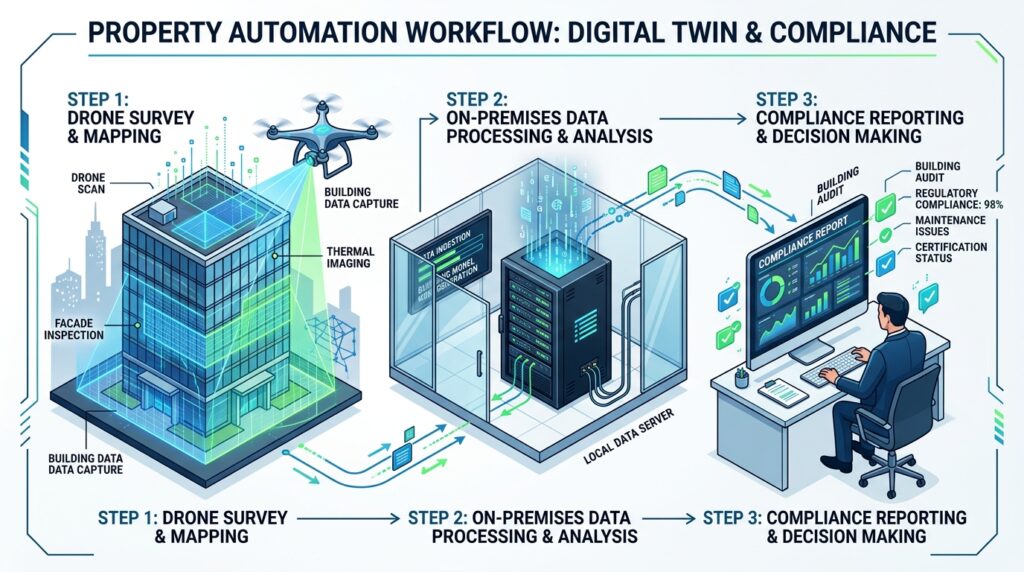
Step 1: Drone Trajectory Programming & Flight Grid Optimization
Automated visual capture avoids the inconsistency of manual drone piloting. Operators program autonomous flight paths using vertical and horizontal grid patterns, guaranteeing 90% to 100% building envelope coverage.
To generate high-accuracy 2D orthomosaics and 3D digital twins, the drone mission planning software enforces a strict vertical overlap ($O_v$) and horizontal overlap ($O_h$) of at least 75% to 80%. This density ensures matching visual features align perfectly across adjacent frames during subsequent processing.
To detect very fine, early-stage structural cracks before they turn into concrete spalling, the drone’s camera sensor must achieve a sub-millimeter Ground Sample Distance (GSD). GSD represents the physical distance on the building’s surface that corresponds to a single pixel in the image. It is mathematically calculated using the following formula:
$$GSD = \frac{S_w \times d \times 1000}{F \times I_w}$$
Where:
- $S_w$ is the physical width of the camera sensor (mm).
- $d$ is the standoff distance from the drone to the building facade (m).
- $F$ is the focal length of the camera lens (mm).
- $I_w$ is the horizontal image width (pixels).
For instance, a drone equipped with a modern 1-inch sensor ($S_w = 13.2\text{ mm}$), a $24\text{ mm}$ lens, and a $5472\text{ pixel}$ horizontal image width, flying at a safe, pre-programmed standoff distance ($d$) of $10\text{ meters}$ from the building facade, yields the following:
$$GSD = \frac{13.2 \times 10 \times 1000}{24 \times 5472} = \frac{132000}{131328} \approx 1.005\text{ mm/pixel}$$
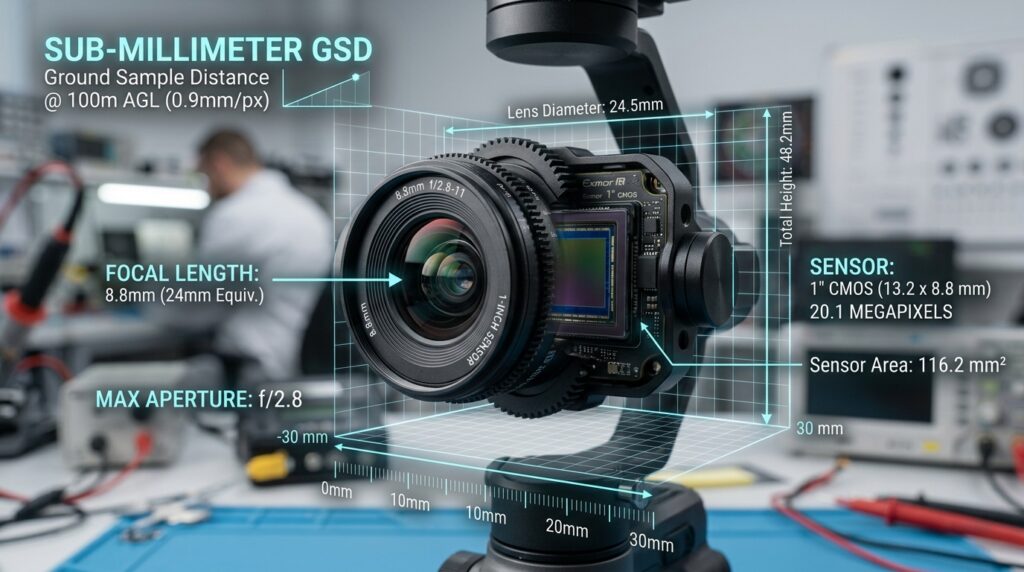
By adjusting flight speeds, utilizing high-resolution payloads, and maintaining a consistent standoff distance via active radar or LiDAR-based obstacle avoidance, operators can achieve GSD values below $1.0\text{ mm/pixel}$. This high resolution allows the system to identify hairline cracks, deteriorated joint sealants, and minor masonry defects with remarkable clarity.
Step 2: Sovereign Edge Ingestion and Localized Computer Vision
Once the drone mission concludes, high-resolution imagery and 4K video are ingested directly into the physical Zanus AI server. Unlike legacy setups that upload massive video files to cloud repositories, this architecture routes all files over a local 10GbE network into on-premises hardware equipped with enterprise-grade GPUs. This approach ensures complete data sovereignty, avoids recurring cloud subscription costs, and eliminates internet bandwidth bottlenecks.
The physical Zanus AI hardware runs a local operating system with pre-installed business and visual processing modules. As data is ingested, localized computer vision models analyze the frames to detect, classify, and log anomalies. The system is trained to identify two primary classes of inspection targets:
Raw Drone Data (Photos/Video)
       │
       ▼ (Direct Local Load via 10GbE Network)
┌────────────────────────────────────────────────────────┐
│ Zanus AI Sovereign Physical Server Node                │
│                                                        │
│  • Enterprise GPUs (RAID 10 NVMe Storage)              │
│  • Edge Computer Vision Model Inference                │
└────────────────────────────────────────────────────────┘
       │
       ├─► Detected Anomaly: Exterior Facade Crack (Width: 2.1mm)
       └─► Extracted Meta: Lat: 25.7617, Lon: -80.1918, Alt: 14.2m
- Aesthetic and Compliance Violations: Improper trash bin placement, landscaping encroachments, unapproved exterior modifications, unauthorized structures, and vehicle parking violations.
- Structural and Safety Defects: Concrete spalling, structural concrete cracking, efflorescence, waterproofing failures, rusted steel reinforcements, and sealant degradation.
Each identified defect or violation is immediately tagged with its precise spatial coordinates. The Zanus AI system extracts the GPS metadata (latitude, longitude, and altitude) directly from the EXIF data of the high-resolution drone photos. This data is indexed directly into the local property profile within the database, generating a highly accurate map of property compliance and structural health.
Step 3: Integrating the Zanus Precision Vector Store for Legal Notice Generation
Once anomalies have been classified and mapped, the system initiates the final compliance process by querying the Zanus Precision Vector Store. This secure, local vector database contains all of the community’s governing documents, including its specific CC&Rs, bylaws, collection policies, and relevant state compliance codes (such as Florida’s SB-4D and SB 154 requirements).
The system calculates vector embeddings of the detected violation and compares them to the vectorized bylaws. For example, if the system detects an unapproved patio structure, it retrieves the precise section of the HOA rules regarding architectural changes. It then passes this regulatory context, the violation photos, and the spatial metadata to a local Large Language Model (LLM) running on the Zanus server. The local LLM automatically drafts a highly professional, legally compliant notice of violation or structural maintenance request.
┌────────────────────────────────────────────────────────┐
│ Local Vector Database (Precision Vector Store)         │
│                                                        │
│  • Vectorized HOA CC&Rs & Bylaws                       │
│  • Vectorized Florida SB-4D & SB 154 Laws              │
└────────────────────────────────────────────────────────┘
       │
       ▼ (Semantic Mapping of Anomaly to Rule)
┌────────────────────────────────────────────────────────┐
│ Local LLM Document Generation Module                   │
│                                                        │
│  • Merges detected crack/violation data with bylaws    │
│  • Drafts legally compliant violation/notice letter    │
└────────────────────────────────────────────────────────┘
       │
       ▼ (Pushed to Local Workflow Queue)
┌────────────────────────────────────────────────────────┐
│ Human-in-the-Loop Approval Interface                   │
│                                                        │
│  • Manual verification by the HOA Manager              │
│  • Single-click validation and multi-channel dispatch  │
└────────────────────────────────────────────────────────┘
To maintain high data quality and a personal touch, this workflow uses a “Human-in-the-Loop” verification process. The generated document is sent to a central review queue in the Zanus task management dashboard rather than being mailed automatically.
An HOA manager or operations director can quickly review the auto-drafted letters, view the supporting drone photos, and confirm the details. This human check allows managers to apply personal judgment, address edge cases, and maintain positive community relationships before approving and sending the notice with a single click.
Editor’s Perspective
By localizing the computer vision and vector-matching loops onto an on-premises physical appliance, system integrators eliminate the latency and recurring subscription expenses of standard cloud models. The true value lies in the system’s ability to turn unstructured drone imagery into a legally backed operational workflow with absolute data sovereignty.
The Performance Case: Quantifying the ROI of Localized Automation
Deploying a sovereign, drone-integrated AI system provides a strong business case for property management firms, HOAs, and system integrators. Research from Morgan Stanley shows that artificial intelligence and workflow automation can automate roughly 37% of tasks across property operations, leasing, administration, and maintenance. This automation potential can unlock significant operating efficiencies for real estate portfolios and community associations.
Operational statistics highlight the inefficiencies that property managers face daily:
- Tenant Issue Management: Approximately 46% of property management teams find manual issue tracking highly time-consuming.
- Preventive Maintenance: About 38% of real estate professionals identify preventive maintenance planning as a prime candidate for automation.
- Administrative Overhead: Property managers estimate that 11% to 25% of residents miss at least one lease or community rule obligation, creating a constant cycle of manual follow-ups and enforcement.
[Traditional Property Management Teams]
   │
   ├─► 46% of daily time spent on manual tenant issues
   └─► 38% of daily time spent on manual maintenance scheduling

[Zanus AI Integrated Property Teams]
   │
   └─► Automates 37% of core operational tasks
   └─► Saves 10+ hours per week per manager
   └─► Reduces admin overhead by 92%
By automating routine inspections, tagging violations, and drafting compliance notices, property managers can save more than 10 hours per week on manual administrative tasks. This administrative relief allows existing staff to manage larger portfolios without needing to hire additional personnel, turning compliance into a highly scalable process.
To understand the long-term financial benefits, it is helpful to compare the costs of a physical, on-premises Zanus AI server against typical, cloud-based SaaS AI platforms.
| Operational Vector | Multi-Tenant Cloud SaaS Solutions | Sovereign On-Premises Zanus AI Nodes |
| User & Licensing Costs | Escalates with team growth; monthly per-seat licensing fees create financial friction. | Unlimited users; no per-seat licenses, allowing the entire team to access the system. |
| API & Data Processing Fees | Variable monthly billing based on data volume, image count, and token usage. | One-time capital investment; zero per-token fees or processing charges. |
| Data Privacy & Security | Data is uploaded to external servers, increasing the risk of exposure and violating privacy policies. | 100% on-premises; data remains secure on local hardware with no external exposure. |
| System Customization | Locked-in cloud structures; modifying workflows often requires expensive custom coding. | Turnkey operating system with 15+ pre-installed modules and drag-and-drop workflow tools. |
| Offline Capabilities | Unusable without a continuous, high-speed internet connection. | Fully operational offline, making it ideal for remote or secure communities. |
Real-world Consideration
Choosing a localized Zanus AI architecture turns technology costs into a predictable, one-time capital expense. By avoiding ongoing SaaS fees and the high development costs of building custom AI tools, organizations can deploy a secure, highly scalable automated inspection system that immediately improves operational efficiency.
Growth Hacking CTA and Lead Capture Strategy
From a growth hacking perspective, this technical implementation guide serves as an excellent lead generation asset for targeting property managers, community board members, and real estate operations directors. These professionals are actively searching for ways to streamline operations, reduce compliance overhead, and manage rising insurance premiums.
To maximize B2B lead generation, this guide should be paired with targeted call-to-action (CTA) elements:
- Exit-Intent Overlay: Trigger a slide-in form when a user moves to exit the article, offering the “Free Florida SB-4D Milestone Drone Inspection Checklist” in exchange for their business email.
- In-Line Document Widget: Embed an interactive preview of the checklist midway through the article, inviting readers to download the complete, print-ready document.
- Contextual ROI Form: Place a quick contact form alongside the performance statistics section, allowing readers to request a custom cost-benefit analysis for their specific property portfolio.
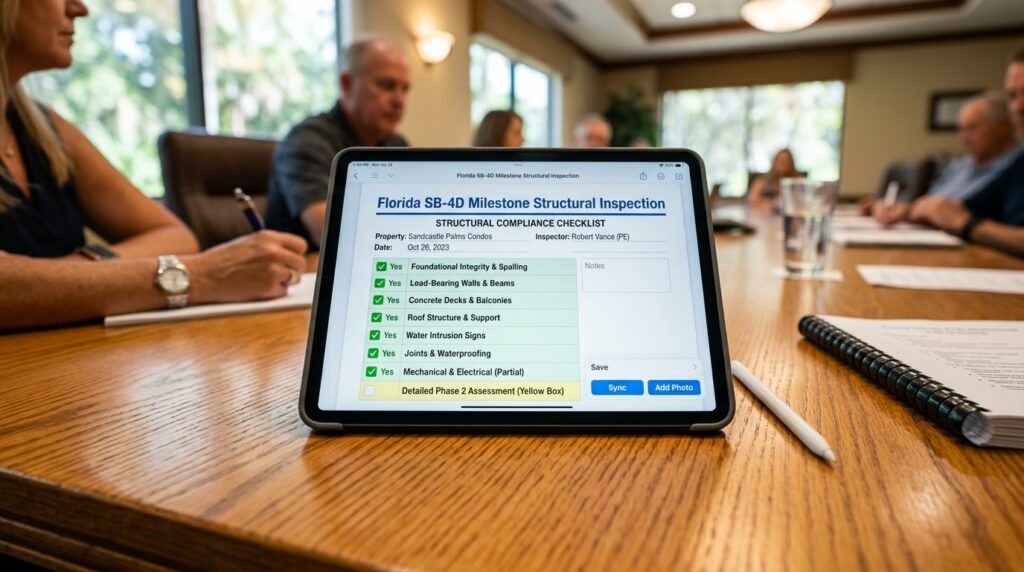
To demonstrate the value of this resource and capture high-quality leads, the complete, ready-to-use structural compliance checklist is included below. This asset provides immediate utility to property managers while showing how automated drone inspections can simplify their regulatory requirements.
Florida SB-4D Milestone Structural Inspection Checklist
Phase 1: Structural Integrity Verification (F.S. 553.899)
This section covers the primary visual structural elements that must be inspected by a licensed professional engineer or architect to verify that the building is safe for continued use and occupancy.
[Structural Inspections: Phase 1 vs. Phase 2]
       │
       ├─► Phase 1: Visual Structural Assessment
       │             │
       │             ├──► No Issues Found ─────► File Compliance Report
       │             └──► Deterioration Found ─► Trigger Phase 2
       │
       └─► Phase 2: Destructive / Non-Destructive In-Depth Testing
Foundation and Sub-Grade
- [ ] Foundation Walls: Inspect all visible foundation walls and grade beams for structural shifting, settling cracks, or lateral movement.
- [ ] Slab-on-Grade: Check concrete ground slabs for major settlement cracks, shifting, or water intrusion.
- [ ] Sub-Grade Voids: Assess soils around the foundation perimeter for signs of erosion, sinkholes, or settling.
Concrete Framing and Columns
- [ ] Concrete Columns: Inspect all structural concrete columns for cracking, spalling, or exposed rebar.
- [ ] Load-Bearing Beams: Check structural concrete beams and transfer girders for deflection, cracks, or rust staining.
- [ ] Shear Walls: Examine concrete shear walls for diagonal shear cracks or structural distress.
Floor Slabs and Ceilings
- [ ] Elevated Floor Slabs: Inspect the underside of elevated concrete slabs for cracking, mineral deposits (efflorescence), or spalling.
- [ ] Slab Connections: Check the structural joints where floor slabs connect to columns and walls for cracking or movement.
- [ ] Expansion Joints: Verify that expansion joints are clean, properly sealed, and moving as designed.
Roof Support Structure
- [ ] Roof Framing: Inspect steel trusses, concrete roof decks, or wood framing for structural rot, corrosion, or deflection.
- [ ] Roof Anchors: Verify that structural connections, wind tie-downs, and roof anchors are secure.
- [ ] Roof Decking: Check structural roof decking for soft spots, water damage, or rot.
Balconies and Cantilevers
- [ ] Balcony Slabs: Inspect the top and bottom of cantilevered balcony slabs for cracking, concrete spalling, or exposed steel reinforcement.
- [ ] Handrail Attachments: Verify that balcony handrails are securely anchored into the concrete slab and free of rust or cracking.
- [ ] Balcony Drainage: Check that balcony floors slope away from the building and that drains are clear to prevent standing water.
Phase 2: Building Envelope and Moisture Protection
This section covers the building’s exterior barrier systems, which protect structural components from water damage, salt-air exposure, and environmental wear.
Waterproofing Membranes
- [ ] Facade Sealants: Inspect joint sealants, expansion joints, and caulking around exterior wall penetrations for failures.
- [ ] Stucco and Facade Coatings: Check exterior stucco and masonry coatings for cracking, bubbling, or peeling.
- [ ] Below-Grade Waterproofing: Inspect visible below-grade waterproofing seals and planter linings for water leaks.
Exterior Walls and Openings
- [ ] Expansion Joints: Verify that expansion joints are clean, properly sealed, and moving as designed.
- [ ] Window and Door Renders: Inspect perimeter sealants around all exterior windows and doors for weathering or failure.
- [ ] Wall Penetrations: Check that all utility, HVAC, and electrical penetrations are properly sealed and weatherproofed.
Drainage and Water Shedding
- [ ] Roof Drainage Systems: Inspect roof drains, scuppers, gutters, and downspouts for blockages, damage, or leaks.
- [ ] Site Grading: Verify that ground grading slopes away from the building foundation to prevent water pooling.
- [ ] Surface Runoff: Ensure that area drains, catch basins, and swales are clear of debris and functioning properly.
Phase 3: Structural Integrity Reserve Study (SIRS) System Components
This section covers the essential building systems that must be evaluated and funded as part of the mandatory 10-year Structural Integrity Reserve Study.
Fire Protection Systems
- [ ] Fire Sprinklers: Inspect fire sprinkler mains, branch lines, and control valves for leaks, corrosion, or damage.
- [ ] Fire Alarms: Verify that fire alarm control panels, detectors, and pull stations are operational and up to code.
- [ ] Life Safety Assemblies: Check fire doors, fire-rated walls, and emergency exit signs for proper function and compliance.
Plumbing and Waste Systems
- [ ] Water Supply Lines: Inspect booster pumps, manifolds, and main water lines for leaks, corrosion, or pressure issues.
- [ ] Waste Stacks: Check waste, vent, and drainage stacks for structural integrity and leaks.
- [ ] Sump Pumps: Verify that emergency sump pumps, backflow preventers, and lift stations are fully operational.
Electrical Infrastructure
- [ ] Main Switchgear: Inspect main electrical switchboards, distribution panels, and transformers for heat buildup or corrosion.
- [ ] Emergency Power: Verify that emergency generators, transfer switches, and backup fuel systems are tested and operational.
- [ ] Conduits and Chases: Check structural electrical conduits and riser chases for safe, dry conditions.
Strategic Conclusions and Recommendations
Transitioning from manual, paper-based inspections to a system designed to automate hoa property inspections via an autonomous drone workflow powered by sovereign AI represents a significant leap forward in operational efficiency and risk management for community associations. By utilizing precise, repeatable drone flights, HOAs can achieve complete, 90% to 100% building envelope coverage. This high-resolution visual data captures minor aesthetic violations and critical structural defects long before they escalate into costly repairs or create legal liabilities.
[Strategic Implementation Path]
       │
       ├─► 1. Conduct Structural Feasibility Study
       ├─► 2. Deploy Sovereign On-Premises Zanus AI Hardware
       ├─► 3. Establish Localized Bylaw Vector Database
       └─► 4. Run Automated Milestone & Aesthetic Audits
For community associations and property management groups looking to implement this modern inspection workflow, the following actions are recommended:
- Implement High-Overlap Drone Flight Standards: Require all property inspection flights to be programmed using automated grid paths with a minimum of 75% to 80% horizontal and vertical overlap. This ensures the data collected is dense enough to generate accurate 3D models and clear, orthomosaic facade images.
- Establish a Local Sovereign AI Data Repository: Deploy an on-premises physical Zanus AI server to process and store all property imagery, video records, and resident data locally. Processing this data on a local, secure server ensures resident privacy, satisfies data compliance requirements, and eliminates unpredictable cloud subscription and token fees.
- Integrate Community Regulations into the Vector Store: Load the HOA’s complete rules, covenants, and bylaws directly into the Zanus Precision Vector Store. This allows the local AI system to accurately match detected issues with specific rules, automating the drafting of legally consistent violation notices and maintenance requests.
- Maintain a Human-in-the-Loop Workflow: Ensure that every automated report, notice, or letter generated by the AI is routed to a manager’s review queue before being sent. This step preserves the human touch necessary for managing community relations while still saving hours of administrative time each week.
- Incorporate Drone Inspections into Reserve Planning: Utilize drone-generated structural data to support the 10-year Structural Integrity Reserve Study (SIRS). Proactively identifying concrete, roofing, and waterproofing issues allows associations to plan repairs accurately, keep reserves appropriately funded, and reduce liability for board members and officers.
Your Next Step
Transitioning to an automated drone inspection workflow is the most effective way to eliminate manual blind spots and secure your community’s infrastructure. To successfully present this modern engineering strategy to your HOA board for budget approval, we recommend leveraging our complete technical resources:
- Financial Framework: Calculate your exact return on investment and hardware options by exploring the Zanus AI Pricing & ROI Analysis.
- Security Architecture: Learn how our localized firewall configuration protects private resident data by reading the Zanus AI Security Review.
- System Infrastructure: See how the physical appliance integrates within a secure on-premises environment through our deep dive into the Zanus AI Hardware Infrastructure.
- Regulatory Context: For a deeper look at specific regional legislation, review our comprehensive compliance guide on cutting the Florida SB-4D inspection cost.
Don’t let manual walkthrough liabilities or unexpected maintenance fines drain your association’s reserves—automate your property operations and secure absolute data sovereignty today.
References
- Zanus AI: Private On-Premises AI Software Packages
- Zanus AI Enterprise: Multi-Node Private AI Server Cluster
- Aerially.ai: Florida SB-4D Milestone Inspection Guide
- Beryl Project Engineering: Structural Integrity Reserve Study – The Ultimate Guide
- SkyBrowse: Drone Facade Inspection: The Complete Guide
- Hammer Missions: What is Vertical Overlap in Drone Mapping & Inspection?
- Buildium: Property Management Technology Shifts and Industry Trends
- The Florida Senate: Senate Bill 154 (2023) – Condominium and Cooperative Association Governance