

This zanus ai security review analyzes how the integration of artificial intelligence into enterprise operations has transitioned from a technical upgrade to a core infrastructure requirement. In the highly regulated sectors of United States property management and Homeowners Associations (HOAs), executive boards and Chief Information Security Officers (CISOs) face a critical risk mitigation dilemma: how to leverage advanced machine learning models without exposing sensitive corporate and resident data to the security vulnerabilities inherent in the public cloud.
This review evaluates the operational trade-offs of shifting from cloud-dependent AI systems to sovereign, on-premises, and physically isolated (air-gapped) AI appliances using the Zanus AI turnkey private server platform.
Zanus AI Security Review: Best For
- Enterprise Property Management Firms: Organizations handling high volumes of Non-public Personal Information (NPI), Protected Health Information (PHI), and direct banking credentials.
- HOA Boards & Legal Teams: Boards requiring absolute confidentiality of legal strategies, board disputes, and pending litigation.
- Compliance-Driven Security Officers: CISOs who need to guarantee 100% data localization and eliminate third-party data processing risks.
Technical Deep Dive: The Sovereign Hardware Architecture
The Engineering of a Physical Air Gap
An air-gapped network physically isolates critical IT assets from external networks, including the public internet and untrusted local area networks (LANs). While cloud providers rely on logical network segmentation—such as virtual local area networks (VLANs), software-defined firewalls, and access control lists (ACLs)—these boundaries remain vulnerable to software exploits, zero-day vulnerabilities, and human misconfiguration.
The Zanus AI Prime operates in a true physical air-gap configuration. The hardware contains zero active external network interfaces, and wireless interface controllers (Wi-Fi/Bluetooth) are permanently disabled or physically removed from the motherboard. Inbound or outbound data packets cannot cross the physical boundary of the machine without direct human intervention. The Zanus AI Operating System runs its custom Large Language Models (LLMs) and built-in database modules directly on the server’s onboard enterprise-grade GPUs, eliminating the latency, rate limiting, and security vulnerabilities associated with external API calls.
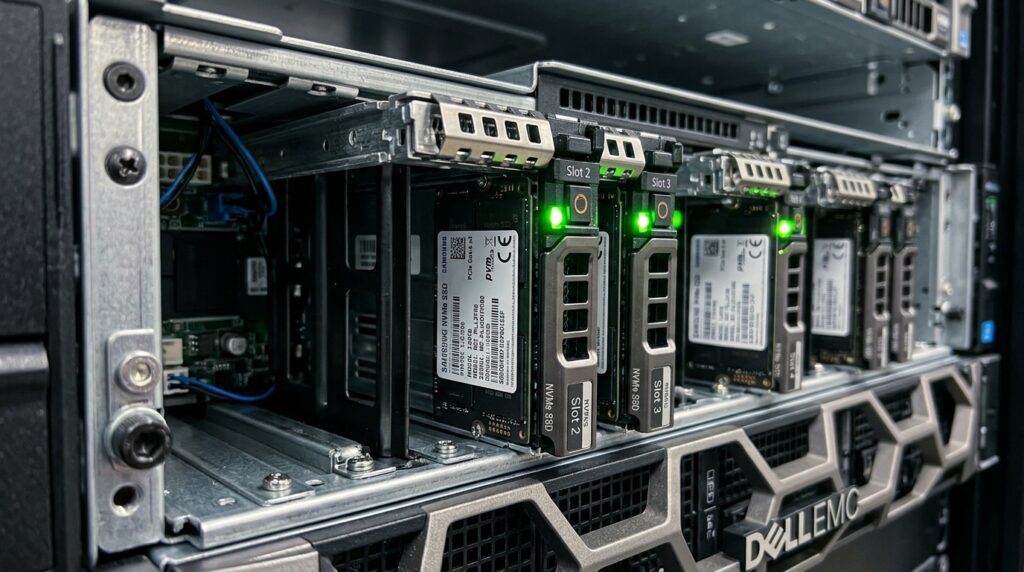
Real-Time Mirrored Storage via RAID 10 NVMe
Data integrity within the Zanus AI architecture is maintained by an enterprise-grade solid-state storage subsystem configured in a RAID 10 (Redundant Array of Independent Disks) configuration. Zanus deploys enterprise Non-Volatile Memory Express (NVMe) solid-state drives (SSDs) utilizing the high-speed PCIe bus to achieve massive input/output operations per second (IOPS), which is critical for the low-latency vector embeddings required by Retrieval-Augmented Generation (RAG) pipelines.
RAID 10 combines the performance benefits of disk striping (RAID 0) with the fault tolerance of disk mirroring (RAID 1). Every block of data written to the Precision Vector Store is mirrored in real-time across a paired drive. If a physical drive fails, the system triggers an immediate administrative alert while continuing to operate on the surviving mirrored drive with zero downtime.
To quantify the structural reliability of a RAID 10 NVMe array, the probability of a catastrophic data loss event upon a second drive failure can be calculated mathematically. Let $N$ represent the total number of drives in a RAID 10 array of $2n$ drives, organized into $n$ mirrored pairs. Assuming a single drive has already failed, the probability $P(\text{Data Loss})$ that a subsequent random drive failure occurs on the exact mirror of the failed drive—thereby causing data loss—is represented by:
$$P(\text{Data Loss}) = \frac{1}{2n – 1}$$
For an eight-drive RAID 10 array ($2n = 8, n = 4$), the probability that a second failure causes data loss is minimal:
$$P(\text{Data Loss}) = \frac{1}{7} \approx 14.28\%$$
Ransomware Immunity through Offline LTO Tape Backups
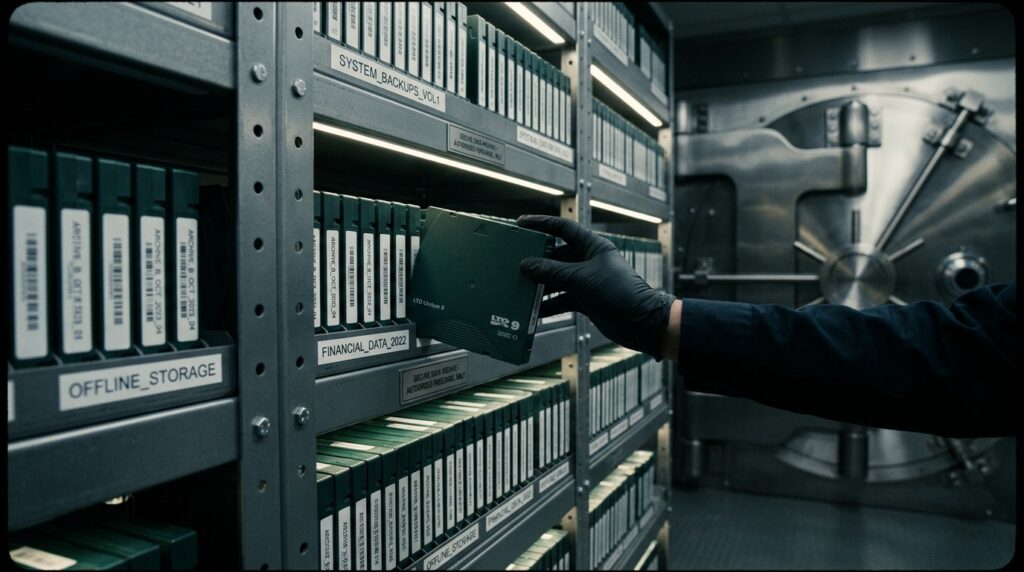
While RAID 10 protects against physical hardware failures, it does not prevent data corruption or deletion caused by insider threats or sophisticated malware. To provide absolute disaster recovery capabilities, the Zanus AI Enterprise platform integrates offline Linear Tape-Open (LTO) magnetic tape backup modules and robotic tape archives.
Modern ransomware variants are designed to locate and encrypt online backup servers, NAS devices, and cloud storage buckets before encrypting the primary production environment. By utilizing an LTO tape system, organizations write their historical vector stores, resident documents, and transaction logs to a physical tape cartridge. Once the backup job is complete, the tape is physically ejected from the tape drive, breaking the connection to the server. Because the unmounted magnetic tape is stored offline in a secure, fireproof vault, it cannot be accessed, modified, or encrypted by network-borne threats.
Operational Impact: Buying AI infrastructure before establishing clear data isolation standards exposes an organization to severe regulatory penalties. The value of an air-gapped system lies not in the computation speed, but in the elimination of perimeter vulnerabilities.
Compliance and Auditability Matrix
To achieve a 100% compliance rating during security audits, HOAs and property management companies can present the Zanus AI turnkey system as a closed loop that inherits and enhances existing on-premises security controls.
| Regulatory Framework | Specific Compliance Requirement | Zanus AI Technical Control | Audit Verification Method |
| Fair Housing Act (FHA) / HUD Guidance | Prevention of algorithmic bias; ability to audit and explain screening decisions. | Local control over model parameters; fully auditable RAG context pathways. | Review local system prompt configurations and verify vector search history logs. |
| RESPA & Gramm-Leach-Bliley Act (GLBA) | Safeguarding Non-public Personal Information (NPI); preventing financial exposure. | AES-256 Full-Disk Encryption (FDE); zero cloud data transit; no external API integrations. | Inspect local disk encryption status and verify outbound WAN routes are disabled. |
| SOC 2 Trust Services Criteria | Verification of data security, availability, and confidentiality controls. | Immutable local audit trails; RBAC; MFA; redundant power supplies. | Export system-generated audit logs showing timestamped records of user queries. |
| HIPAA Security Rule | Protection of Protected Health Information (PHI) in housing application files. | On-premises deployment with active session timeouts; encrypted intra-LAN TLS 1.3 transit. | Perform local network packet captures to confirm TLS 1.3 encryption for internal traffic. |
| Architectural Pros (Advantages) | Operational Cons (Limitations) |
|---|---|
|
• Absolute Data Sovereignty: Zero data egress or external telemetry phone-home functions. • Hardware-Enforced Air-Gapping: True physical isolation with wireless controllers removed from the motherboard. • Ransomware Resilience: Built-in immutable protection via physical, offline LTO tape backup integration. • Predictable TCO: Replaces variable token pricing and API rate-limiting with a one-time CapEx model. |
• High Upfront Capital: Requires significant initial upfront hardware expenditure compared to cloud SaaS. • Closed Ecosystem Lock-in: Completely prevents downstream integrations with third-party webhooks or cloud-native platforms. • Physical Maintenance Overhead: Requires on-site server management, active cooling, and physical data closet space. • Manual Patch Management: Firmware and model updates must be deployed manually via cryptographically signed USB paths. |
Pricing
- Zanus AI Prime Server: Turnkey single-node appliance. Custom enterprise pricing based on GPU and storage capacity deployment requirements.
- Zanus AI Enterprise Cluster: Multi-node cluster configuration for large-scale operations. Available via custom corporate procurement quotes only.
Alternatives
Cloud-Based Enterprise Instances (OpenAI Enterprise / AWS Bedrock)
- Why choose it: Lower initial upfront costs, zero physical hardware maintenance overhead, and instant scalability of computational resources.
- The compromise: Introduces systemic third-party data exposures, potential data mining liabilities, and susceptibility to cloud infrastructure downtime.
Hybrid On-Premises Solutions (Private cloud deployments via local hypervisors)
- Why choose it: Provides more scalability than an air-gapped server while keeping data within the local network infrastructure.
- The compromise: Does not achieve a true physical air gap; logical network configurations are still prone to software exploits and perimeter vulnerability exposure. However, deploying an air-gapped appliance locks the property into a closed ecosystem, completely cutting off the infrastructure from external third-party API integrations, automated webhooks, and cloud-native software marketplaces.
Editor’s Take
Editor’s Perspective: If your property management organization or HOA processes highly sensitive resident financials, background screenings, or privileged legal documentation, then the Zanus AI platform offers an unparalleled security framework because it replaces the vulnerable, logical perimeters of cloud-based AI with absolute physical isolation.

Final Recommendation
Choosing an AI ecosystem requires balancing deployment speed against long-term risk.
- If your priority is absolute compliance, data sovereignty, and ransomware resilience: Choose Zanus AI. The elimination of cloud-facing endpoints directly addresses the most significant legal and operational vulnerabilities facing property managers today.
- If your priority changes to instant operational scaling with minimal upfront budget: Choose an enterprise cloud instance, but ensure your data processing agreements explicitly state that your internal data will never be used for model training or model optimization.
What you should do next: Audit your current data compliance workflows and review your current vendor agreements. If you are ready to remove cloud liabilities entirely, contact an enterprise hardware consultant to map out your infrastructure requirements.
Your Next Step
Navigating data privacy and algorithmic compliance doesn’t have to stall your organization’s AI integration. To move forward with board approval, your executive team needs an infrastructure strategy that eliminates third-party data processing liabilities completely.
To map out your deployment, we recommend following this structured evaluation path across our network:
- Financial Architecture: Evaluate the long-term investment profile and lifetime licensing by reviewing the Zanus AI Pricing & ROI Analysis.
- Hardware Specifications: See how a physically isolated appliance fits your local server room by checking out our deep dive into the Zanus AI Hardware Infrastructure.
- Comparative Evaluation: For a complete look at software capabilities and vector performance, read our comprehensive Zanus AI Deep Review.
- Regulatory Application: If you are managing physical assets and need to see how localized computing secures visual data under regional laws, read our tactical guide on minimizing the Florida SB-4D inspection cost using drone-assisted AI.
Don’t let cloud compliance risks or volatile token pricing compromise your data sovereignty—secure your enterprise infrastructure today.
References
- Mass.gov: AG Campbell Reaches $795,000 Settlement with Property Management Company for Failing to Protect Personal Information [https://www.mass.gov/news/ag-campbell-reaches-795000-settlement-with-property-management-company-for-failing-to-protect-the-personal-information-of-thousands-of-massachusetts-residents]
- South Carolina Office of the State Treasurer: South Carolina Joins $20 Million Multistate Data Breach Settlement with Nation’s Largest Nonbank Mortgage Servicing Company [https://treasurer.sc.gov/news/south-carolina-joins-20-million-multistate-data-精选-breach-settlement-with-nations-largest-nonbank-mortgage-servicing-company/]
- Federal Trade Commission (FTC): Greystar Agrees to Pay $24 Million and Stop Deceptive Advertising Practices as a Result of FTC and Colorado Lawsuit [https://www.ftc.gov/news-events/news/press-releases/2024/02/greystar-agrees-pay-24-million-stop-deceptive-advertising-practices-result-ftc-colorado-lawsuit]
- U.S. Department of Housing and Urban Development (HUD): HUD Issues Fair Housing Act Guidance on Applications of Artificial Intelligence [https://www.hud.gov/press/press_releases_media_advisories/hud_no_24_106]
- Zanus AI: Zanus AI Prime Turnkey Private Architecture [https://zanusai.com/prime]