Throughout this review, I wanted to evaluate whether Zanus AI for HOA management could actually reduce the time spent on property inspections.
If you are managing a Homeowners Association (HOA), you already know the worst part of the job: property inspections.
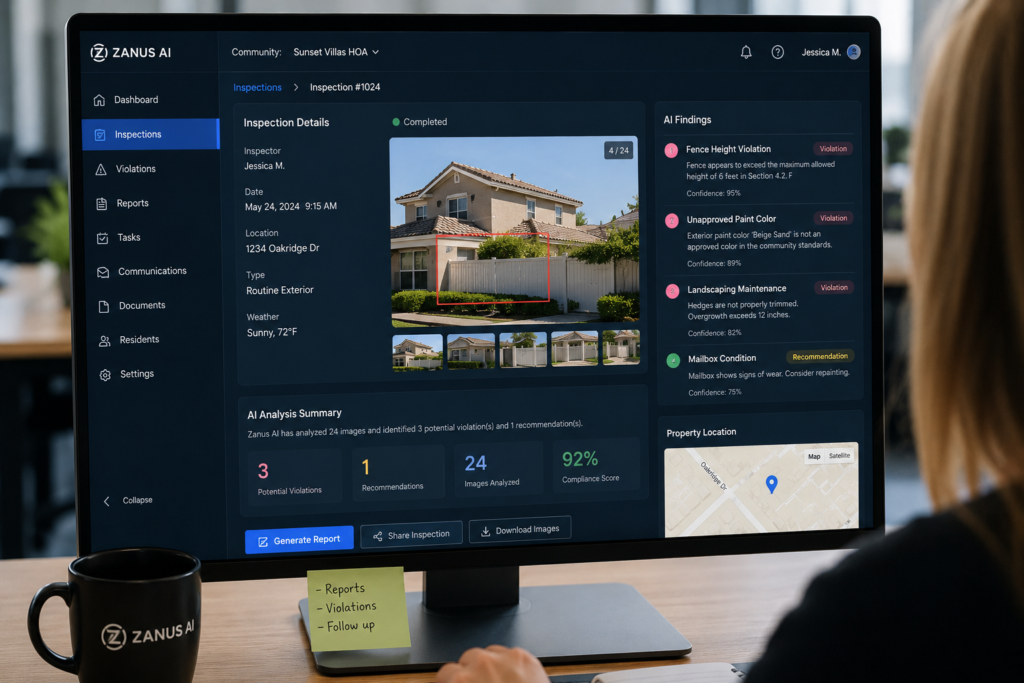
Walking or driving through neighborhoods to spot long grass, broken fences, or unauthorized paint colors takes days. Worse, it relies on the subjective eyes of your staff, frequently leading to heated arguments with residents, board complaints, or expensive legal battles under strict regulations like California’s Davis-Stirling Act.
To fix this, some management companies started uploading community photos to public cloud AI tools like OpenAI or AWS. But that creates a massive legal backdoor: accidentally capturing a resident’s face, a child playing in a backyard, or a sensitive security camera layout can trigger catastrophic Fair Housing Act (FHA) and privacy violations.
Enter Zanus AI.
Instead of routing your community’s private data through the internet, Zanus AI packs dedicated hardware, local vision models, and secure vector databases into a single, physical server that sits directly in your office. It is “AI in a box”—fully offline, completely air-gapped, and designed to automate property compliance without the cloud liability.
The Core Verdict: Is Zanus AI for HOA Worth It?
Zanus AI solves the ultimate HOA dilemma: It delivers the automated speed of modern computer vision without the data privacy nightmares of cloud-based AI. If you manage a large footprint or multiple communities where compliance disputes and data privacy are constant risks, this local machine pays for itself by eliminating unpredictable cloud token fees and legal vulnerabilities.
Who Is It For (And Who Should Skip It)?
Best For:
- Large-Scale HOA Management Firms: Companies handling thousands of homes across multiple communities where manual inspections are a massive operational bottleneck.
- Compliance-Sensitive Regions: Managers operating in states with aggressive privacy laws (like California or Texas) who need an airtight, auditable paper trail.
- Data-Conscious Boards: Communities that want automated drone or mobile tracking but refuse to let resident data leave their physical property.
Avoid If:
- Small, Solo-Community HOAs: If you manage a single 30-unit condo building with minimal exterior maintenance, the upfront hardware infrastructure is overkill.
- Zero IT Capability: While the system is built to be plug-and-play, you still need someone who understands basic local area networks (LAN) to get the most out of it.
Key Outcomes: Real-World Business Value
The draft marketing text talks about “on-premises architecture” and “GPU processing.” Let’s translate that into actual operational outcomes.
1. Zero Cloud Token Costs
Cloud-based vision tools charge you every time you analyze an image. If your field staff captures 5,000 high-resolution photos or hours of drone footage during a monthly inspection cycle, your cloud bill skyrockets. Zanus AI operates on a fixed-cost model. Once the server is in your office, your cost per image analyzed drops to exactly zero.
2. Bulletproof Evidence vs. “AI Hallucinations”
Standard language models love to make things up when they don’t know the answer. Zanus prevents this by anchoring its deep reasoning model strictly to a local vector database containing your specific community’s CC&Rs (Covenants, Conditions, and Restrictions).
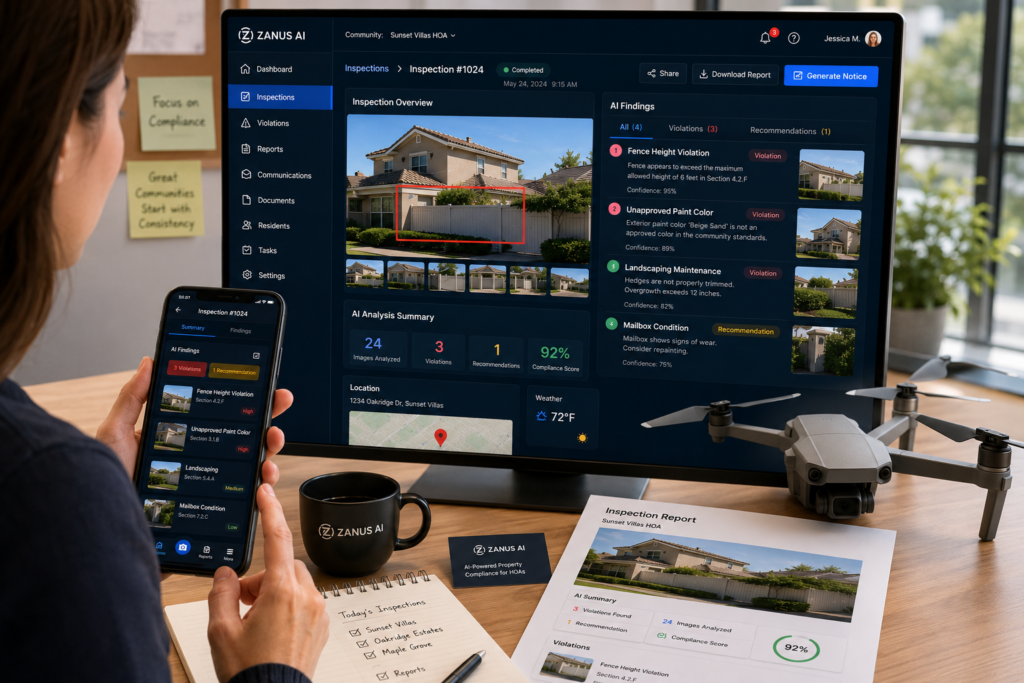
When a violation is detected—such as an unapproved wooden fence variation—the system doesn’t generate a generic warning. It cross-references your exact rulebook, generating a draft notice that cites the precise section, paragraph, and historical precedent.
[Field Photo] ➔ [Internal Vision LLM]
                     │ (Detects out-of-spec fence height)
                     ▼
[Your CC&Rs]  ➔ [Local Vector Database] ➔ [Zanus Reasoning Model]
                                              │ (Cross-references Section 4.2)
                                              ▼
                                   [Flawless Violation Draft]
                                   Zero hallucinations. Accurate citations.
3. Absolute Privacy Isolation (The Air-Gap Advantage)
Because the server operates entirely offline, resident data cannot be leaked, hacked via the web, or scraped to train public AI models. When homeowners complain about drones or cameras “spying” on them, your legal counsel can point to a physically isolated machine. The data never hits the internet.
One thing that stood out about Zanus AI for HOA communities was its privacy-first architecture.
Hardware Breakdown: Choosing Your Machine
Zanus AI offers different physical server scales depending on your portfolio size:
| Technical Spec | Zanus AI Prime | Zanus AI Quantum | Enterprise Cluster |
| Target Audience | Mid-sized HOA managers | Large portfolios / Master communities | Enterprise management firms |
| Document Capacity | Up to 2,000,000 pages | Up to 5,000,000 pages | Unlimited (Scalable nodes) |
| Video/Drone Processing | 50,000 hours | 100,000 hours | Petabyte-scale capability |
| Reasoning Type | Standard Deep Reasoning | Extended Context Reasoning | Multi-node distributed processing |
The Trade-Offs: Real Implementation Roadblocks
No platform is magic. Shifting your AI infrastructure from the cloud to your own office brings distinct physical requirements that traditional software-as-a-service (SaaS) tools don’t have.
- Power and Thermal Demands: The Zanus AI Prime server can draw up to 6 kW under heavy vision-processing loads (dropping to 1 kW on standby). You cannot simply shove this into an unventilated storage closet. It requires a dedicated, climate-controlled space with clean AC power circuits to ensure the enterprise GPUs don’t overheat.
- Physical Security Responsibility: Cloud providers handle physical security automatically. With Zanus, you are entirely responsible for the box. If your office suffers a fire, flood, or break-in, your data goes with it. You must establish a rigid, localized backup strategy (like RAID 10 or physical LTO tape copies).
Pros & Cons
Pros
- Complete Data Ownership: Resident photos, license plates, and structural data never leave your facility.
- Instantaneous Processing: Zero internet lag or peak-hour bottlenecks; enterprise-grade local GPUs process hundreds of high-res photos instantly.
- Predictable ROI: High upfront cost eliminates unpredictable, recurring monthly subscription and token fees.
- Air-Gapped Compliance: Easily satisfies strict legal frameworks like the Davis-Stirling Act without complex web-security setups.
Cons
- High Initial Capital Expense: Requires a significant upfront investment ($19,900 for typical Prime hardware packages) instead of a low monthly fee.
- On-Premise Maintenance: Your team must manage physical environment factors like server room cooling, power distribution, and hardware backups.
Editor’s Take
If you are an established HOA management firm handling complex communities with strict architectural guidelines, then investing in an on-premises solution like Zanus AI is a highly strategic move, because it eliminates your long-term variable cloud costs while providing your legal team with an unassailable, private data boundary that protects you from resident privacy lawsuits.
Final Recommendation
Do not buy Zanus AI if you want a quick, cheap app to check a few lawns once a quarter.
However, if your priority is scaling an efficient, automated property inspection workflow across dozens of neighborhoods without exposing your company to massive data liabilities, choose Zanus AI Prime. It turns compliance from a messy, subjective argument into a secure, objective, and deeply professional business operation.
You may also like: