
Running autonomous AI agent systems in production comes with brutal lessons about infrastructure stability and state management. For systems engineers and AI architects, transitioning from linear processing chains to cyclical graph architectures is no longer a luxury—it is a mandatory step to fix context drift and memory state losses in Large Language Models (LLMs).
This LangGraph review breaks down the v0.x framework from the perspective of engineers who design, deploy, and maintain multi-agent networks at an industrial scale.
Technical Architecture Matrix: LangGraph vs Letta vs Mem0 vs Competitors
Before diving into the codebase realities, it is essential to map out how this framework positions itself against other state-management libraries and runtimes in the 2026 AI ecosystem.
| Architectural Standard | LangGraph (v0.x Engine) | Letta (Virtual OS Runtime) | Mem0 (Semantic Middleware) | Claude Code / Agent SDK | Aegra (Self-Hosted Platform) |
| Classification | State-graph orchestration library | Full agent operating system runtime | Semantic memory REST API service | CLI runner and terminal-native toolkit | Open-source self-hosted backend stack |
| State Paradigm | Directed Graphs with explicit value reducers | Agent-managed three-tier virtual memory layers | Entity-relationship semantic vector stores | Session-bound CLI execution loops | Inherited state graph checkpointing |
| Vendor Lock-in | Low to Moderate (Coupled to LangGraph SDK) | Very High (Tied directly to Letta’s runtime environment) | Low (Framework agnostic via standardized REST API) | High (Optimized exclusively for Anthropic APIs) | None (Apache 2.0 license, total database sovereignty) |
| Scalability | High, provided the checkpointer layer is optimized | Complex due to distributed filesystem syncing | High (SaaS-managed scalability bounds) | Restricted by local hardware compute footprints | High, powered by Redis queues and FastAPI nodes |
1. State Management and Cyclical Workflows
The lack of contextual consistency in stateless LLMs is the single biggest barrier to building reliable agent applications. First-generation frameworks attempted to solve this with linear chains, where data flows in a single direction and gets destructively overwritten at each step. This model falls apart the moment an application requires an agent to self-correct code errors, backtrack out of dead ends, or execute multi-turn validation loops.
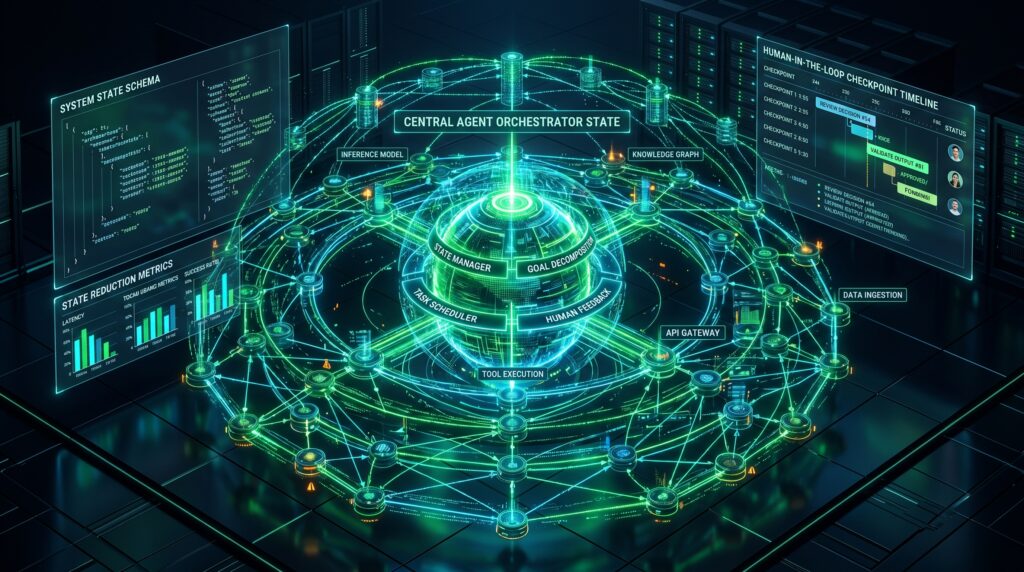
LangGraph addresses this state-management crisis by modeling workflows as Directed Graphs with built-in state persistence. Within this framework, each node functions as a stateless execution block that ingests the current state vector, runs its respective logic, and outputs a partial update.
The core magic lies in its state-mutating reduction logic governed by explicitly defined reducer functions. Instead of destructively overwriting data, the reducer merges partial updates from sequential or concurrent nodes in a controlled manner. This state transition is modeled mathematically:
$$S_{t+1} = \mathcal{R}(S_t, \Delta S)$$
Here, $S_t$ represents the state vector at step $t$, $\Delta S$ is the partial state update returned by the executed node, and $\mathcal{R}$ is the reducer function responsible for merging the values. This mathematical architecture guarantees absolute data integrity even when executing concurrent branches within a single processing superstep, completely neutralizing race conditions at the application layer.
2. Structural Highlights: Stream Control, Human Interaction, and Time Travel
When analyzing LangGraph vs Letta or other autonomous runtimes, senior developers appreciate the absolute deterministic control LangGraph provides over the execution lifecycle. Rather than handing complete autonomy to an LLM, this platform forces you to programmatically define safety rails and transitions.
Precise Agent Loop Governance
Unlike black-box agent frameworks that let the LLM vaguely dictate its next actions, LangGraph forces developers to define exact state transition boundaries using graph Edges and conditional routing functions. This minimizes context drift and prevents infinite tool-calling loops, bringing predictable stability to production software.
Native Human-in-the-Loop Interruption
Production workflows frequently demand manual human approval before executing sensitive tasks like writing database changes or sending external API calls. By setting interrupt_before or interrupt_after hooks during graph compilation, execution pauses automatically at designated nodes.
The framework serializes the active state into a persistent checkpointer and completely unloads the system resources. The agent can remain dormant for days without consuming active RAM or CPU. Once a human updates the state via graph.update_state() and triggers a resumption via graph.invoke(None, config), the runtime seamlessly reconstructs the context from the latest checkpoint and continues execution.
Time-Travel Debugging
Every single state transition at a superstep boundary is stored as an immutable snapshot with a unique, structured identifier. If an agent hits a logic error mid-run, engineers can query the historical record of that specific thread_id to reconstruct the exact environment state at the moment of failure. You can adjust prompts, patch local bugs, and resume execution directly from the failure point without wasting tokens rerunning the entire workflow from the beginning.
Hierarchical Multi-Agent Orchestration
Complex enterprise tasks can be isolated into modular sub-graphs. These sub-agents encapsulate their own scoped context, memory parameters, and local tools, preventing the primary AI agent orchestrator from experiencing context window overflow. This isolation confines bugs to specific sub-systems and keeps per-turn token usage highly efficient.
3. Infrastructure Overhead and the Database Serialization Bottleneck
Despite its exceptional control mechanisms, a candid LangGraph review must address its steep learning curve and the heavy boilerplate code required to define schemas, nodes, and edges. When deep, nested graphs encounter silent logical failures, debugging stack traces across decentralized runtimes becomes highly complex.
However, the most severe operational threat to production scaling is state serialization latency and the resulting database write bloat. By default, LangGraph checkpointers like PostgresSaver rely on the JsonPlusSerializer protocol to translate complex Python types (such as Pydantic models, datetimes, and enums) into storage formats. To preserve history for time-travel debugging, the framework never runs a standard SQL UPDATE on existing state rows. Instead, it issues a fresh INSERT statement containing the complete state snapshot at the end of every node’s superstep execution.
[Node Execution Completes] ──► [JsonPlusSerializer Encodes State]
                                      │
                                      ▼ (Time-Travel Persistence Requirement)
                        [SQL INSERT of Full Snapshot Data]
                                      │
                                      ▼ (If State Size > 2KB)
                        [PostgreSQL TOAST Table Out-of-Band Write]
If your state schema holds rich payload data, extensive chat histories, or dense vector results, the snapshot size ($S$) expands rapidly. The moment this payload breaks the 2KB TOAST_TUPLE_THRESHOLD in PostgreSQL, the database engine is forced to push the data out into external TOAST tables.
Consider a graph with $15$ nodes handling a modest state size of $100\text{ KB}$. A single run will trigger $15$ individual SQL INSERT statements, writing a total of $1.5\text{ MB}$ of state data to disk. We can model this total write volume using:
$$W_{\text{total}} = N \times S$$
where $N$ is the number of executed supersteps and $S$ is the total serialized state size. At a concurrent volume of $100$ active users, the data streams hitting the Write-Ahead Log (WAL) can spike to $150\text{ MB/s}$. This massive volume quickly leads to disk I/O bottlenecks, high CPU usage from compression algorithms (pglz or lz4), and replica sync delays of 3 to 5 seconds, which can severely impact system scalability.
The Remediation: Pointer State Pattern
To survive this database bottleneck, production teams must implement the Pointer State Pattern. You should never store heavy raw payloads directly inside the LangGraph State schema.
Instead, configure the graph state to hold only lightweight metadata and thin URI reference pointers. The heavy payloads should be written directly to a high-speed Redis caching tier or an object store like AWS S3/GCS. When the checkpointer runs its get_tuple() read method, a custom serializer intercepts the URI prefix and pulls the heavy data from Redis or S3 to reconstruct the state object in active memory right before the graph execution loop fires.
4. The Loop Engineering Shift and Self-Hosted Sovereign Ecosystems
When analyzing LangGraph vs Mem0, it becomes clear that they serve completely different operational needs. Mem0 functions as a pluggable, out-of-band semantic memory layer accessible via a clean REST API. It handles cross-session user personalization with sub-second latencies, making it ideal for teams who want to add long-term memory without the complex architectural management of LangGraph.
Meanwhile, the terminal-native agent space has embraced raw “loop engineering,” popularized by tools like Anthropic’s Claude Code and Agent SDKs. These systems use automated terminal execution loops driven by fast validation models to solve software problems. However, this approach is exceptionally token-heavy. Maintaining cost efficiency with tools like Claude Code requires strict adherence to prefix-sensitive prompt caching. Any mid-session tool configuration shifts or system prompt adjustments instantly invalidate the cached keys, which can cause transaction costs for long sessions to spike by up to 8x.
For enterprise software departments that reject commercial cloud dependencies or SaaS tools like LangGraph Cloud and LangSmith, Aegra has emerged as a powerful, self-hosted open-source alternative. Built on FastAPI, PostgreSQL (with pgvector), and Redis, Aegra provides complete infrastructure sovereignty. It natively supports human-in-the-loop validation gates, safe cron scheduling using database SKIP LOCKED primitives, real-time Server-Sent Events (SSE) streaming, and standardized OpenTelemetry (OTLP) tracing exports to open platforms like Langfuse or Phoenix.
Production Playbook and Architecture Recommendations
LangGraph is an incredibly reliable framework if your enterprise application requires strict determinism, granular execution control, and deep human oversight. To scale this framework successfully without overloading your database infrastructure, platform teams should adopt the following production playbook:
- Enforce the Pointer State Pattern: Keep your core graph state schemas lean. Offload large text logs, raw documents, and file attachments to an enterprise Redis or S3 bucket, leaving only lightweight reference URIs inside the LangGraph engine to prevent WAL bloat.
- Select the Right Checkpointer: Restrict the volatile, in-memory
MemorySaverexclusively to local development environments and unit testing suites. For production infrastructure, always implement an asynchronous PostgreSQL checkpointer (AsyncPostgresSaver) to maximize connection pool efficiency and isolate database write overhead from the client response thread. - Decouple the Tracing Architecture: Avoid vendor lock-in by routing your application telemetry through open-source self-hosted backends like Aegra combined with OpenTelemetry-compliant tools like Langfuse. This keeps sensitive user data securely inside your corporate firewall while providing deep operational visibility.
Explore More from Our AI Agent Production Series
- Deep Research Memory Frameworks: Check out our Mem0 vs Letta Architectural Comparison to select the ultimate long-term memory layer for your production agent network.
- Autonomous Engineering Workspace Reviews: Read our hands-on OpenHands Review: A Brutally Honest Look at the Open-Source AI Software Engineer to see how a model-agnostic, fully sandboxed stack behaves in production workflows.
- Terminal-Native Power Tools: Dive into our recent Claude Code Review: A Blunt, Production-Tested Evaluation of Anthropic’s CLI Agent to master the safety guardrails and caching strategies required for agentic terminal loops.