
When choosing between Mem0 vs Letta, managing memory in stateless Large Language Models (LLMs) presents a clear challenge for production-grade AI agent systems: they convert text inputs into text outputs without retaining operational context across network requests. To simulate conversational continuity, typical architectures must repeatedly pass the entire dialog history back into the model’s active context window. As interaction sequences lengthen, this pattern hits a severe performance wall—latency escalates, attention mechanisms degrade, and token consumption scales linearly.
To solve this state-management crisis at scale, two distinct architectural philosophies have emerged in 2026: Mem0 (v3), an independent, pluggable semantic memory layer that operates entirely out-of-band, and Letta (formerly known as MemGPT), an operating-system-inspired virtual memory runtime that integrates deeply into the agent’s core cognitive loop.
Choosing between them dictates your system’s latency profiles, model dependencies, and infrastructure economics. This review breaks down both platforms based on technical architecture, real-world benchmarks, and hands-on deployment realities.
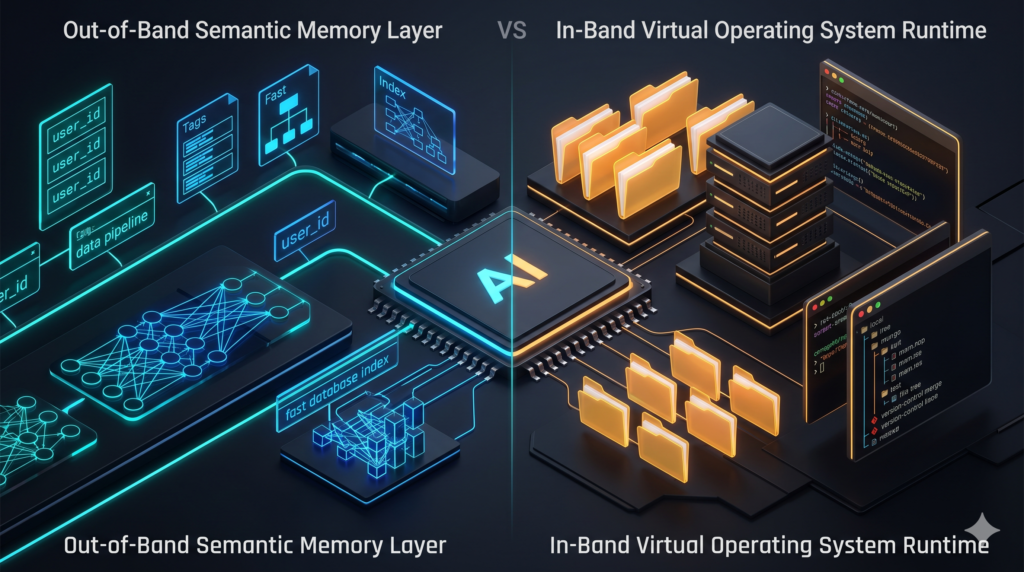
Technical Trade-Offs Matrix: Mem0 vs Letta
| Feature / Metric | Mem0 (v3 Decoupled Middleware) | Letta (Git-backed Virtual OS Runtime) |
| Integration Model | Pluggable middleware layer via SDK/API | Monolithic runtime managing full agent lifecycle |
| Memory Management Path | Out-of-Band (Outside main inference path) | In-Band (Self-directed via synchronous tool calls) |
| Token Efficiency | Bounded: $O(1)$ stable at $< 7,000$ tokens per turn | Volatile: Scales $O(N)$ with core file structures |
| System Latency (P95) | Low: $\sim 150\text{ms} – 300\text{ms}$ (Direct DB queries) | High: $> 1.5\text{s} – 3\text{s}$ (Requires multi-turn reasoning) |
| Model Compatibility | High: Works reliably with small local models ($8\text{B} – 70\text{B}$) | Low: Demands top-tier frontier models (e.g., Claude 3.5 Sonnet) |
| Data Cleanup Mechanism | Automated Ebbinghaus forgetting curves | Idle-time Defragmentation & Reflection background swarms |
| Critical Failure Modes | Silent parser failures; semantic contradiction blind spots | Infinite heartbeat loops; Local memory HTTP 413 gateway errors |
| Self-Hosted Complexity | Moderate: Managing vector index scaling and structured cache | High: Orchestrating Git worktrees and concurrent file locks |
1. In-Band vs. Out-of-Band Architecture
The fundamental differentiator between these platforms is where the memory management process lives relative to the LLM’s primary inference path.
Mem0 (Out-of-Band):
[User Input] ───► [Agent Inference Loop] ───► [Response]
                         ▲
                         │ (Direct DB Fetch during Prompt Assembly)
                  [Mem0 Ingestion DB Store] ◄─── (Asynchronous Post-Chat Write)

Letta (In-Band):
[User Input] ───► [Agent Cognitive Loop (RAM)] ───► [Self-Directed Tool Call?] ───► [Update RAM/MemFS] ───► [Response]
Letta: The In-Band Self-Directed Reasoning Loop
Letta treats the LLM’s context window like physical RAM and partitions external storage tiers into a virtual filesystem. In this in-band setup, the agent is the primary actor executing synchronous tool calls to modify its own cognitive state. When an input arrives, the model inspects its active context (Core Memory) and programmatically invokes tools like core_memory_append or core_memory_replace to update its baseline knowledge.
This is driven by a single-ready-unit scheduler where the model controls the execution loop. To process deep multi-step reasoning without user intervention, Letta uses automated heartbeats via the request_heartbeat=true parameter. This allows the agent to repeatedly chain internal memory operations—reading from archival storage, page-updating the core partition, reflecting, and final-answering—in a single client interaction.
The latest iteration of Letta Code replaces rigid tabular storage with Context Repositories (MemFS). Adhering to the Unix philosophy that “everything is a file,” Letta projects the agent’s memory as plain Markdown files on a local filesystem. The agent uses standard terminal primitives—such as running bash loops or Python scripts—to query and edit its context programmatically.
Changes are tracked via a local Git workspace, creating distinct commits with explanatory messages documenting why the agent updated its memory. This enables concurrent multi-agent architectures: sub-agents can work in parallel on isolated Git worktrees and later reconcile state using standardized merge conflict resolution pipelines.
Mem0: The Asynchronous Out-of-Band Pipeline
Mem0 completely separates memory management from the agent’s execution loop. The orchestration framework (such as LangGraph, CrewAI, or a native loop) focuses solely on business logic, while the memory path operates as an asynchronous, out-of-band pipeline.
When a conversation turn concludes, the raw payload is offloaded to the Mem0 Ingestion Queue. A specialized background LLM performs a single-pass extraction to distill observations into an append-only (ADD-only) format. This append-only design prevents the real-time overwriting or deletion of older historical values at the storage layer, maintaining chronological continuity and preventing data loss from premature data compression.
At the hardware layer (e.g., when integrated with Valkey or PostgreSQL), Mem0 verifies historical duplicates using a hybrid query structure combining target identity scope tags (user_id, agent_id, run_id) and vector similarity metrics. It updates indexes in real time via a single HSET operations. On the read path, instead of relying on the agent to query its past, the host application executes a direct database fetch during prompt construction and infuses the relevant facts straight into the system instructions.
2. Memory Management, Retrieval Performance, and Token Efficiency
Production environments demand high context recall with low token overhead to keep inference costs sustainable.
Mem0 v3: Multi-Signal Scoring and Forgot-Curve Suppression
Mem0 v3 removes dependencies on external graph databases like Neo4j by handling entity extraction and linking natively within its unified vector-relational layer. When a read request is triggered, it runs three retrieval signals in parallel to grade memory candidates:
- Dense Semantic Search: Calculates cosine distance across vector embeddings to surface conceptual matches.
- Sparse Keyword Search: Uses exact BM25 keyword matching with token lemmatization to catch explicit strings, model codes, or configuration variables that get lost in abstract dense spaces. (Note: Local self-hosted deployments must explicitly install the
[nlp]extra to compile spaCy; otherwise, the engine silently defaults to basic vector matching). - Entity Search: Maps identified proper nouns from the input query against internal graph networks to inject a relevance weight boost.
The total score balances semantic relevance (~50%), ingestion importance (~30%), and a temporal decay factor modeled after the Ebbinghaus forgetting curve (~20%). The decay is calculated using:
$$S_{\text{weighted}} = \min(C_{\text{access}}, 255) \cdot 0.5^{\frac{\Delta t}{7}}$$
where $C_{\text{access}}$ tracks frequency (capped at 255 to prevent integer overflow) and $\Delta t$ tracks days since last access. To preserve new data, Mem0 locks a 14-day grace period where temporal decay is suspended. Finally, a Cross-Encoder models re-ranking using weighted Reciprocal Rank Fusion (WRRF) to order results, eliminating the “lost-in-the-middle” attention degradation typical of long context windows.
Letta MemFS: Progressive Disclosure and Idle-Time Defragmentation
Letta handles token budgets through progressive disclosure on top of the MemFS file layout. Rather than dumping raw files into the system prompt, Letta keeps only the abstract directory filetree and the YAML frontmatter configuration metadata visible in the core window.
This works as a map; only files explicitly moved to the system/ directory are loaded with full text. The agent manages its active context allocation by moving memory files into or out of this folder based on its current task requirements.
To prevent context drift across long lifecycles, Letta uses three background skills:
- Memory Initialization: Launches parallel sub-agents to analyze long-term conversation logs and baseline code repositories, constructing a clean hierarchical folder structure.
- Memory Reflection: An automated background thread that executes during idle windows (“sleep-time compute”). It parses recent message logs, compresses relevant insights, and commits them to an isolated Git branch, preventing lock contention on the main thread.
- Memory Defragmentation: When total index sizes break safety limits, a sub-agent consolidates duplicate documents, splits oversized logs, and condenses the MemFS workspace down to a clean suite of 15 to 25 explicitly structured files.
Standardized Performance Benchmarks
Based on empirical evaluations using the standardized LoCoMo and BEAM long-context datasets, the performance profiles of the two frameworks break down as follows:
| Metric Vector | Mem0 (v3 Multi-Signal Hybrid) | Letta (MemFS Context Repositories) |
| Overall LoCoMo Accuracy | 91.6% | 74.0% |
| – Single-hop Recall | 92.3% | Not Publicly Disclosed |
| – Multi-hop Inference | 93.3% | Not Publicly Disclosed |
| – Temporal Reasoning | 92.8% | Not Publicly Disclosed |
| Avg. Retrieval Tokens/Turn | $< 7,000$ tokens | Volatile (Highly dependent on active MemFS page files) |
| BEAM 1M Pass Rate (700 QA) | 64.1% | Not Publicly Disclosed |
| BEAM 10M Pass Rate (200 QA) | 48.6% | Not Publicly Disclosed |
Mem0 v3’s high temporal score marks a significant improvement over legacy versions, validating the use of the append-only write architecture combined with read-time decay filters. Letta’s 74.0% overall score on LoCoMo shows that structured file-tree mappings can match the accuracy of highly complex graph databases while maintaining deterministic control over context window placement.
3. Developer Experience, Model Vulnerabilities, and Fault Tolerance
Deploying these frameworks in industrial applications reveals several critical edge-case failure modes and unique behavioral vulnerabilities.
Letta: Format Sensitivity and the Infinite Heartbeat Loop
Letta’s self-directed virtual memory model places an exceptional cognitive load on the underlying model. When deployed alongside standard open-source models ($8\text{B}$ to $70\text{B}$ parameters), the loop introduces a catastrophic failure pattern:
[Model emits broken/malformed JSON tool call payload]
                         │
                         ▼
   [Letta engine auto-triggers Heartbeat for self-correction]
                         │
                         ▼
      [Model hallucinates arguments in the broken context]
                         │
                         ▼
    [Infinite Loop of sequential tool failures consumes token budget]
                         │
                         ▼
[Unbounded context growth triggers HTTP 413 Payload Too Large Gateway Error]
                         │
                         ▼
[413 Error string gets written into Recall history, locking Agent permanently]
Because sub-frontier models frequently output malformed JSON or miss required arguments in tool calls, the Letta runtime auto-triggers a heartbeat to let the agent fix its own error. This easily devolves into an infinite loop of sequential tool failures, rapidly burning through your token budget.
As the historical context grows, the payload size eventually hits gateway limits, triggering an HTTP 413 Payload Too Large error (commonly capped at 1MB on enterprise Nginx proxies). Because Letta writes system errors back into the agent’s transaction history, this 413 error payload gets appended to the prompt log, locking the agent into a permanent failure state until the session is manually purged.
Furthermore, because memory operations are unconstrained text edits, sequential operational dependency (e.g., reading a file before editing it) easily breaks when the model encounters attention degradation. This makes frontier models like Claude 3.5 Sonnet a functional requirement for Letta.
Mem0: Silent Parser Failures and Semantic Blind Spots
Mem0 runs efficiently with smaller local models on the read path because it uses standard database queries. However, its background ingestion path includes silent failure modes that can lead to quiet data loss:
- Silent Parser Failures: When using open-source reasoning models (like DeepSeek-R1 or Qwen-2.5-Instruct via Ollama), the model outputs chain-of-thought tokens within
<think>tags before rendering the raw JSON schema block. Mem0’s default ingestion handler does not strip these tags out, causing JSON parsing to fail completely. The internal_add_to_vector_storehandler wraps this in a broad try-except block that silently swallows the exception, logs a generic warning, and outputs an empty array[]. The system returns a success status to your main application loop, but no memory was written. A similar issue occurs in the SDK’sremoveCodeBlocksfunction, which can accidentally strip valid characters inside Claude or Gemini JSON text blocks. - Local Embedding Swallow: During bulk ingestion processing, if a single fact embedding generation call fails due to API timeouts or rate limits, Mem0 logs a warning but does not throw a bubble-up exception. The fact is permanently omitted from storage while the orchestration client receives a successful return code.
- Semantic Contradiction Blind Spots: Because the open-source Mem0 v3 pipeline implements duplicate checks using a strict MD5 text hash of the fact string, it cannot detect semantic conflicts at write-time. If a user updates their shipping address from “Chicago” to “New York,” both entries will exist simultaneously as separate dense vectors. During read queries, both contradictory strings return with high cosine scores, forcing your downstream application LLM to guess which fact is current.
4. Sovereign Stack Feasibility and Infrastructure Economics
For enterprises operating under strict privacy frameworks like GDPR or internal data governance rules, deploying a fully localized Sovereign Stack is often a non-negotiable requirement.
Infrastructure Blueprints and Storage Architecture
The underlying infrastructure components for self-hosted instances of both platforms show distinct architectural differences:
Mem0 Sovereign Stack: Qdrant + Valkey / PostgreSQL
Mem0 requires two complementary storage layers: a high-performance vector engine (such as Qdrant supporting Binary Quantization n-fold memory optimization) and an ultra-low-latency structured relational metadata cache (Valkey or PostgreSQL).
The storage schema in Valkey isolates tenants at the physical layer by defining a clean search space using a composite index configuration:
Đoạn mã
FT.CREATE user_memories ON HASH PREFIX 1 mem: SCHEMA
    memory TEXT
    embedding VECTOR HNSW 6 TYPE FLOAT32 DIM 1536 DISTANCE_METRIC COSINE
    user_id TAG
    agent_id TAG
    run_id TAG
    created_at NUMERIC
    updated_at NUMERIC
This enforces a strict multi-tenant barrier. The engine applies an exact metadata TAG pre-filter prior to calculating vector cosine distances, completely eliminating the risk of cross-tenant data leakage between separate user accounts.
Letta Sovereign Stack: PostgreSQL Connection Pools + Distributed Git Workspaces
Letta shifts infrastructure complexity from vector indexing to file-system state and concurrency management. It requires a robust PostgreSQL cluster to manage the active agent configuration state (AgentState) and complete message execution logs, paired with a distributed storage system to host the Git-backed MemFS.
The primary hurdle for a self-hosted Letta setup is managing file-system state synchronization when agents migrate across stateless compute nodes. Every file modification requires local locking, background defragmentation loops, and Git commits. If multiple concurrent sub-agents are pushing updates to the same workspace, you must maintain a dedicated coordination proxy server to handle merge conflicts in real time, introducing a heavy storage-layer management burden.
Total Cost of Ownership (TCO) Analysis
When evaluating scaling costs at a stable workload of 10,000 operations per day (approximately 300,000 memory-related turns per month), the economic profiles break down as follows:
| Cost Component (Monthly) | Managed Mem0 Pro Cloud | Sovereign Self-Hosted Stack (Qdrant + Postgres + Valkey) |
| Base Subscription / License | $5,000 / month | $0 (Open-Source Apache 2.0 / MIT) |
| Overages (Graph/Vector Overage) | $2,500 / month (1M entity links) | $0 (Included in base hardware compute) |
| Network Data Egress | Included | $450 / month (Estimated 5TB transmission traffic) |
| Compute Hardware (DO Droplets) | Included | $1,200 / month (Dedicated 4vCPU/16GB nodes) |
| Compliance & Attestation Logging | Not Available | $35 / month (Cryptographic append-only storage) |
| Engineering Maintenance (O&M) | $1,200 / month (Est. 8 hours/month at $150/hr) | $1,200 / month (Dedicated cluster management time) |
| Total Monthly TCO | $9,240+ | $3,870 |
The Sovereign Crossover Point
Financial modeling indicates that the economic break-even point occurs at 7,500 operations per day.
- Below 5,000 operations/day: The engineering overhead of self-hosting outweighs the premium of managed SaaS providers. Teams should use the managed cloud to eliminate setup complexity and maintenance costs.
- Above 10,000 operations/day: Moving to a self-hosted Sovereign Stack cuts monthly operational expenditures by up to 58%, making local infrastructure highly cost-effective for high-volume deployments.
Legal Compliance: Attestation Proxy for the EU AI Act
Enterprises operating under Article 13 of the European Union AI Act must supply verifiable audit logs showing exactly what memory components were extracted and injected into an agent’s prompt during inference. To meet this requirement on a self-hosted stack, teams can deploy an independent Attestation Proxy layer.
The Attestation Proxy sits as a secure interceptor before your database endpoints. When memory fragments are pulled from Qdrant or Postgres, the proxy intercepts the JSON payload, computes an SHA-256 hash of the content, and signs it using the enterprise’s private RSA-2048 key.
This cryptographic token is passed into the prompt header alongside the memory block, while a parallel log entry is committed to an unalterable write-ahead ledger. This provides verifiable proof of data provenance for legal compliance audits with minimal latency overhead ($\sim 22\text{ms}$).
Final Verdict: Which Platform Is Better in 2026?
Neither platform is a universal solution; each serves distinct architectural objectives and operational constraints.
Choose Mem0 if:
- You have an existing agent framework: If you are running production systems on LangGraph, CrewAI, or bespoke python runtimes, Mem0 integrates as a pluggable middleware layer without requiring a rewrite of your core orchestration logic.
- Your system has strict latency limits: If your application demands fast response times (SLA $< 500\text{ms}$), Mem0’s direct database lookup avoids the multi-turn model reflection loops that slow down agent execution.
- You are deploying on local open-source models: Mem0’s decoupled read path runs reliably on smaller hardware footprints ($8\text{B}$ to $70\text{B}$ parameter local models), lowering computational costs.
- Your data is highly structured around identities: It fits use cases focused on tracking explicit, user-scoped configurations, persistent customer profiles, or static session variables.
Choose Letta if:
- You are building highly autonomous, long-lived agents: Letta excels when designing complex agents (like automated software engineers or deeply personalized virtual companions) that operate over long execution horizons.
- The agent must modify its own logic: If your application requires agents to actively update their own operating instructions, build custom tools, or self-correct execution rules based on real-world feedback.
- You require human-in-the-loop file transparency: By projecting memory onto Markdown files via MemFS, human engineers can open the agent’s memory directory using standard text editors, edit states, and track revisions via Git.
- Your stack runs entirely on frontier models: If your budget allows for high API spending on models like Claude 3.5 Sonnet, where tool-calling accuracy minimizes the risk of infinite failure loops.
AI Review Zones Expert Verdict: The Paradigm Choice
At AI Review Zones, we strip away the marketing hype to look at infrastructure through a purely capital and operational lens. The choice between Mem0 and Letta isn’t just about picking a library—it’s about choosing your core architectural paradigm.
Mem0 represents the “Keep It Simple” philosophy. By decoupling memory from the main inference path, it acts as an external state sidecar. This design limits cognitive drift, guarantees lower latency, and allows you to scale up concurrent users without facing exponential token costs. If your primary goal is to add persistent user personalization to an existing application framework, Mem0 v3 is your most economical and resilient choice.
Letta, conversely, is for engineers building fully autonomous, agent-first systems. It is an ambitious operating system metaphor that gives the agent true agency over its own mind. While the MemFS file-based structure and Git versioning are brilliant developer-first improvements, the operational realities—such as extreme model dependency, infinite heartbeat loops, and high token burn—mean it demands a massive cloud budget and top-tier engineering maintenance.
Our recommendation is straightforward: Use Mem0 if you need an efficient, cost-predictable personalization layer that runs smoothly on local open-source models today. Choose Letta only if you are building long-horizon autonomous agents, have strict requirements for human-editable memory files, and possess the infrastructure budget to back frontier models in production.