
If you have been following the AI agent space lately, you know it is flooded with flashy marketing videos promising a world where junior developers are completely obsolete. We’ve all seen the claims surrounding autonomous coding assistants. But if you are an engineering lead or a core architect trying to run these systems in production, you know the reality of executing code under real-world constraints is a completely different beast.
That is why we are doing a deep-dive OpenHands review today. OpenHands (which many devs still remember by its original project name, OpenDevin) represents one of the most serious, model-agnostic attempts to build a truly functional, open-source AI software engineer.
After tearing through the framework, reviewing its V1 SDK architecture, and analyzing telemetry data, we are breaking down what actually happens when you let OpenHands loose on a real codebase.
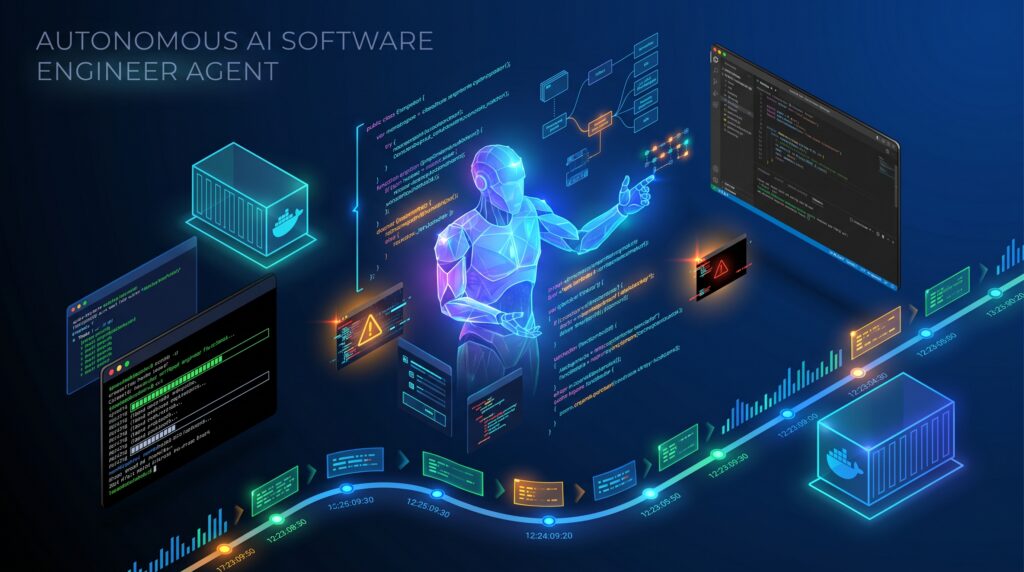
The Technical Trade-Offs: OpenHands vs Devin & Alternatives
To set the stage, let’s look at how OpenHands stacks up as an autonomous programming runtime. While proprietary platforms like Devin by Cognition remain locked behind closed enterprise walls, OpenHands brings the entire environment to your local machine.
Core Comparison Matrix
| Technical Vector | OpenHands (V1 Runtime Stack) | Proprietary / Cloud Competitors |
| Architectural Model | Stateless Agent + Stateful EventStream Pub/Sub | Monolithic state trees (typically cloud-managed) |
| Execution Safety | Local secure Docker container sandboxing (DockerWorkspace) | Cloud-hosted remote virtual machines |
| Workspace Visibility | Live VS Code server tunnels, persistent tmux pipelines, VNC browser forwarding | Proprietary web-based control dashboards |
| Telemetry & Monitoring | Active StuckDetector loops with semantic action tracking | Hard token/time execution limits |
| Model Agnostic | Yes. Supports frontier APIs (Claude, GPT) and local Sovereign Stacks (Qwen, Llama) | No. Tightly coupled to specific closed models |
1. Under the Hood: The EventStream and Stateless Abstraction
Moving from its early legacy architecture to the modern V1 Software Agent SDK, OpenHands went through a massive structural overhaul. The old design suffered from a monolithic setup where the agent’s cognitive logic was tightly coupled with the execution sandbox, creating fragile runtimes.
The V1 SDK completely fixes this by splitting the engine into four decoupled Python packages: openhands.sdk (core abstractions), openhands.tools (reusable tools), openhands.workspace (the execution sandbox), and openhands.agent_server (FastAPI REST/WebSocket interfaces). The old monolithic controller is gone. Instead, the runtime relies on a clean, append-only EventStream.
                       +-----------------------------------+
                       |           Conversation            |
                       |  (Stateful Append-Only EventLog)  |
                       +-----------------+-----------------+
                                         |
                                         v  EventStream Pub/Sub
+----------------------------------------+----------------------------------------+
|                                        |                                        |
v                                        v                                        v
[Stateless Agent]                [Tool Registry]                 [Docker Workspace]
Reads History ──► Acts           JSON Args ──► Pydantic          Executes Bash / Mounts
Every single user prompt, bash execution, compiler warning, and file change is treated as an immutable event in a transaction-style log. The AI software engineer agent itself is a stateless, immutable Pydantic class. It reads the current log history and outputs a single ActionEvent. The stateful Conversation class handles the log, saving events as JSON files to allow complete session recovery and deterministic replays.
When you watch it work, this design enforces a highly logical, four-phase prompt methodology:
$$\text{Exploration} \longrightarrow \text{Analysis} \longrightarrow \text{Implementation} \longrightarrow \text{Verification}$$
The agent reads the repository structure, forms a logical hypothesis for the fix, applies the code change, and immediately verifies its work by running your project’s native test suites.
2. Sandbox Isolation and Workspace Telemetry
One of the biggest anxieties engineering leads have when adopting an AI software engineer is security—you simply cannot trust an LLM-generated script to run natively on your production host machine. OpenHands addresses this brilliantly by isolating everything inside a secure DockerWorkspace.
To keep container spin-up times fast, OpenHands uses a clever three-tiered image caching and tagging system:
- Source Tags (
oh_v{ver}_{lock_hash}_{source_hash}): Reuses the image instantly if local code and dependency lock files match perfectly. - Lock Tags (
oh_v{ver}_{lock_hash}): Skips heavy system-level installations (apt-get,poetry install) and just copies updated local source code onto a cached dependency layer. - Versioned Tags (
oh_v{ver}_{base_image}): Reuses pre-compiled runtimes (like Python 3.12 or Node.js 22) but requires a fresh dependency resolution step.
The host project folder is mounted directly into the container at /projects. This bi-directional sync means you can actively modify files in your local IDE while the agent runs diagnostic commands inside the container sandbox.
Even better, if you set extra_ports=True during initialization, OpenHands opens up incredible real-time telemetry tunnels:
- Port $p$ (e.g., 8010): Direct access to the FastAPI agent server.
- Port $p+1$ (e.g., 8011): A web-accessible VS Code IDE running inside the sandbox so you can watch code modifications live.
- Port $p+2$ (e.g., 8012): A VNC remote desktop session showing an automated Chromium browser—allowing you to visually monitor web UI tests as the agent fills out forms and debugs front-end code.
3. Real-World Failure Modes: Loops, Zombies, and Token Burn
No OpenHands review would be honest without discussing where this framework encounters friction in real development workflows. When tasks stretch out over long, multi-file editing sessions, a couple of major bottlenecks emerge.
The Model Dependency Chasm
Here is the raw truth regarding OpenHands vs Devin and other competitors: your choice of underlying LLM completely dictates your success rate. When powered by top-tier frontier APIs like Claude 3.7 (with Thinking enabled) or Claude 3.5 Sonnet, OpenHands behaves like a highly capable engineer.
But if you try to enforce absolute data privacy by forcing it onto smaller, unoptimized local open-source models (like standard Llama-3 8B or basic Qwen2.5-Coder variants), the agentic loop frequently falls apart. Local models regularly fail to parse the complex JSON tool schemas, ignore bash environmental feedback, or generate syntax errors that violate the sandbox constraints.
Logical Loop Freezes
If a test suite fails or a compiler throws an unhandled exception, the agent can easily get stuck in a repetitive loop:
$$\text{Build Attempt} \longrightarrow \text{Catch Compile Error} \longrightarrow \text{Install Package X} \longrightarrow \text{Retry Build} \longrightarrow \text{Install Package X} \dots$$
To fight this, OpenHands deploys a built-in StuckDetector that monitors the EventStream. By evaluating action patterns and ignoring timestamps, it steps in automatically when specific thresholds are breached:
- Repeating Action-Observation Pairs (4+ instances): Aborts the loop and fires a
LoopRecoveryActionto ask for human guidance. - Repeating Action-Error Pairs (3+ instances): Freezes the cycle and sets the task state to failed.
- Agent Monologues (3+ consecutive events): Intervenes if the agent sits there writing text thoughts without executing tools.
The Tmux Zombie Process Crisis
Under the hood, OpenHands manages terminal persistence inside the Docker sandbox using tmux sessions. Over long, intense coding runs, the framework suffers from a severe process leak. It frequently fails to reaping child processes, leading to an accumulation of up to 149 zombie processes consisting of orphaned tmux servers and su wrapper calls.
Eventually, the container hits its process limit, and the primary Bash shell enters an un-interruptible sleep state (do_wait). The user interface will sit there stating “Agent is running task” indefinitely, but the terminal is completely dead. Standard kill signals won’t work; your only recovery option is to drop to your host terminal and use the Docker daemon to force-kill the zombie container.
4. Operational Telemetry and Financial Benchmarks
Autonomous agent loops are incredibly resource-intensive. Because every single execution step re-transmits the evolving EventStream history (including code blocks and lengthy build logs) back into the model’s context window, token growth escalates fast.
Furthermore, these runs are highly stochastic; the exact same bug-fixing task can vary wildly in total token consumption depending on the model’s initial tool choices. Below is the real-world performance and financial data across different configurations within the OpenHands runtime environment:
| System Framework & LLM Choice | Benchmark Resolve Rate (ECR %) | Complete Task Success (TPR %) | Mean Input Tokens per Run (k) | Mean Output Tokens per Run | Mean Financial Cost per Task ($) |
| OpenHands + Claude 3.7 (Thinking) | 72.22% | 48.15% | 9,501.25 | 85,033.05 | $29.80 |
| OpenHands + Claude 3.5 Sonnet | 53.70% | 40.74% | 2,858.00 | 24,929.47 | $8.95 |
| OpenHands + GPT-4.1 (o1 Series) | 55.56% | 42.59% | 465.94 | 1,535.47 | $0.94 |
| OpenHands + Gemini 2.5 Pro | 51.85% | 35.19% | 760.88 | 35,173.29 | $2.18 |
| OpenHands + DeepSeek V3 | 45.37% | 26.85% | 4,717.78 | 31,957.67 | $1.31 |
| OpenHands + Qwen3-32B (Optimized) | 44.44% | 29.63% | 208.00 | 8,755.35 | Sovereign Stack |
| OpenHands + Qwen3-32B (Standard) | 35.19% | 25.93% | 591.02 | 2,097.89 | Sovereign Stack |
| OpenHands + Llama 3.3 70B | 27.78% | 20.37% | 132.69 | 872.93 | Sovereign Stack |
| OpenHands + GPT-4o | 21.30% | 14.82% | 760.53 | 3,990.31 | $1.94 |
The numbers showcase a massive performance-to-cost delta. While Claude 3.7 hits an incredible 72.22% resolve rate, it swallows an average of 9.5 million input tokens per task, leading to a steep cost of nearly $30 per run. This highlights why features like the V1 Memory Condenser are critical—they compress historical logs to slash API bills by roughly half with almost no impact on the agent’s success rate.
5. Enterprise Feasibility: Cloud APIs vs. Sovereign Stack
For teams trying to figure out their long-term infrastructure strategy, the big question is whether to deploy on an enterprise cloud API budget or build a self-hosted Sovereign Stack using local GPU clusters.
The Code Security Reality Gap
When evaluating an AI software engineer for production, you must look past academic benchmarks like SWE-bench Verified (where frontier models score high on historical, curated issues). On real-world, live software environments (SWE-bench Live), resolve rates drop sharply to 18%-20% across the board because systems struggle with completely novel codebase patterns.
More importantly, code correctness does not mean secure implementation. Data from the Agent Security League shows that over 74% of functionally correct solutions generated by coding agents contain serious vulnerabilities:
[Agent Generates Code Output] ──► [Functional Tests Pass: 100%]
                                        │
                                        ▼ [Security Audit Gate]
                                  [74.7% Solutions Contain Vulnerabilities]
                                  (Injection Flaws, Leaky Dependencies)
Because agents focus heavily on getting the immediate test cases to pass, they routinely introduce injection vulnerabilities, dependency risks, or memory management bugs. This means unsupervised junior dev replacement is a myth; a rigorous, human-in-the-loop security review is mandatory for enterprise adoption.
The Hosting Economics
- The Cloud API Route: Offers the highest possible resolve rates out of the box using models like Claude 3.7. However, the variable operational cost scales sharply with task volume. If your agents are running extensive test-and-debug cycles all day, your monthly API bills will explode.
- The Sovereign Stack Route: By renting affordable, high-RAM local GPU instances (on hardware platforms like Clore.ai for $0.20 to $0.35 per hour) or buying on-premise rigs, you can host optimized open-source models like Qwen3-Coder (32B). This completely eliminates per-token variable fees, giving your team a flat-rate, private automation pipeline. The trade-off is infrastructure complexity (managing connection pools, handling local vector stores, and allocating a minimum of 24GB VRAM for quantized instances) and a slight drop in baseline task resolve accuracy.
The Verdict & Production Playbook
OpenHands is an incredibly mature, robust, and highly structured framework, making it a standout open-source tool for augmenting your engineering team. However, it requires deliberate system-level safeguards to run safely and affordably at scale.
If you are deploying OpenHands in an enterprise environment, we highly recommend following these three operational guidelines:
- Enforce Automated Sandbox Recycling: To completely counter the
tmuxzombie process leaks, set strict execution limits in your backend. Always configureSANDBOX_TIMEOUT=120and cap runs atMAX_ITERATIONS=50to prevent runaway loops from locking up your host resources. - Deploy Hybrid Cost Routing: Do not route simple repository exploration or routine documentation tasks to premium frontier models. Implement an upstream router to handle initial diagnostic sweeps with affordable models like DeepSeek V3, reserving high-tier tokens for complex multi-file debugging.
- Mandate CI/CD Security Scanners: Because coding agents heavily favor functional passing over secure engineering, never allow an autonomous pull request to merge automatically. Route every single agent-generated line through automated static analysis (SAST) scanners and treat it as untrusted code until verified by a senior human reviewer.
Looking to optimize the data layer powering your AI agents? Check out our comprehensive Mem0 vs Letta Architectural Comparison to choose the right persistent memory engine for your production stack!