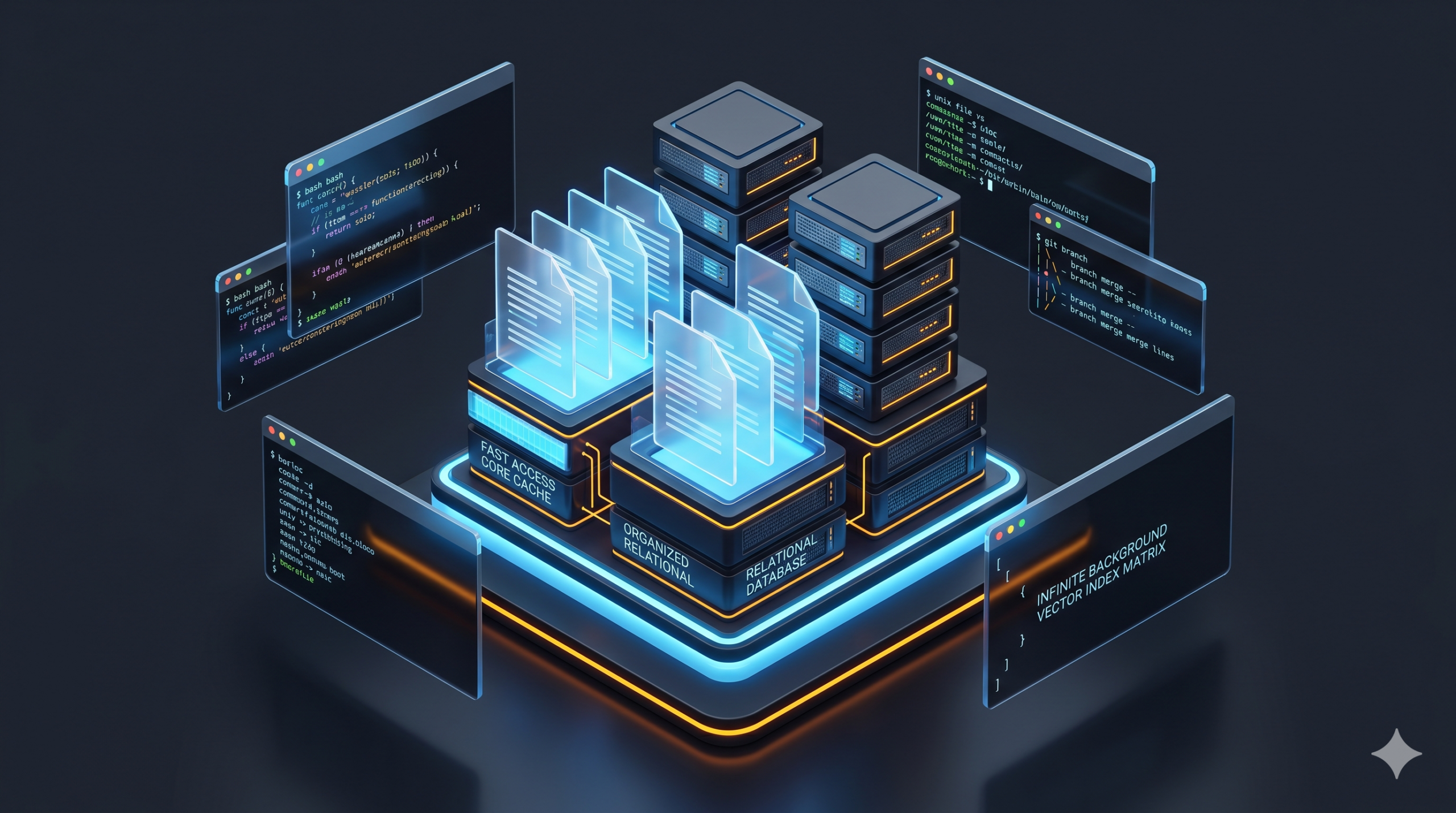
Large language models function as stateless APIs, converting text inputs into text outputs without retaining operational context across network requests. To simulate conversational continuity, typical architectures must repeatedly pass the entire dialog history back into the model’s active context window. As interaction sequences lengthen, this pattern hits a severe performance wall: latency escalates, attention mechanisms degrade, and token consumption scales linearly.
This detailed Letta review explores how Letta (formerly MemGPT) attempts to solve this state-management crisis by implementing an operating-system-inspired memory hierarchy. This architecture decouples active processing context from unbounded long-term storage, enabling agents to self-manage their state via programmatic function calling.
1. The Core Value Proposition: Self-Managed Virtual Memory
The primary value proposition highlighted in this Letta review is its ability to offload state management from application middleware directly to the agent’s core cognitive loop. Instead of requiring the software harness to anticipate, fetch, and inject relevant context on every user turn, Letta delegates memory operations to the model itself. The agent orchestrates its context window using structured tool calls to load, edit, and write back data across a multi-tiered memory architecture.
The Three-Tier Memory Model
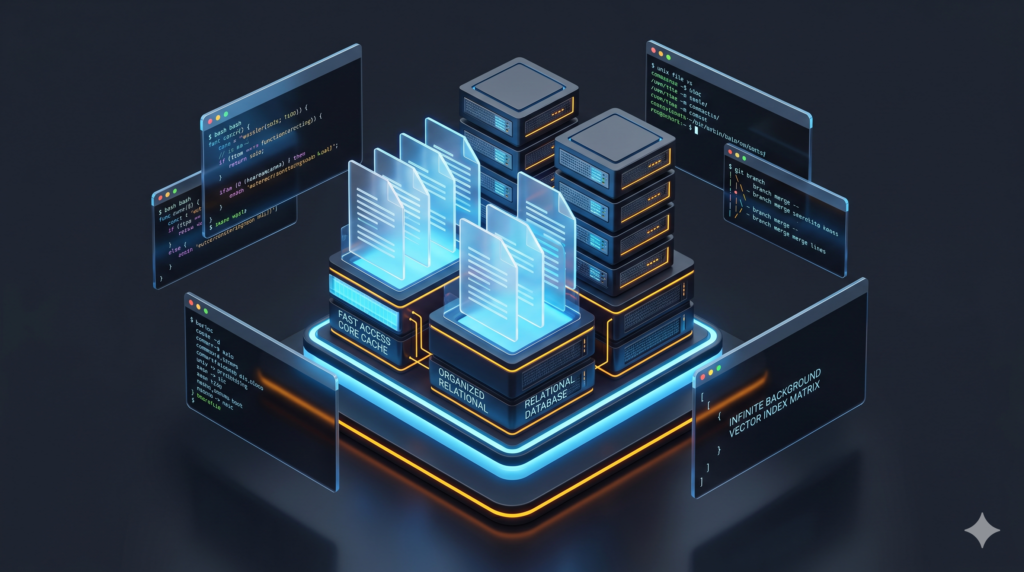
The Letta architecture partitions data into distinct logical layers, allowing the agent to manage its limited context budget dynamically:
- Core Context (Working Memory): This is the active, always-on-context window exposed directly to the model during execution. It contains essential identity definitions, user preferences, and a highly condensed message buffer.
- Recall Memory: A complete, append-only chronological log of all past raw messages, typically backed by a relational database. It allows the agent to search through transactional history via SQL-backed queries.
- Archival Memory: An unbounded long-term storage system integrated with a vector database. It houses deep semantic facts, historical project trajectories, and large documents that cannot fit into the active context window.
The Shift to MemFS and Context Repositories
The evolution of the Letta Code runtime has fundamentally altered how memory is managed. Legacy server-side designs relied on rigid, specialized database-editing tools (such as core_memory_replace) that required direct API calls to modify memory fields. The modern Letta Code architecture introduces MemFS (Context Repositories), which projects the agent’s memory structure directly onto the local filesystem as simple, universal files.
Because memory is expressed as file primitives, the agent can use standard terminal operations, bash loops, and Unix command-line utilities to manage its context. This design shifts state synchronization from centralized databases to client-side filesystems backed by Git, introducing version-control mechanics directly to the agent’s memory.
2. The Good: Architectural Strengths in Production Environments
In production deployments, Letta’s stateful agent loop excels at resolving three primary engineering bottlenecks: context window exhaustion, dynamic state adjustment, and multi-user scaling.
Dynamic Context Compaction
When an agent is locked in a long-horizon task, its message history eventually approaches the physical limit of the context window. In a naive architecture, this boundary triggers an immediate crash or truncates critical early instructions.
Letta mitigates this by executing automatic context compaction routines. The system acts as a virtual memory paging mechanism, compressing older historical message blocks into episodic summaries, committing them to Recall Memory, and evicting the raw tokens from the active window. This sliding window compaction keeps the agent highly focused on its primary objective while preserving an unbroken timeline of past decisions.
Collaborative Concurrency and Git-Backed Memory Swarms
The integration of git-backed Context Repositories brings version-control mechanics to collaborative agent networks. Traditional multi-agent learning is single-threaded; agents cannot write to the same memory database simultaneously without risking data corruption, write-stream collisions, or race conditions.
By assigning each subagent to an isolated Git worktree, Letta Code allows multiple subagents to process trajectories concurrently. Divergences and state conflicts are later merged back into the main branch using standard Git merge operations and conflict-resolution routines. This enables “Memory Swarms” to process large datasets offline, analyze separate code paths, and run background reflection processes without locking the main execution thread.
Multi-User Scaling via the Conversations API
In customer-facing or organization-wide deployments, creating a distinct agent instance for every single user is computationally and operationally prohibitive. The Conversations API addresses this by decoupling the agent’s identity and core memory from its immediate message threads.
A single corporate knowledge agent can manage hundreds of concurrent, parallel conversations across different Slack channels or web threads. Each conversation is assigned an isolated write stream and an independent context window. If the agent updates its core memory block (such as an updated API spec) in one thread, that modification immediately propagates across all other active conversations. This shared context layer minimizes structural fragmentation and prevents inconsistent responses across user sessions.
3. The Bad: High Token Overhead and Operational Realities
No evaluation is complete without pointing out structural flaws. A critical Letta review reveals that this approach introduces severe operational penalties, budget risks, and failure modes that must be addressed before moving from a local playground to production.
Extreme Model Dependency
Letta’s architecture places an immense cognitive burden on the underlying language model. The model must execute precise tool calls, write structured JSON, and strictly adhere to prompt constraints under deep context loading.
When deployed against smaller, open-source models (such as Qwen-2.5-7B, Llama-3.1-8B, or Mistral-7B), the virtual memory framework experiences frequent failures. These models struggle with structural JSON parsing, experience token-placement sensitivity, and often hallucinate parameters when invoking system-level functions.
Furthermore, studies show that long context windows degrade performance even when irrelevant tokens are fully masked. Accuracy drops of up to $50\%$ have been observed on logical and arithmetic tasks when context boundaries exceed $30\text{K}$ tokens. Letta’s core context operates as a rigid, unstructured text block where the relationship between memory blocks and active task queries is highly sensitive. In controlled tests using Qwen and Llama models, task success rates fell off a cliff when critical memory blocks were positioned past the seventh or twelfth index position in the prompt registry.
The Financial Cost of Iterative Decision Loops
The ReAct (Reason-Action-Observation) loop at the heart of Letta’s runtime is highly token-intensive. Every single turn in a multi-step task requires the agent to read its full system prompt, load its core memory blocks, evaluate historical messages, generate a tool call, execute that tool, and process the output in a subsequent model call. This pattern turns a single user request into a sequence of multiple model invocations.
If an agent enters an unresolved state—such as repeatedly failing to access an external endpoint or attempting to parse an unexpected response—it will continuously invoke the model to resolve the issue, rapidly consuming its token budget. This token burn escalates in multi-agent environments: coordinating shared memory state and running background reflection swarms can consume up to $15\times$ more tokens than standard single-agent chats.
4. Production vs. Playground: Evaluating the Sovereign Stack
For enterprises seeking data sovereignty and economic predictability, deploying Letta on a local Sovereign Stack (e.g., Qwen or Llama models with self-hosted PostgreSQL) is a highly attractive proposition. However, the performance gap between local open-source setups and frontier cloud providers (such as Claude 3.5 Sonnet or GPT-4o) remains a major deployment challenge.
Latency and Compaction Bottlenecks in Local Settings
Running a local-first Sovereign Stack requires managing severe latency and execution overhead. When Letta Code is configured in local mode (letta --backend local), heavy compute processes like context compaction and “sleep-time” memory reflection run on local hardware.
On standard commodity servers, local inference engines running large-context operations can stall execution threads, requiring system-level provider timeouts to be set as high as $600\text{ seconds}$ to prevent connection timeouts during compaction phases. While optimized local inference pipelines (such as LLM-Sieve) have demonstrated the ability to cut token payloads by up to $95\%$ and speed up follow-ups by $3\times$ to $7\times$ on models like Llama-3.1-70B and Qwen-2.5-72B, the base Letta framework still introduces significant operational overhead.
Database Sizing and Concurrency Tuning
Deploying Letta at scale requires fine-tuning the underlying database. Letta relies on PostgreSQL to persist state across agents and conversation threads. Under concurrent workloads, the database can easily become a performance bottleneck.
To support multiple active agents, system operators must scale up database connection parameters, setting pool allocations to at least $80$ concurrent connections and adjusting overflow limits to avoid thread exhaustion. While cloud-hosted serverless solutions (such as AWS Aurora PostgreSQL) can automatically scale compute resources to absorb transactional spikes, local sovereign deployments require highly over-provisioned database servers to handle the continuous reads, writes, and vector searches generated by active agent loops.
5. Architectural Verdict and Implementation Guidelines
This comprehensive Letta review shows that the runtime’s shift to client-side Context Repositories (MemFS) represents a major architectural improvement, replacing rigid database-backed memory with a flexible, developer-friendly local filesystem. The integration of Git-backed versioning and the parallel Conversations API provides a robust framework for managing complex, long-lived agent states across concurrent user sessions.
However, Letta is not a universal solution for all agent applications. For straightforward, short-horizon tasks (such as single-turn document summarization), the administrative and computational overhead of virtual memory management is rarely justified. In those scenarios, standard semantic RAG pipelines or lightweight context engineering tools are far more cost-effective and performant.
For engineering teams committed to deploying Letta in production environments, the following technical guidelines are highly recommended:
- Implement Model Tiering: Route standard user interactions and low-complexity tasks to cheaper, faster models. Restrict the use of expensive frontier models (like Claude 3.5 Sonnet) to complex background tasks, such as memory defragmentation, sleep-time reflection, and git-merge conflict resolution.
- Optimize Database Configurations: When deploying self-hosted Letta instances, configure high-capacity PostgreSQL connection pools (
LETTA_PG_POOL_SIZEset to $80+$) and establish robust provider-level timeouts ($600\text{s}+$) to survive the processing demands of context compaction and vector index rebuilds. - Enforce Rigid Validation Guardrails: Protect local sovereign models from execution cliffs by implementing strict Pydantic schemas for all tools and enforcing prompt-gating rules. This reduces tool-calling errors and prevents models from entering infinite, costly loop retries.
- Leverage Conversations for Multi-Tenancy: Use the Conversations API to scale a single Letta agent across multiple parallel user threads. This maintains clean, isolated context windows for individual users while preserving a shared, unified memory store.
AI Review Zones Verdict & Related Insights
At AI Review Zones, we favor systems that justify their token-burn with clear, predictable operational benefits. Our ultimate Letta review verdict is that Letta introduces brilliant operating-system metaphors to agentic workflows, particularly through its file-based MemFS approach. However, the cost of the agent’s self-directed reasoning loop can be astronomical if left unmonitored. It demands top-tier engineering talent to manage the underlying PostgreSQL tuning and tool-calling validation.
If you are expanding your organization’s sovereign tech stack or exploring alternative data layers, don’t miss our hands-on Mem0 Review: Hands-On Production Engineering to see how an out-of-band memory model compares directly against Letta’s runtime. You can also explore our Enterprise Vector Database Tuning Guide to optimize your local PGVector or Qdrant setups for scale.